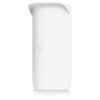
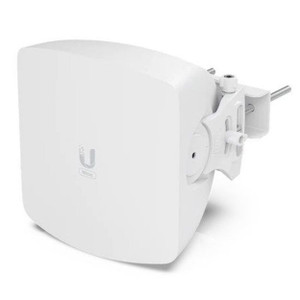
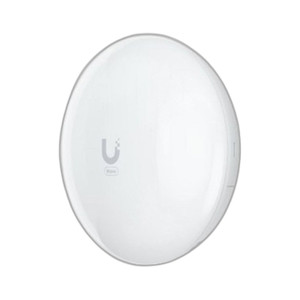
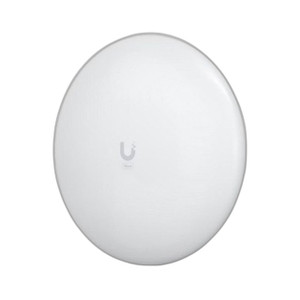
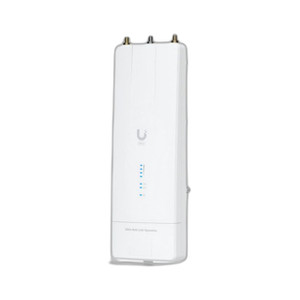
Ubiquiti WAVE-AP-GEN2-US 60 GHz Wireless Bridge
Overview
The Ubiquiti WAVE-AP-GEN2-US is a multipoint base station engineered for high-capacity wireless backhaul in enterprise campus networks, carrier deployments, and distributed surveillance architectures. Operating across 60 GHz and 5 GHz dual-band spectrum, the unit delivers 2.7 Gbps symmetrical throughput — meaning you get the same speed in both upload and download directions, which is critical when pushing video streams, data replication, or VoIP traffic across multiple remote sites simultaneously. Unlike asymmetrical links common in traditional wireless bridges, symmetrical operation simplifies capacity planning and eliminates the guesswork when sizing links for bidirectional workloads.
Key Features
- 2.7 Gbps Symmetrical Throughput: Balanced upload and download speeds eliminate bottlenecks in bidirectional applications. A 24/7 surveillance network pushing concurrent video feeds from remote buildings to a central NVR won't degrade uplink performance or force compression trade-offs.
- Dual-Band Architecture (60 GHz + 5 GHz): The 60 GHz primary band provides directional, high-capacity links with inherent interference rejection due to physical propagation characteristics. The 5 GHz fallback band ensures network continuity if line-of-sight is temporarily obstructed or environmental conditions degrade. Automatic band steering and failover eliminate manual intervention during link degradation.
- Multipoint Base Station Configuration: A single WAVE-AP-GEN2-US unit serves multiple client stations concurrently, reducing the number of access points required in distributed topologies. One base station can aggregate traffic from several remote sites, lowering capex and operational complexity compared to point-to-point mesh architectures where each node requires peer-level connectivity.
- Line-of-Sight Operation: 60 GHz links demand clear line-of-sight between transmitter and receiver. Survey tools and predictive path analysis must precede installation to confirm signal propagation over the intended distance and identify potential obstructions (buildings, vegetation, rain fade).
- Standard Ethernet Integration: Connects via standard RJ-45 interfaces to upstream routing infrastructure, switching, and firewalls without architectural redesign. Integrates with L3 routing protocols and Quality-of-Service policies to prioritize critical traffic — video streams, VoIP calls, and real-time telemetry maintain performance guarantees even during peak utilization.
- Pole and Wall Mounting: Form factor accommodates outdoor pole or wall installations. Weatherproofing suitable for North American climate exposure — protect from direct water jets and dust, but consider shelter if subjected to heavy rain or salt spray in coastal environments.
- PoE Power Delivery: Standard Power over Ethernet eliminates need for separate AC power infrastructure at remote locations. Simplifies cabling runs and reduces total cost of ownership on distributed campuses or industrial sites.
- UniFi and UISP Ecosystem Integration: Centralized management via UniFi or UISP controllers streamlines provisioning, firmware updates, monitoring, and traffic analysis across the entire wireless backhaul network. Firmware patches and performance improvements deploy consistently without manual per-unit configuration.
Deployment Scenarios
Campus backhaul scenarios benefit most: building-to-building connectivity eliminates trenching costs, accelerates deployment timelines, and avoids permanent infrastructure modification. Multi-tenant office parks and university networks leverage multipoint capability to serve numerous remote locations from a single aggregation point. In outdoor mesh environments, the WAVE-AP-GEN2-US functions as a core aggregation node, collecting data from distributed edge devices and funneling traffic toward the core network. Video surveillance networks spanning multiple structures exploit the symmetrical 2.7 Gbps throughput to stream concurrent feeds from remote cameras without compression artifacts or unacceptable latency.
Integration and Compatibility
The WAVE-AP-GEN2-US (often searched as WAVE AP GEN2 US) integrates seamlessly into existing Ubiquiti wireless ecosystems and third-party IP infrastructure. Standard ONVIF and Ethernet connectivity ensure compatibility with a broad range of network video recorders, managed network switches, and enterprise routing platforms. QoS features prevent non-critical background traffic from consuming bandwidth needed for surveillance or real-time applications.
Installation Considerations
Proper grounding and surge protection are mandatory in high-risk RF environments. Line-of-sight alignment is non-negotiable for 60 GHz performance; obstructions introduce multipath reflections and signal attenuation that degrade throughput. Rain fade — signal degradation during heavy precipitation — is a known characteristic of 60 GHz links; the 5 GHz fallback band provides resilience during weather events but at reduced capacity. Position antennas to minimize Fresnel zone blockage and account for seasonal foliage growth when surveying long-distance links. Refer to wireless site survey guidance before finalizing installation locations.
Frequently Asked Questions
Q: Can the WAVE-AP-GEN2-US operate indoors?
A: The WAVE-AP-GEN2-US is designed for outdoor deployment. 60 GHz propagation through walls and dense materials results in severe attenuation, making indoor use impractical for the primary frequency band. If indoor backhaul is required, consider a dedicated indoor-rated access point.
Q: What is the maximum operating distance for the WAVE-AP-GEN2-US?
A: 60 GHz range depends on line-of-sight quality, antenna alignment, and environmental conditions. Clear line-of-sight over several hundred meters is typical, but exact range requires site survey with predictive path analysis tools. Rain fade and temperature inversions affect real-world performance.
Q: Does the WAVE-AP-GEN2-US support mesh auto-recovery if a link fails?
A: Yes. Automatic band steering and failover to 5 GHz occur transparently when 60 GHz performance degrades. However, 5 GHz fallback delivers reduced throughput — plan for this when sizing backup links.
Q: Is the WAVE-AP-GEN2-US compatible with Ubiquiti UniFi controllers?
A: Yes. The unit integrates with UniFi and UISP management platforms for centralized provisioning, monitoring, and firmware updates. Standard Ethernet uplink connects to any IP network.
Q: What PoE power standard does the WAVE-AP-GEN2-US require?
A: Refer to manufacturer specifications for exact PoE class and wattage. Standard 802.3af or 802.3at PoE should be verified before deployment to ensure your switch has sufficient available power budget per port.
Q: Can multiple WAVE-AP-GEN2-US units be daisy-chained for longer distances?
A: Yes, but each hop introduces latency and potential throughput reduction. Design multi-hop networks conservatively and monitor performance in production to identify bottlenecks.
Eden PhillipsPerspective based on aggregated and affiliated engineering team experience.
The WAVE-AP-GEN2-US hits a pragmatic middle ground for campus backhaul where fiber trenching is cost-prohibitive but bandwidth demands are substantial. The 2.7 Gbps symmetrical rating holds up under real-world load when line-of-sight is clean, and the multipoint architecture genuinely reduces operational complexity compared to full-mesh topologies. However, 60 GHz is not forgiving — you need clear line-of-sight, and rain fade will degrade performance during heavy precipitation. If your site survey shows marginal clearance or frequent cloud cover, expect fallback to 5 GHz band more often than marketing implies.
Technical Highlights:
- Symmetrical 2.7 Gbps Throughput: Unlike asymmetrical consumer Wi-Fi, identical upload and download speeds mean a surveillance network pushing 1.5 Gbps outbound to a central NVR won't saturate the uplink. This matters for multi-building deployments where each remote site streams independently.
- Dual-Band Fallback (60 GHz + 5 GHz): 60 GHz provides the capacity; 5 GHz provides the insurance. Automatic band steering is transparent to the client, but understand that 5 GHz throughput is lower. Plan redundancy, not replacement.
- Multipoint Base Station Model: One unit aggregates traffic from multiple clients. In a three-building campus, you deploy one WAVE-AP-GEN2-US at the core and client units at remotes — far simpler than point-to-point meshing where every node needs separate radios.
Deployment Considerations:
- 60 GHz line-of-sight is unforgiving. Trees, rain, and even window panes introduce loss. Site survey before installation is non-optional; use Fresnel zone calculators and predictive RF tools, not guesswork.
- PoE power simplifies remote installation, but verify your switch has sufficient available wattage per port. Standard 802.3af or 802.3at should be confirmed against the datasheet before ordering PoE injectors.
- The 5 GHz fallback band is resilience, not a performance alternative. During rain or atmospheric effects, throughput drops significantly. Design capacity budget accordingly for mission-critical links.
Deploy the WAVE-AP-GEN2-US in multi-building campuses with clear line-of-sight, surveillance networks requiring symmetrical bandwidth across remote sites, and scenarios where centralized aggregation (multipoint) reduces capex compared to mesh. Avoid marginal link budgets or sites with seasonal foliage growth that blocks Fresnel zone — test performance in-season before committing production traffic.