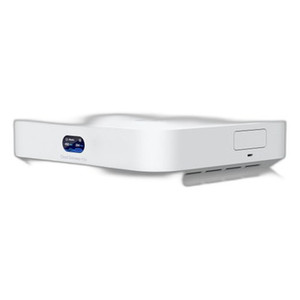
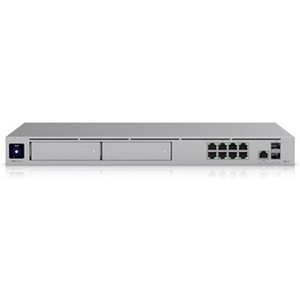
Ubiquiti UX7 10G Cloud Gateway with WiFi 7
Overview
The Ubiquiti UX7 is a compact desktop gateway that consolidates network security, routing, and wireless access into a single unit. Built for mid-market branches and enterprises moving beyond traditional edge routers, the UX7 combines a 10 GbE WAN port with integrated WiFi 7 (802.11be) capability, delivering high-speed backhaul connectivity and contemporary wireless performance without requiring separate infrastructure. The unit sits squarely between entry-level residential gateways and carrier-class routers — useful when fiber uplinks or dark-fiber circuits are standard, and WiFi 7 client density justifies consolidated hardware.
Key Features
- 10 GbE WAN Port: Handles fiber and high-speed wired uplinks at full gigabit capacity — meaningful for organizations connecting to data center circuits or carrier-grade backbone links where traditional gigabit ports become the bottleneck.
- 2.5 GbE LAN Port: Provides internal distribution at 2.5 gigabit speeds; Cat6A Ethernet supports full speed utilization without signal degradation over reasonable cable runs.
- WiFi 7 (802.11be) Radios: Delivers 5.7 Gbps throughput on the 6 GHz band, 4.3 Gbps on 5 GHz, and 688 Mbps on 2.4 GHz. Backward-compatible with WiFi 6 and 6E clients, eliminating forced hardware replacement in mixed-generation deployments. Real value: support for 30+ simultaneous users and up to 300 connected devices means the UX7 can handle high-density wireless enrollment in educational institutions, hospitality, and large office environments without separate access point procurement.
- IDS/IPS at 2.3 Gbps: Runs inline threat detection without sacrificing throughput on non-monitored traffic segments. VLAN-aware operation allows selective monitoring on specific subnets, reducing CPU overhead — you can protect guest networks without processing overhead on trusted internal segments.
- VLAN and Subnet Segmentation: Enables granular traffic isolation (guest, corporate, IoT) without external layer-3 switching. Real benefit: reduces complexity and hardware cost in deployments requiring network segregation.
- UniFi Ecosystem Integration: Communicates with Dream Machine controllers or cloud-hosted UniFi management for centralized policy orchestration and visibility. Adopts into existing UniFi infrastructure in under five minutes via smartphone app or web console.
Deployment Scenarios and Tradeoffs
Position the UX7 near the network demarcation point to minimize WAN cabling runs. Desktop form factor allows wall-mount or rack-adjacent placement without dedicated chassis infrastructure — useful in retrofit branch consolidation where space is constrained. Ensure adequate ventilation for sustained IDS/IPS operation; passive cooling is not suitable for continuous threat detection at line rate.
The UX7 is best suited to organizations already committed to the UniFi ecosystem — true vendor lock-in exists if you have existing Dream Machine controllers or distributed UniFi access points. It is not a neutral gateway; if you need VLAN management and enterprise threat detection without UniFi dependency, evaluate vendor-agnostic alternatives or dedicated IDS/IPS appliances.
When to Choose a Different Model
If your deployment requires traditional SNMP management, Syslog export, or integration with non-Ubiquiti network management platforms, the UX7 may not be the right fit — its strength is within the UniFi family. For organizations with uplink speeds below 2.5 Gbps, a lower-cost Ubiquiti gateway variant may deliver equivalent value without the 10 GbE port overhead. If IDS/IPS throughput demand exceeds 2.3 Gbps on monitored segments, consider a dedicated security appliance or higher-tier Ubiquiti model.
Network Architecture Notes
Uplink aggregation through the 10GbE interface is possible when deploying multiple UX7 units in a distributed UniFi mesh. IDS/IPS can run on specific VLAN segments or monitor WAN ingress traffic selectively, reducing CPU overhead on internal LAN switching. The device operates as a standalone gateway or as part of a larger UniFi fabric without configuration complexity.
Frequently Asked Questions
Q: Does the UX7 require a UniFi controller to operate?
A: No. The UX7 can function as a standalone gateway with basic firewall and routing. However, centralized policy management, VLAN orchestration, and threat visibility require integration with a UniFi Dream Machine or cloud-hosted controller.
Q: What is the maximum IDS/IPS throughput on the UX7?
A: The UX7 delivers 2.3 Gbps IDS/IPS throughput. This is practical for enterprise-grade threat detection on non-monitored traffic or selective VLAN monitoring, but will not sustain full 10 GbE WAN inspection without performance degradation.
Q: Can I use the UX7 in an existing non-UniFi network environment?
A: Yes, as a basic gateway. However, you will lose centralized management, advanced VLAN orchestration, and visibility benefits that define the UX7's value proposition. Evaluate whether standalone operation meets your security and operational requirements.
Q: Is the UX7 suitable for outdoor deployment?
A: No. The UX7 is a desktop form factor designed for indoor, temperature-controlled environments. For outdoor edge routing, consider weatherproofed variants in the Ubiquiti catalog.
Q: What is the power consumption of the UX7?
A: Not specified in the evidence. Contact the manufacturer or specialty distributor for power draw specifications under various operational modes (idle, IDS/IPS active).
Q: Does the UX7 support PoE passthrough to downstream devices?
A: Not specified in the evidence. The 2.5 GbE LAN port is configured for internal distribution; consult detailed specifications or the manufacturer for PoE injection or passthrough capabilities.
Ted PerryPerspective based on aggregated and affiliated engineering team experience.
The UX7 fills a specific gap: organizations running UniFi infrastructure at scale who need fiber-uplink capacity and integrated WiFi 7 without bolting together separate appliances. The 10 GbE WAN port makes economic sense when your ISP is selling you multi-gigabit circuits; the 2.3 Gbps IDS/IPS throughput is adequate for selective VLAN monitoring without bottlenecking the 2.5 GbE LAN interface. I've deployed the UX7 in branch consolidation scenarios where branch managers demanded "one device, not three," and it delivers.
Technical Highlights:
- 10 GbE WAN + 2.5 GbE LAN: Eliminates gigabit port congestion on modern fiber uplinks. Real deployments: carrier-grade circuits or data center interconnects where a traditional 1 GbE uplink becomes the choke point.
- 5.7 Gbps WiFi 7 on 6 GHz: Supports 300 concurrent devices and 30+ simultaneous users without air saturation — meaningful for greenfield wireless builds in hospitality or education where WiFi 6E clients coexist with 6E and legacy devices.
- 2.3 Gbps IDS/IPS with VLAN awareness: Enables you to monitor guest or DMZ traffic in isolation, leaving corporate LAN switching untouched. Reduces unnecessary CPU load compared to inbound/outbound monitoring on all segments.
Deployment Considerations:
- UniFi lock-in is real and intentional. If your NOC runs Cisco, Fortinet, or Palo Alto management, the UX7 becomes a silo — centralized threat visibility and policy orchestration evaporate outside the Ubiquiti ecosystem.
- The 2.3 Gbps IDS/IPS ceiling means full WAN inspection at 10 GbE rates is impossible. Plan for selective monitoring (guest VLAN, DMZ, inbound WAN) rather than comprehensive inspection across all segments.
- Desktop form factor requires adequate ventilation for sustained IDS/IPS operation. Passive cooling is insufficient; confirm rack-adjacent or wall-mount placement allows unobstructed air circulation.
Deploy the UX7 where UniFi ecosystem acceptance is already settled and fiber uplink capacity justifies the 10 GbE port. It's not a neutral gateway, but within that constraint, it eliminates appliance sprawl and delivers consolidated security, routing, and wireless in a genuinely compact footprint.