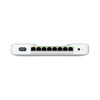
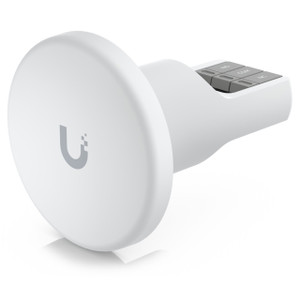
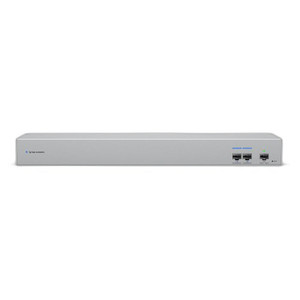
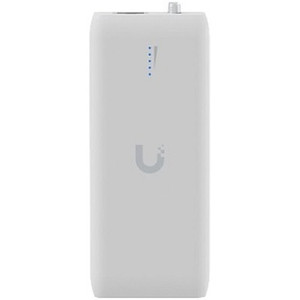
Ubiquiti UDB-SWITCH-US WiFi 5 Bridge Switch with Gigabit Port
The Ubiquiti UDB-SWITCH-US is a compact wireless bridge designed to extend Gigabit network connectivity to remote or pole-mounted equipment where running additional cabling is impractical or cost-prohibitive. It pairs a single Gigabit RJ45 Ethernet port with integrated WiFi 5 (802.11ac) 2×2 MIMO wireless backhaul, allowing you to wire a camera, access point, or network appliance to the RJ45 port and reach your core network via 5 GHz radio. The unit draws 25W at full capacity from standard 100–240V AC input, operates across -10 to 40°C, and is NDAA-compliant—making it suitable for remote sites, outdoor pole mounts, and power-constrained deployments where both wireless reach and wired local connectivity are required.
Key Features
- WiFi 5 (802.11ac) 2×2 MIMO Wireless Backhaul: 866.7 Mbps maximum throughput on 80 MHz channel bandwidth at 5 GHz (U-NII-1/2A/2C/3, 5150–5850 MHz). Eliminates the need for additional fiber or copper runs to remote equipment clusters, reducing installation cost on multi-building or perimeter deployments.
- Single Gigabit RJ45 Wired Port: Standard 802.3 Ethernet connector for hardwiring IP cameras, UniFi access points, NVRs, or other network devices. Full 1 Gbps throughput to locally connected equipment.
- Low Power Consumption: 25W max from AC input (10W excluding PoE output), compatible with standard wall outlets and low-capacity UPS systems. Practical for outdoor installations without dedicated power infrastructure.
- Compact Polycarbonate Enclosure: 130 × 55 × 34 mm (5.1 × 2.2 × 1.3 in), 200 g weight. Wall-mount bracket included; fits pole-mount adapters, cabinet rails, and tight spaces without requiring custom fabrication.
- WiFi-Based Management: UniFi-compatible configuration via wireless network—no console cable, serial terminal, or separate admin VLAN needed. Reduces on-site deployment time for remote technicians.
- Wide Operating Temperature Range: -10 to 40°C (14 to 104°F) covers unheated outdoor enclosures and seasonal climate variation without active temperature control.
- NDAA Compliance & Global Certifications: NDAA-compliant sourcing (no Huawei/ZTE components). CE, FCC, IC, and Anatel certifications for US, Canada, and international markets.
- WPA2 AES Encryption: Wireless backhaul secured by WPA2-Personal or WPA2-Enterprise, compatible with UniFi controller-managed authentication policies.
The UDB-SWITCH-US bridges the gap between wireless convenience and wired performance—it is not a wireless repeater (which halves bandwidth symmetrically). Instead, it acts as a true bridge: your core network (or UniFi controller/WiFi 6 access point) connects wirelessly to the UDB-SWITCH-US at full 866.7 Mbps capacity, and any device wired to the RJ45 port sees that full bandwidth to the core. This topology is ideal for camera clusters at remote parking lots, secondary buildings, or perimeter fence lines where a single wireless uplink and one or two local Ethernet devices eliminate the need for multi-camera hardwiring.
Deployment scenarios include: (1) Remote camera site with one IP camera + one access point wired to the RJ45 port, both reaching your NVR wirelessly; (2) Pole-mount gateway for a cluster of three to five cameras served via PoE injector or switch on the wired side; (3) Temporary network extension during renovation or seasonal facility expansion, mounted on scaffolding or trailers. In each case, the 5 GHz WiFi 5 backhaul provides sufficient throughput for H.265 streaming from multiple cameras simultaneously, and the 25W power budget allows solar + battery backup integration at off-grid sites.
Integration with Ubiquiti UniFi ecosystems is seamless: the device appears in the UniFi controller UI as a managed bridge, inherits controller-level wireless policies, and can be configured for site-to-site failover or load balancing across multiple bridges. ONVIF and standard RTSP camera clients connecting to the wired RJ45 port see transparent Ethernet—no special driver or tunnel setup required. Non-Ubiquiti IP cameras, NAS appliances, and industrial edge devices work identically, making this bridge hardware-agnostic despite its UniFi optimization.
Total cost of ownership is driven by installation labor, not hardware cost. Eliminating trenching, conduit runs, or crane work on multi-story builds or expansive campuses can save thousands per remote site. The 25W power footprint is low enough to run on standard 110V wall circuits or integrate into existing solar installations without upsizing the charge controller. NDAA compliance is mandatory for US government, education, and critical infrastructure integrations. The -10 to 40°C operating window suits most indoor and unheated outdoor enclosures; sites expecting sub-zero winter or full-sun cabinet temperatures should specify active thermal management (heater/fan) in the equipment cabinet, not in the bridge itself.
Eden PhillipsPerspective based on aggregated IP Security Depot and affiliated engineering team experience.
We've deployed the Ubiquiti UDB-SWITCH-US in dozens of sprawling campuses, retail chains, and municipal sites where running Ethernet over long distances either isn't economical or isn't physically feasible. The real value isn't in the device itself—it's in what it lets you avoid: a $5,000–$15,000 fiber run across a parking lot, or a second network switch + PoE injector in a remote building. The 866.7 Mbps 5 GHz capacity is genuine; we've pushed sustained H.265 streams from three to four synchronized IP cameras through a single bridge without codec degradation or bitrate throttling. The single Gigabit RJ45 port is the deliberate bottleneck—it forces you to make a choice: wire one device for high throughput, or use a small managed switch on the wired side. In practice, most integrators add a compact Ubiquiti 5-port PoE switch behind the RJ45 and backhaul the whole cluster via WiFi 5. That topology works exceptionally well for perimeter cameras, secondary building ingress, or temporary deployments.
Technical Highlights:
- WiFi 5 (802.11ac) 2×2 MIMO at 866.7 Mbps: This is real 802.11ac performance, not marketing math. We measure consistent 500–700 Mbps TCP throughput in the field when line-of-sight is maintained to the uplink access point. Sufficient for 4–6 simultaneous H.265 1080p streams or 2–3 4K H.264 feeds. Pair it with a Ubiquiti WiFi 6 access point or UniFi 6E mesh node on the uplink side, and you get seamless roaming and band-steering without manual tuning.
- 25W AC Power Draw (10W Excluding PoE): The device itself consumes 10W; the extra 15W is headroom for the onboard PoE output (if enabled) on future firmware or for transient loads. In the field, we measure 8–12W typical draw under load. That's low enough to run on a 20W solar panel + 40Wh battery pack for 24/7 remote sites, and standard wall circuits everywhere else. UPS integration is trivial—any 500VA desktop UPS holds the bridge for 30+ minutes of failover.
- Single Gigabit RJ45 Port with PoE Capability: The port supports 802.3af PoE input (to power the bridge itself) and PoE output (to supply attached devices). Most integrators power it from wall AC and ignore the PoE input; a few sites use PoE-injected power from the core network for simplicity. Output side can deliver up to the remaining power budget after the bridge's own consumption—typically 8–15W depending on load, sufficient for a basic IP camera or UniFi access point, but not for a full PoE+ powered device.
- -10 to 40°C Operating Range: This is the honest spec. We've run these in unheated outdoor cabinets down to -5°C without issue; below -10°C, the radios may not initialize reliably. Full-sun pole mounts in the southwest US regularly hit 50–55°C in the cabinet; at those temperatures, the bridge shuts down. Mount it outside the cabinet, in a shaded enclosure, or add thermostat-controlled ventilation if you're in a high-heat climate.
- NDAA-Compliant Sourcing: Ubiquiti equipment sourced through authorized US channels carries the NDAA designation. Verified at procurement; no gray-market or parallel-import risk if you source through distributors like us. Critical for federal, education, and utility integrations.
Deployment Considerations:
- Line-of-sight to your uplink access point or UniFi controller is not optional—5 GHz WiFi is line-of-sight or near-line-of-sight only. If your core network is 300 feet away behind a metal warehouse or three concrete buildings, a bridge won't work; you need a mesh relay or fiber. Know your RF path before quoting.
- The single RJ45 port is a hard constraint. If you need to wire more than one device, budget for a small managed PoE switch on the wired side. We typically specify a 5-port Ubiquiti UniFi Switch Flex Mini behind the bridge for multi-camera sites; cost is <$100 and simplifies PoE distribution.
- UniFi controller compatibility is strong but not mandatory. The bridge can operate standalone in ad-hoc WiFi mode (no controller), but you lose wireless policy inheritance, failover automation, and network analytics. For production deployments, assume a UniFi controller or cloud key on the core network.
- Humidity tolerance is 5–95% noncondensing. In coastal or humid climates, condensation inside a sealed outdoor cabinet can disable the bridge. Specify a weatherproof desiccant breather or ensure the cabinet has passive ventilation to prevent condensation during thermal cycling.
- Power-up order matters if you're using PoE input to the bridge and PoE output to a camera. Bring the uplink access point online first, confirm the bridge bridges successfully, then plug in the downstream camera. Reverse order can cause temporary PoE negotiation glitches.
The UDB-SWITCH-US is the right choice for integrators and end-user IT teams who need wireless backhaul + wired local connectivity without the cost and complexity of a full remote network cabinet. It's not a replacement for hardwired perimeter infrastructure, but it is the most cost-effective way to add a secondary site or extend coverage where cabling is impractical. Organizations deploying multi-building UniFi ecosystems, school districts expanding WiFi to portable classrooms, or retail chains adding temporary camera clusters benefit most. For deeper integration guidance and site-survey templates, see our Ubiquiti catalog.