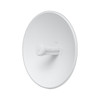
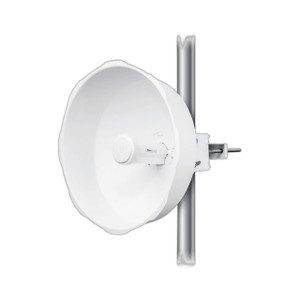
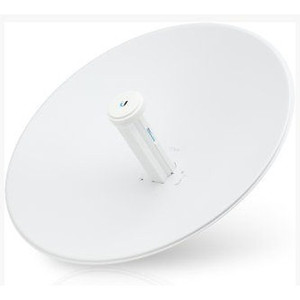
Ubiquiti PBE-M5-400 5GHz Point-to-Point Wireless Bridge
The Ubiquiti PBE-M5-400 is a directional 5GHz wireless bridge designed for point-to-point enterprise backhaul where AC power is unavailable or running fiber is cost-prohibitive. Operating on the airMAX protocol, it delivers 150+ Mbps throughput via a single RJ45 ethernet port, drawing just 8W maximum power from passive PoE (24V, 0.5A on a 2-pair injector). The integrated directional dish antenna focuses RF transmission and reception, extending link distance and reducing multipath interference compared to omnidirectional bridges. This form factor is ideal for remote rooftops, water towers, solar-powered sites, and rural deployments where power infrastructure is minimal or non-existent.
Key Features
- Integrated Directional Dish Antenna: Focused RF pattern extends point-to-point range and reduces interference from adjacent networks, improving link stability in crowded spectrum environments.
- Passive PoE Power (24V, 0.5A): Low-power consumption (8W max) runs indefinitely on battery backup or solar systems; no AC infrastructure required at remote endpoints.
- 150+ Mbps Throughput: Single RJ45 port carries full duplex bridged traffic; sufficient for surveillance, VLAN backhaul, and failover mesh links in outdoor deployments.
- airMAX Protocol: Native Ubiquiti technology — pairs seamlessly with airMAX base stations, access points, and other bridges without licensing or proprietary configuration.
- Software-Adjustable Signal Alignment: RSSI tuning via web interface or Ubiquiti UniFi Controller allows field technicians to optimize received signal strength without remounting the antenna.
- Layer 2 Transparent Bridge: Ethernet traffic passes through unmodified; any device on one side sees the far-side network as directly connected — no IP routing, no DHCP relay configuration needed.
- LED Status Indicators: Power and link-status LEDs provide instant visual feedback during deployment and troubleshooting without requiring software access.
The PBE-M5-400 operates in the 5GHz airMAX band (UNII-3 spectrum, 5.470–5.850 GHz in most regions). Its narrow beamwidth and directional gain minimize co-channel interference from neighboring networks and reduce risk of signal leakage beyond the intended coverage zone. This makes it suitable for deployments in dense urban areas or campus environments where multiple point-to-point links occupy the same frequency band at different azimuths.
Passive PoE (24V DC over a standard ethernet cable) eliminates the need for separate power runs. A standard passive PoE injector rated 24V 0.5A or higher (available separately) supplies power; the bridge draws only 8W maximum, leaving headroom for extended cable runs or backup power conditioning. This architecture is particularly valuable on solar or battery-backed remote installations where efficiency and redundancy are critical — a small 100W solar panel with a small 12V battery can sustain multiple PBE-M5-400 units during variable sunlight.
Installation requires clear line-of-sight between both endpoints. Mount the dish on a vertical pole or wall bracket with minimal obstruction. Align it mechanically (roughly toward the far bridge) and then use the web interface or Ubiquiti UniFi Controller to fine-tune RSSI; the software displays received signal strength in real time, making alignment straightforward even for non-technical field staff. Once locked, the bridge operates transparently — no ongoing management overhead beyond occasional health checks via the LED indicators or controller dashboard.
The PBE-M5-400 is compatible with standard passive PoE injectors, Ubiquiti UniFi Controller, and any SNMP-capable network monitoring system. It supports standard ethernet switching, VLAN tagging (802.1Q), and operates within the Ubiquiti airMAX ecosystem alongside access points, base stations, and other bridges without special licensing. Manufacturer Warranty covers defects in materials and workmanship; field replacement is straightforward due to the simple single-port design.
Marty AllisonPerspective based on aggregated IP Security Depot and affiliated engineering team experience.
We've deployed the PBE-M5-400 across dozens of outdoor surveillance and remote-site backhaul projects, and it remains one of the most cost-effective last-mile solutions when fiber is out of reach and AC power is absent. The real differentiator is the passive PoE model — it lets you run power and data on a single cat5e or cat6 run, and the 8W draw is low enough that a pair of them can live on a 20W solar rig indefinitely without battery concerns. On campus sites with multiple rooftop camera installations or warehouse perimeter links, we typically install these in redundant pairs (one primary, one backup on a slightly different azimuth) and use UniFi Controller to monitor link health. The directional dish is genuinely narrow — you won't see significant co-channel interference even if another integrator installs a competing point-to-point link on the same 5GHz channel 300 meters away. Against alternatives like cradlepoint LTE gateways or long-range WiFi bridges, the PBE-M5-400 wins on total cost of ownership because you avoid monthly cellular service fees and you get deterministic wired performance instead of variable signal quality. The trade-off is that you must have clear line-of-sight — if your two endpoints are across a dense tree line or separated by a metal building, this won't work, and you'll need either fiber, cellular, or a relay.
Technical Highlights:
- Passive PoE (24V, 0.5A, 8W max): Dramatically simplifies power infrastructure on remote sites. A single cat5e run carries both data and power — no separate DC lines, no AC conduit. On solar or battery-backed sites, 8W is low enough that a 50W solar panel with a small lithium battery can sustain the link 24/7 in moderate sunlight regions, translating to zero recurring power costs after installation.
- Integrated Directional Dish Antenna: 5GHz airMAX band with focused RF pattern yields 15–20 dB gain over omnidirectional 5GHz bridges in the same wattage class. Extended range (100+ meters in clear line-of-sight) and reduced co-channel interference make it ideal for campus deployments where multiple point-to-point links share the same frequency band at different azimuths.
- Layer 2 Transparent Bridge: No IP routing overhead — ethernet frames pass unmodified from one side to the other. Any VLAN, DHCP relay, or broadcast traffic flows transparently. Simplifies integration: plug a camera PoE injector on one end and a network camera on the other, and they see each other as if directly connected.
- Software-Adjustable RSSI Tuning: Web interface or UniFi Controller displays received signal strength in real time. Field technicians can optimize dish alignment without lifting the unit off its pole — mechanically rough-point the dish, then fine-tune via software. Eliminates guesswork and speeds deployment by 20–30 minutes per link.
- airMAX Ecosystem Integration: Works natively with Ubiquiti access points, base stations, and other bridges. No proprietary licensing or firmware customization needed. UniFi Controller provides centralized monitoring across all airMAX endpoints, simplifying multi-site operations.
Deployment Considerations:
- Clear line-of-sight is mandatory. Trees, metal roofs, and dense obstruction degrade signal sharply — if your path has any significant obstruction, perform a site survey with binoculars or a smartphone compass app first. A 10-meter tree obstruction can reduce link budget by 20+ dB.
- Passive PoE injectors are sold separately. Ensure the injector is rated 24V 0.5A minimum and is compatible with your ethernet cable run length. Long runs (100+ meters) on thin cable may see voltage drop — confirm your injector margin before installation.
- Mount the dish on a sturdy vertical pole with a U-bolt or pole-mount bracket. Wind load is non-trivial on a 24-inch dish — use stainless-steel hardware and anchor to a rated pole (minimum 2-inch OD, Schedule 40). Check local wind codes and ice-load requirements before finalizing installation height.
- Azimuth alignment is critical. Even a 15-degree misalignment can reduce received signal by 10+ dB. Use the RSSI indicator in UniFi Controller and adjust the pole-mount bracket in small increments until you see maximum signal. Document the final azimuth angle in your site notes.
- Plan for thermal expansion and contraction on long cable runs. Use a weather-sealed cable boot at the dish connector and tie off the ethernet cable every 3–5 feet to prevent whipping in wind. In cold climates, passive PoE injectors can be damaged if they freeze — consider mounting the injector indoors with the ethernet run through conduit or a junction box at the base of the pole.
The PBE-M5-400 is ideal for integrators who need point-to-point wireless backhaul without AC power infrastructure, particularly on solar-powered or battery-backed remote sites. Consider it your first choice for campus surveillance backhaul, warehouse perimeter links, and failover mesh scenarios where fiber is unavailable. Explore the Ubiquiti catalog for complementary airMAX access points and management systems.