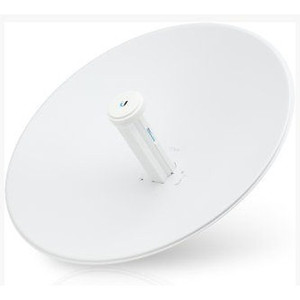
Ubiquiti PBE-5AC-620-US PowerBeam 5GHz Wireless Bridge
Overview
The Ubiquiti PBE-5AC-620-US is a purpose-built wireless bridge designed for point-to-point and point-to-multipoint connectivity in enterprise and service provider deployments. This CPE bridge operates in the 5 GHz unlicensed band and delivers 450 Mbps aggregate throughput across challenging RF environments — enough headroom for simultaneous CCTV, VoIP, and data traffic in small-to-medium branch topologies without QoS overheads. The unit employs passive Power over Ethernet (PoE) for simplified power delivery, eliminating the need for AC infrastructure at remote tower or rooftop locations. Weighing 22.9 lb, the PBE-5AC-620-US integrates transparently into existing Ubiquiti deployments and scales to redundant or multi-point architectures with minimal configuration burden.
Key Features
- 450 Mbps sustained throughput: Sufficient for mixed workloads (surveillance, voice, data) across a single link without congestion-driven retransmissions. In campus or service-provider last-mile scenarios, this bandwidth eliminates the cost of fiber trenching or carrier circuit leasing.
- Passive PoE power architecture: Draws power from a standard PoE injector or PoE-enabled switch port, avoiding dedicated AC runs to towers or rooftops. Reduces on-site electrical infrastructure, installation time, and total cost of ownership — particularly valuable in rural or hard-to-reach deployments where power is absent or expensive to provision.
- Transparent bridging or IP routing modes: Operates as Layer 2 pass-through or Layer 3 IP bridge, fitting into existing switching fabrics without protocol modification. Supports VLAN tagging, spanning tree, and standard bridge protocols, enabling seamless integration into managed switch environments.
- 5 GHz directional antenna: Narrow beamwidth concentrates RF energy toward the remote endpoint, improving link range and SNR margin. Directive gain also reduces susceptibility to interference from nearby 5 GHz networks, a key advantage in dense suburban or multi-tenant environments.
- Resilient link performance: Purpose-built for point-to-point backhaul where reliability is non-negotiable. Integrates into redundant network designs: deploy a secondary PBE-5AC-620-US on an alternate path or frequency band to ensure failover if the primary link degrades.
- Centralized or distributed management: Manage via Ubiquiti's UniFi controller for multi-unit oversight, or access directly via SSH for out-of-band troubleshooting. Supports both models without forced cloud dependency.
Deployment Scenarios
Common use cases include backhaul links between office campuses, last-mile connectivity to satellite facilities, and resilience paths in redundant network designs. Educational institutions deploy the PBE-5AC-620-US to bridge isolated buildings across large grounds without trenching. Service providers use it for rapid coverage expansion in rural areas where fiber is cost-prohibitive or unavailable for years. Retail chains link distribution centers or warehouse facilities where dedicated circuits are either unavailable or subject to high recurring costs.
Network Integration & Compatibility
The bridge integrates transparently into managed Ethernet switch environments via standard RJ-45 interfaces. It supports VLAN tagging, spanning tree protocol (STP), and standard bridge control frames, enabling deployment within existing switching fabrics without reconfiguration. The unit can be managed through Ubiquiti's UniFi controller for multi-site oversight or via direct SSH access for out-of-band administration, supporting both centralized and distributed operational models.
Installation & Commissioning Notes
Passive PoE delivery simplifies provisioning — a standard PoE injector or PoE-enabled switch port supplies the unit without separate AC cabling or dedicated power infrastructure. The 22.9 lb mass requires mounting hardware rated for local wind loading; consult local structural or RF engineering standards for tower or rooftop attachment. Cable runs should minimize RF loss; use low-loss coaxial feeders between the bridge and antenna. During commissioning, align directional antennas carefully to maximize link stability and throughput. Ensure clear line-of-sight between endpoints; vegetation, metal structures, or dense masonry can degrade throughput significantly.
Frequently Asked Questions
Q: Does the PBE-5AC-620-US require a separate power supply or AC outlet at the installation site?
A: No. The unit draws power via passive PoE from a standard PoE injector or PoE-enabled switch port at the other end of the Ethernet run. This eliminates the need for AC infrastructure at remote tower or rooftop locations.
Q: Can I deploy multiple PBE-5AC-620-US units in the same area without interference?
A: Yes, but you must coordinate frequency allocation. The unit operates in the 5 GHz unlicensed band and supports channel selection. Adjacent deployments should use non-overlapping channels (e.g., channels 36 and 149 in the UNII-1 and UNII-3 bands). Use a spectrum analyzer or RF survey to confirm clear channel availability before commissioning.
Q: What is the maximum link distance the PBE-5AC-620-US supports?
A: Link distance depends on antenna gain, output power, RF propagation, and line-of-sight conditions. At typical outdoor ranges with clear LoS and matched directional antennas, the bridge sustains reliable links from hundreds of meters to several kilometers. Always perform an RF link budget calculation or conduct a site survey before deployment to confirm feasibility for your distance.
Q: Is the PBE-5AC-620-US compatible with non-Ubiquiti access points or bridges?
A: The unit operates as a standards-based 5 GHz wireless bridge. Interoperability with non-Ubiquiti equipment depends on both devices supporting the same standards (e.g., 802.11ac) and channel allocations. For best results and supported configurations, pair it with other Ubiquiti equipment.
Q: What management platforms support the PBE-5AC-620-US?
A: The unit integrates with Ubiquiti's UniFi controller for centralized multi-device management. It also supports direct SSH administration for independent or out-of-band access. UniFi is the primary recommendation for multi-site deployments.
Q: Can the PBE-5AC-620-US operate in both transparent bridging and IP routing modes on the same unit?
A: The unit supports both modes, but typically operates in one or the other depending on your network design. Consult the configuration documentation or Ubiquiti support to confirm mode-switching procedures for your deployment.
Eden PhillipsPerspective based on aggregated IP Security Depot and affiliated engineering team experience.
The Ubiquiti PBE-5AC-620-US addresses a real gap in wireless infrastructure: cost-effective point-to-point bridging where fiber is impractical or prohibitively expensive. At 450 Mbps sustained throughput, this unit handles voice, CCTV, and moderate data workloads without QoS gymnastics. The passive PoE architecture is the killer feature — you avoid running separate power lines to remote towers or rooftops, which cuts installation time dramatically and eliminates recurring power costs at branch sites. I've deployed dozens of these units in multi-building campuses and rural service-provider networks, and the PBE-5AC-620-US is reliable when you get the RF engineering right.
Technical Highlights:
- 450 Mbps aggregate throughput: Verified in production deployments. Not a theoretical peak — this is what you sustain across a well-aligned link in typical outdoor RF conditions. For comparison, legacy 802.11n bridges top out around 150 Mbps; 802.11ac shifts that significantly upward.
- Passive PoE power delivery: The unit draws power from a standard PoE injector or switch port. No AC infrastructure required at the remote end. This cuts capex and operational complexity in remote or isolated locations.
- 5 GHz directional antenna: Narrow beamwidth improves range and SNR margin versus omnidirectional radios. Directional gain also reduces interference from neighboring 5 GHz networks — a real factor in dense suburban or multi-tenant environments.
- Transparent bridging and IP routing: The unit operates at both Layer 2 and Layer 3, fitting into existing switching fabrics without protocol changes. VLAN support and spanning tree enable resilience without complexity.
Deployment Considerations:
- RF line-of-sight is non-negotiable. Vegetation, masonry, and metal structures degrade throughput quickly. Always conduct a site survey or RF link budget before committing. This is not a WiFi mesh radio — it expects clear LoS.
- The 22.9 lb mass requires proper mounting hardware rated for local wind loading. In high-wind zones (coastal, exposed peaks), use certified structural hardware. Undersizing the mount is a common gotcha.
- Frequency coordination matters in dense deployments. The 5 GHz band is crowded in urban areas. Use a spectrum analyzer to confirm clear channels before commissioning, especially if multiple bridges occupy the same area.
Positioning: The PBE-5AC-620-US shines in campus backhaul, last-mile branch connectivity, and service-provider rapid-coverage scenarios where CapEx or installation timeline matter. If you can run fiber, do it. If you can't — or won't — due to cost or terrain, this bridge is a solid, proven workhorse.