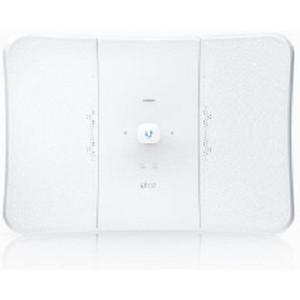
Ubiquiti LOCOM2(US) NanoStation Loco M2 Wireless CPE
Overview
The Ubiquiti LOCOM2(US) is a compact external-mount MIMO CPE (Customer Premises Equipment) built for point-to-point and point-to-multipoint wireless bridging in remote and long-distance deployments. Designed around Ubiquiti's airMAX protocol, the LOCOM2(US) delivers reliable RF performance in congested or challenging spectrum environments where traditional indoor access points lack the range or interference rejection needed. This model serves dual roles: as a client unit in distributed architectures or as a remote access point extending coverage to underserved areas. It's particularly suited for service providers building last-mile broadband, enterprises establishing wireless backhaul between branch sites, and integrators deploying mesh topology extensions across campuses or rural properties.
Key Features
- 150+ Mbps Throughput via Dual-Chain MIMO: The LOCOM2(US) leverages two spatial streams to push real-world throughput above 150 Mbps, reducing latency degradation over distance and enabling bidirectional communication on a single RF link — meaningful when you need to avoid running separate uplink and downlink paths to the same remote site.
- PoE Power Delivery (802.3af): Draws power exclusively via standard PoE, eliminating the need for a separate 12V or AC supply run to the mounting pole or tower. This cuts installation labor significantly and allows you to leverage managed switch power budgeting and UPS backup on the supply end.
- airMAX Protocol for Interference Resilience: Ubiquiti's proprietary airMAX stack provides frame-collision avoidance and efficient TDMA scheduling, allowing multiple CPEs to share the same frequency band without the throughput collapse you'd see with standard Wi-Fi in congested 2.4 GHz or 5 GHz bands.
- Compact, Lightweight External Housing (1.100 lb): The small form factor and low weight minimize structural loading on pole or wall mounts, making it practical to deploy on existing antenna towers, building edges, or temporary mounting structures without reinforcement.
- Layer 2 Bridging without Routing Overhead: The LOCOM2(US) operates as a transparent bridge, forwarding traffic between subnets without requiring routing table entries or gateway configuration — simplifies network integration when connecting remote equipment shelters, warehouses, or temporary field sites back to the main LAN.
- Directional Antenna Pattern for Point-to-Point Alignment: The unit's antenna characteristics are optimized for long-distance links; careful RF path analysis and orientation toward the remote station maximize signal strength and minimize multipath distortion — skip this if you need omni-coverage, but for fixed backhaul this is a strength.
Deployment Considerations
Installation of the LOCOM2(US) requires line-of-sight or near-line-of-sight RF path planning. Heavy obstruction (dense vegetation, steel structures) will degrade throughput and range; radio surveys prior to deployment are standard practice. Mounting orientation is critical — misalignment of even 15–20 degrees off-boresight can cut throughput by 30–50% depending on distance. PoE injector or managed switch ports must support consistent power draw; undersized injectors or oversubscribed switch power budgets lead to intermittent dropouts. Cable sealing and grounding at outdoor termination points protect against lightning transients; many integrators pair the LOCOM2(US) with surge-rated PoE protectors on long cable runs.
Configuration occurs through Ubiquiti's web interface or centralized management via UniFi Dream Machine or equivalent controllers, supporting both standalone operation and large-scale deployments. The MPN LOCOM2(US) appears on all warranty documentation and inventory systems, ensuring accurate parts tracking and support escalation.
When to Choose a Different Model
If you need higher throughput (300+ Mbps), consider Ubiquiti's NanoBeam or PowerBeam line, which offer greater gain and faster modulation rates at the expense of larger physical footprint. For indoor coverage extension or mesh-friendly topology, standard UniFi access points may be more practical. If your site cannot support external mounting or requires true omni-directional coverage, the LOCOM2(US) is not the right fit.
Frequently Asked Questions
Q: Can the LOCOM2(US) operate in 5 GHz as well as 2.4 GHz?
A: No — the LOCOM2(US) is a 2.4 GHz device only. For 5 GHz deployments, refer to the NanoBeam M5 or similar 5 GHz airMAX CPEs in the Ubiquiti product line.
Q: What is the typical RF range for the LOCOM2(US)?
A: Range depends on antenna gain, transmit power, and RF environment. On a clear line-of-sight path with proper antenna alignment, distances of 10–15 km are achievable; heavily obstructed paths or lower modulation rates may limit range to 2–5 km. RF survey tools and site walk-throughs should inform your range estimates.
Q: Does the LOCOM2(US) support centralized management via UniFi?
A: Yes — the LOCOM2(US) integrates into UniFi Dream Machine and UniFi Cloud Key environments, allowing centralized provisioning, monitoring, and firmware updates across distributed CPE deployments.
Q: What PoE injector rating is required?
A: The LOCOM2(US) draws modest current under standard 802.3af PoE (15W budget). Any compliant 802.3af injector or managed switch port will suffice; high-power injectors are not required, but undersized or non-compliant supplies may cause intermittent resets.
Q: Can I use the LOCOM2(US) indoors?
A: Technically yes, but it's not recommended. The external housing and antenna pattern are optimized for outdoor mounting; indoor mounting will result in poor coverage patterns and unnecessary RF spillover outside your intended area.
Q: Is lightning protection included?
A: No — standard grounding and cable sealing are your responsibility. Many integrators add surge arrestors on the PoE line and RF connector to protect against lightning transients, especially on long cable runs or elevated mounting structures.
Ted PerryPerspective based on aggregated IP Security Depot and affiliated engineering team experience.
The Ubiquiti LOCOM2(US) is a workhorse for fixed wireless backhaul — straightforward hardware that does one job well: bridging distance without eating into your power budget. At 150+ Mbps throughput via dual-chain MIMO and sub-15W PoE draw, you're looking at a CPE that scales cleanly across service provider networks and campus-level mesh extensions without the maintenance headache of proprietary gateways or licensing tiers.
Technical Highlights:
- Dual-Chain MIMO Architecture: Two spatial streams deliver 150+ Mbps real throughput over distance, reducing the per-link latency tax compared to single-chain CPEs — measurable when you're daisy-chaining multiple backhaul segments or serving latency-sensitive applications like VoIP or video conferencing.
- 802.3af PoE (sub-15W): Minimal power budget means no oversubscription worries on standard managed switches; pair with UPS-backed power supplies on the switch side and you've got rock-solid uptime for remote equipment shelters without expensive dual-power architectures.
- airMAX Frame Collision Avoidance: TDMA scheduling eliminates the hidden-node problem that plagues standard 802.11 in multi-CPE deployments — throughput doesn't collapse when you add a third or fourth unit to the same frequency band, unlike mesh systems based on standard Wi-Fi.
Deployment Considerations:
- Line-of-Sight Dependency: The LOCOM2(US) is directional by design — antenna alignment and RF path clarity are non-negotiable. Skip this unit if your site survey shows heavy vegetation or metal structure obstruction; misalignment costs you 30–50% throughput.
- 2.4 GHz Only: Single-band operation limits flexibility in congested urban environments. If you need frequency diversity or higher modulation rates for throughput-critical links, step up to a 5 GHz variant or check the NanoBeam line.
- No Built-in Surge Protection: Outdoor mounting demands grounding discipline and surge protection on PoE lines — a lightning strike on a long pole-mounted cable will take out your switch port and possibly propagate upstream. Budget for surge arrestors on significant deployments.
The LOCOM2(US) is the right call for service provider last-mile broadband, branch-office wireless bridges, and mesh extensions where you control the RF environment and can guarantee line-of-sight paths. It's not a coverage extender for congested indoor spaces, and it's not a quick fix for poor site survey planning — buy it because you've done the homework and you need a rock-solid, low-power fixed link.