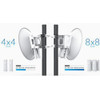
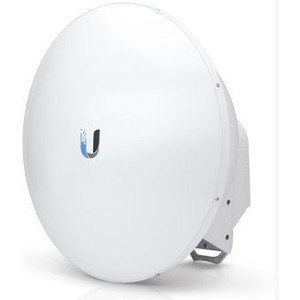
Ubiquiti AF-MPX8-US Licensed Wireless Bridge
Overview
The Ubiquiti AF-MPX8-US is a licensed point-to-point wireless bridge engineered for high-capacity backhaul and network extension across distances where fiber or copper runs are impractical or prohibitively expensive. Operating as a transparent Layer 2 bridge, the AF-MPX8-US eliminates the need for IP routing configuration—network teams treat paired units as logical cable segments, which accelerates deployment in brownfield environments and simplifies topology documentation. Weighing 4.6 lb with a compact form factor, the unit mounts on standard pole or wall hardware, supporting flexible installation on rooftops, towers, and building exteriors. Licensed frequency operation reduces interference risk compared to unlicensed deployments, making the AF-MPX8-US a reliable choice for organizations managing distributed facilities or remote campus interconnection.
Key Features
- Transparent Layer 2 Bridging: No IP assignment required. Existing VLAN configurations, spanning tree protocols, and network management frameworks pass through unchanged—your network sees paired AF-MPX8-US units as a simple cable extension, not a routing device. This cuts deployment complexity and reduces configuration errors in mixed-infrastructure environments.
- Licensed Frequency Bands: Operates in regulated RF spectrum rather than unlicensed bands. Interference immunity improves significantly, reducing retry latency and link fluctuation—critical for backhaul carrying production VoIP, video surveillance feeds, or real-time warehouse automation traffic.
- Point-to-Point Architecture: Fixed, dedicated links between two locations deliver deterministic performance and symmetric throughput. Unlike mesh or multi-point topologies, point-to-point avoids contention and repeater overhead, so your bandwidth is predictable for capacity planning.
- Standard Mounting and Alignment: 4.6 lb chassis accommodates industry-standard U-bolt and wall-mount hardware. Antenna alignment is straightforward, and the compact footprint fits rooftop equipment racks without consuming prime real estate. Clear line-of-sight between paired units is mandatory—Fresnel zone clearance during site surveys prevents the most common field failures.
- SNMP and Syslog Management: Integration with standard network management frameworks simplifies monitoring and alerting. Link status, signal metrics, and configuration changes feed into existing NOC dashboards without custom integrations.
- Rapid Deployment Timeline: Minimal configuration overhead and transparent operation mean field commissioning typically completes in hours rather than days. Backup link provisioning or emergency site extension tasks that would require weeks of fiber trenching can go live in an afternoon.
Deployment Scenarios
The AF-MPX8-US excels in campus network interconnection—connecting remote buildings to a central data center without conduit costs. Remote office backhaul benefits from licensed operation's stability; deterministic links support branch office applications, security camera streams, and point-of-sale systems without jitter concerns. Disaster recovery architectures use paired AF-MPX8-US units to establish failover connectivity between geographically separated data centers, activating in minutes when primary links fail. Warehouse automation networks leverage the transparent bridging model to extend industrial control networks across facilities too large or complex for single-cable runs. Site surveys must confirm Fresnel zone clearance and establish baseline link budgets before installation—RF obstruction (trees, buildings, rain fade) is the primary performance variable, not the equipment itself.
Network Integration and Compatibility
The transparent bridge architecture integrates seamlessly with existing network monitoring, VLAN management, and spanning tree topologies. Protocol translation is not required; network devices connected to each side of the AF-MPX8-US pair communicate as if directly cabled. Standard SNMP queries and syslog events provide visibility into link health and RF metrics. No special VMS or management software is needed—your existing network operations tools handle monitoring and alerting. This straightforward integration model reduces training overhead and support costs for IT teams familiar with traditional switching and bridging.
Frequently Asked Questions
Q: Does the AF-MPX8-US require a license to operate?
A: Yes. The AF-MPX8-US operates in licensed frequency bands. Spectrum licensing requirements vary by region and regulatory jurisdiction—verify licensing availability and lead times with your regional wireless authority before ordering.
Q: Can I deploy a single AF-MPX8-US unit, or do I need two?
A: Wireless bridges require a paired set—one unit at each end of the link. A single unit cannot function standalone.
Q: What line-of-sight clearance is required between paired units?
A: Clear line-of-sight between antennas is mandatory. Fresnel zone clearance—the RF path envelope between the two antennas—must remain largely unobstructed. Trees, buildings, and terrain in this zone degrade signal strength and throughput. Site surveys should measure distance, elevation, and obstacles to calculate Fresnel zone radius and verify clearance before installation.
Q: What is the maximum distance between paired AF-MPX8-US units?
A: Distance capability depends on licensed frequency, antenna gain, and RF path characteristics. Typical point-to-point licensed links operate reliably from a few hundred meters to several kilometers, but baseline link budgets must be calculated during site survey to confirm your specific distance and terrain.
Q: Does the AF-MPX8-US integrate with Milestone, Axis Camera Station, or other VMS platforms?
A: The AF-MPX8-US is a transparent network bridge, not a camera or recording device. It simply extends your network link. Any IP devices connected through the bridge—cameras, servers, workstations—will appear to your VMS and management tools as if they were directly cabled, so VMS compatibility is transparent.
Q: Can I monitor the AF-MPX8-US remotely?
A: Yes. SNMP queries and syslog events allow remote monitoring of link status, signal strength, and configuration through your existing network management framework.
Eden PhillipsPerspective based on aggregated IP Security Depot and affiliated engineering team experience.
The AF-MPX8-US (often searched as AF MPX8 US) remains a straightforward choice for organizations needing licensed wireless bridging without routing complexity. Its transparent Layer 2 operation means network teams can deploy it into brownfield environments and existing VLANs without protocol translation or IP configuration overhead. That said, the single most common field failure is Fresnel zone obstruction—trees, buildings, or terrain in the RF path envelope will silently degrade throughput and increase latency. Site surveys that skip RF clearance verification end up in the support queue.
Technical Highlights:
- Licensed Spectrum Operation: Reduces interference risk compared to unlicensed deployments. Link stability improves, retry latency drops, and jitter becomes predictable—critical for production backhaul carrying video, VoIP, or real-time industrial control traffic.
- Transparent Layer 2 Bridging: No IP routing configuration required. Existing VLAN tagging, spanning tree, and network management frameworks pass through unchanged. Your network sees the paired AF-MPX8-US units as a simple cable extension, accelerating both deployment and troubleshooting.
- Compact 4.6 lb Chassis: Standard pole and wall mounting hardware fit the form factor. Rooftop and tower installations integrate without requiring custom brackets or consuming prime real estate. Installation is straightforward once line-of-sight is confirmed.
Deployment Considerations:
- Fresnel zone clearance is non-negotiable. Calculate RF path geometry during site survey; trees and buildings in the clearance envelope will degrade throughput and increase latency. This is not an equipment limitation—it's physics. Budget survey time accordingly.
- Licensed spectrum availability varies by region. Confirm frequency band availability, licensing timelines, and regulatory requirements in your jurisdiction before committing to a deployment timeline.
- Point-to-point architecture means two units are required for a functional link. Mesh or failover topologies require additional pairs.
Deploy the AF-MPX8-US for campus interconnection, remote office backhaul, or disaster recovery links where fiber trenching is impractical and link stability matters more than absolute range. It's the right answer when your network team already understands bridging and you want minimal configuration overhead in a brownfield rollout.