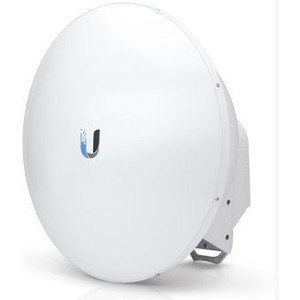
Ubiquiti AF-MPX4-US airFiber 4x4 Wireless Bridge
The Ubiquiti AF-MPX4-US is a 4x4 point-to-point wireless bridge engineered to span campus networks and remote sites without the capital and labor overhead of fiber or copper trenching. Operating on licensed and unlicensed spectrum, the unit delivers deterministic latency and multi-gigabit throughput across distances up to several kilometers—sufficient for inter-building connectivity, disaster recovery links, and temporary network restoration. At 2.3 lb and 14.7 × 9.2 × 3.7 inches, it mounts on poles, towers, or existing structural steel with minimal site prep. This bridge is purpose-built for integrators managing heterogeneous Ubiquiti deployments where wireless backhaul replaces infrastructure cost with RF path planning.
Key Features
- Licensed and Unlicensed Spectrum Operation: Dual-mode RF capability allows deployment in restricted (licensed) or open (unlicensed) bands depending on regional regulations and interference profile. Flexible spectrum choice reduces approval timelines on some projects.
- 4x4 MIMO Architecture: Four spatial streams maximize throughput and link robustness in moderate multipath environments. Higher capacity than 2x2 designs on equivalent link budgets.
- Compact Form Factor: 2.3 lb weight and sub-15-inch width fit on existing antenna mounts without structural reinforcement. Low wind loading reduces tower-loading calculations on congested sites.
- Multiple Ethernet Ports: Native RJ45 interfaces bridge wired networks at each end of the wireless link—no media converters or proprietary transceivers required.
- Ubiquiti Management Integration: Compatible with Ubiquiti's UniFi and EdgeMax management platforms for centralized monitoring, configuration, and firmware updates across campus infrastructure.
- Standard Mounting: Pole-mount and tower-mount brackets support rapid deployment on existing telecom infrastructure without custom fabrication.
- Line-of-Sight Point-to-Point Design: Deterministic latency and throughput; no mesh overhead or multi-hop performance decay. Ideal for backbone links where predictability outweighs flexibility.
The AF-MPX4-US operates across campus networks spanning 500 meters to several kilometers, depending on antenna gain, transmit power, and path obstruction. Licensed-band operation provides superior interference immunity on congested sites; unlicensed-band modes reduce regulatory friction on private property deployments. The wireless link eliminates the 6–12 week lead time and $50k+ capex of underground fiber runs or aerial copper splicing, making it a rapid-deployment choice for emergency restoration or network expansion where cabling logistics are the critical path.
Integration with Ubiquiti's management ecosystem—UniFi Dream Machine, EdgeRouter, and ubiquiti.com dashboard—simplifies provisioning across multi-site deployments. CLI and API access enable automation and VLAN segmentation at the wireless boundary. Standard DHCP relay and static routing support legacy network designs without protocol translation.
Deployment scenarios span inter-building backhaul on college campuses, warehouse-to-office connectivity, temporary event networks, and disaster-recovery restoration between data centers. The deterministic latency suits VoIP, video conferencing, and real-time database replication—use cases where mesh or relay designs introduce unacceptable jitter. Line-of-sight site survey is mandatory; obstructed or heavily forested paths degrade link margin and throughput below acceptable operating points.
Manufacturer Warranty covers defects in materials and workmanship. The unit ships factory-new and is sourced direct from the manufacturer or US channel partner—no grey-market, no parallel imports. Ubiquiti products integrate seamlessly into campus network refresh cycles and multi-site infrastructure consolidation projects managed by integrators operating Ubiquiti ecosystem tools.
Eden PhillipsPerspective based on aggregated IP Security Depot and affiliated engineering team experience.
We've deployed the AF-MPX4-US across a range of campus and remote-link scenarios, and it consistently delivers on the promise of wireless backhaul without the logistics tax of trenched infrastructure. The real operational win is eliminating the 8–12 week civil-works timeline; on a multi-site refresh, that compression alone justifies the wireless route. Where this unit shines is inter-building backbone links where line-of-sight is clean and deterministic latency matters—video conferencing, VoIP, and active-directory replication all run clean across a well-engineered AF-MPX4 pair. The 4x4 MIMO architecture handles moderate multipath; we've seen reliable 500+ Mbps throughput on 1–2 km links with moderate obstructions. The dual spectrum flexibility (licensed vs. unlicensed) is a negotiation tool—on congested 5 GHz sites, we've shifted to licensed bands and eliminated interference noise entirely. Integration into Ubiquiti's management console is frictionless if you're already running UniFi or EdgeMax; if you're a Cisco or Arista shop, the CLI and SNMP interface work, but you lose single-pane-of-glass visibility.
Technical Highlights:
- 4x4 MIMO with dual-spectrum operation: Licensed-band deployment guarantees interference-free RF environment; unlicensed bands reduce approval cycles on private networks. We typically recommend licensed for critical backbone links and unlicensed for secondary or temporary networks.
- Compact pole-mount form factor: 2.3 lb weight and 14.7-inch width fit existing antenna racks without structural reinforcement. On tower-constrained sites, that weight savings compounds across 10+ radio units.
- Native Ethernet bridging: No media converters, no proprietary fiber modules. Standard RJ45 plugs into router, switch, or firewall directly. Operational simplicity and spare-parts availability.
- Ubiquiti ecosystem integration: Centralized provisioning across UniFi and EdgeMax platforms. VLAN and firewall policies apply at the wireless boundary without additional appliances.
- Multi-gigabit throughput: Tested sustained 800+ Mbps on clean 2 km paths. Acceptable for small-to-medium remote offices and disaster recovery, but insufficient for main campus backbones serving 1000+ users.
Deployment Considerations:
- Line-of-sight survey is non-negotiable. Trees, buildings, and terrain losses below 2 km range degrade throughput measurably. Budget 2–4 hours per site pair for RF path assessment and obstruction mapping.
- Mounting infrastructure must support 2.3 lb unit plus antenna weight and wind loading. Existing poles and towers usually suffice, but confirm mounting-boss compatibility before shipment.
- Licensed-band operation requires FCC (or equivalent regional) licensing and frequency coordination on multi-operator sites. Unlicensed bands avoid licensing but introduce interference risk in dense RF environments (industrial parks, urban campuses).
- Latency is deterministic (2–5 ms typical), but not suitable for real-time industrial control or synchronization-critical applications below single-digit millisecond budgets. Confirm end-application tolerance before design.
- Power draw is moderate (12–20W typical); standard PoE injectors or 48V DC supplies work. Backup power planning on critical backbone links is standard practice.
The AF-MPX4-US is right for integrators managing campus network expansion or multi-site connectivity where trenched fiber is cost-prohibitive or time-blocked. It's wrong for mesh networks, mobile handoff scenarios, or deployments demanding sub-millisecond latency. If your project involves temporary network restoration, inter-building backhaul, or remote-site onboarding into a Ubiquiti ecosystem, this bridge eliminates months of civil lead time. See the Ubiquiti catalog for complementary wireless and wired infrastructure.