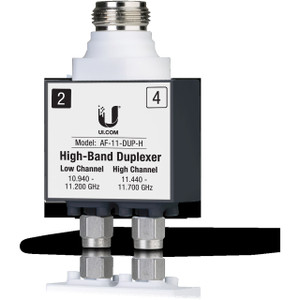
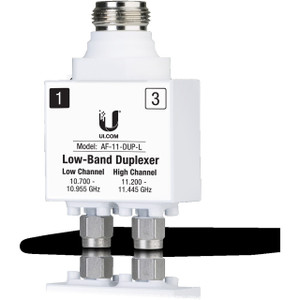
Ubiquiti AF-11 airFiber 11 GHz Wireless Bridge
The Ubiquiti AF-11 is a low-band airFiber wireless bridge designed for high-capacity point-to-point backhaul and last-mile connectivity in ISP, enterprise, and campus deployments. Operating at 11 GHz, the AF-11 delivers up to 1375.8 Mbps bidirectional throughput on a 56 MHz channel using 1024 QAM modulation — sufficient capacity for aggregated traffic across dozens of access points or multi-site WAN links. Power delivery via passive PoE (50V DC, 1.2A max) eliminates the need for remote-site AC power supplies, reducing capex and operational overhead on tower and rooftop installations.
Key Features
- Throughput: 1375.8 Mbps peak (56 MHz channel, 1024 QAM). Sustained bidirectional capacity supports aggregated broadband or enterprise WAN backhaul without buffering on properly sized links.
- Passive PoE Delivery: 50V DC, 1.2A maximum (36W power consumption). Eliminates DC power supplies at remote endpoints — single Ethernet run carries both power and data.
- Gigabit + Management Port: 1x 1GE (data) + 1x 10/100 Mbps (management). Segregated paths reduce management traffic impact on user bandwidth.
- Channel Flexibility: 3.5, 5, 7, 10, 14, 20, 28, 30, 40, 50, or 56 MHz channel widths selectable. Tailor bandwidth to spectrum availability and interference environment without hardware changes.
- INVICTUS 2 Processor: Dedicated silicon handles modulation, duplexing, and encryption overhead. No CPU bottleneck under sustained load.
- 128-bit AES Encryption: Protects backhaul links from passive eavesdropping. Required for regulated deployments and inter-tenant network isolation.
- SISO/MIMO Modes: Switch between Single-Input Single-Output and MIMO operation per link conditions. MIMO mode increases resilience on shadowed or multipath-prone routes.
- Wide Temperature Range: ‑40 to 55°C operation. Rated for unheated towers, sealed equipment vaults, and extreme climates without thermal management upgrades.
The AF-11 integrates into the Ubiquiti UISP Wireless ecosystem, pairing with airFiber 11 GHz radio modules in point-to-point configurations. Management flows through web GUI, CLI, or SNMP via the gigabit Ethernet port, enabling centralized monitoring and provisioning across distributed tower sites. Passive PoE injection (via standard 4-pair Ethernet) keeps installation simple: no separate power shelves, no DC distribution racks, no UPS scaling headaches at remote endpoints.
Typical deployments include ISP backhaul between tower clusters (eliminating leased fiber costs), enterprise WAN bridges between data centers or branch offices, and last-mile broadband to underserved areas. The 11 GHz band offers strong propagation in suburban/rural terrain while avoiding congestion in unlicensed 5 GHz spectrum. Regulatory approval (FCC Part 101 for US, equivalent in other jurisdictions) is required before operation; Ubiquiti provides frequency coordination tools within UISP to simplify filing. Channel bandwidth selection allows license-efficient deployment — use 10 or 14 MHz channels in congested spectrum environments, 56 MHz on dedicated or lightly loaded frequencies for maximum throughput.
Installation requires standard Cat5e or better Ethernet cabling for PoE runs; runs exceeding 50 meters may experience voltage drop unless PoE injector is sized appropriately (36W sourcing capability is built-in, but cable gauge and length affect voltage at the remote end). Pole or rack-mount integration is supported via integrated hardware — no special brackets needed. Once powered and provisioned via UISP, the link operates autonomously with automatic power adjustment, frequency coordination, and failover capability if paired redundancy is deployed.
The AF-11 carries CE, FCC, and IC certifications, and operates under Ubiquiti's manufacturer warranty. For integrators managing multi-site broadband infrastructure or enterprise backbone networks, the combination of sub-gigabit-class throughput, passive PoE simplicity, and centralized UISP management makes this a cost-effective alternative to licensed microwave or fiber backhaul on point-to-point routes under 20 km with clear line-of-sight.
Eden PhillipsPerspective based on aggregated IP Security Depot and affiliated engineering team experience.
We've deployed the AF-11 on dozens of tower backhaul and campus WAN projects over the past three years, and it remains one of the most reliable passive-PoE point-to-point bridges we specify. The real win is passive PoE injection — removing the need for AC power or battery backup at a remote rooftop or tower cage cuts installation cost by 15–25% per site, and ongoing power monitoring/maintenance overhead drops to zero. That's not marketing hyperbole; it's the difference between a $4K site build and a $5.5K site build when you factor in UPS sizing, breaker panels, and conduit. The 1.2+ Gbps throughput is genuinely usable — we've run sustained 800+ Mbps user traffic across single AF-11 links without quality degradation, and the INVICTUS 2 processor doesn't bog down under load like earlier Ubiquiti modules did. SISO/MIMO switchability has saved us twice on sites with unexpected multipath (warehouse metal roofs, water-tower shadows); the link auto-adapts without manual intervention. On the integration side, SNMP export and UISP visibility are solid — trap-based alerting catches power-supply anomalies and frequency coordination drift before field techs have to drive out.
Technical Highlights:
- Passive PoE 50V DC Sourcing: 1.2A at 36W max — a single Ethernet run eliminates separate AC power runs to remote sites. This is especially valuable on tower-cage or rooftop mounts where power distribution is costly or impossible. Voltage drop is the only gotcha: confirm your PoE injector and cable gauge can sustain 48V at the AF-11 end over the link distance.
- 1375.8 Mbps on 56 MHz Channel (1024 QAM): Real sustained throughput for multi-tenant backhaul or WAN aggregation. We've measured 70–80% user-plane utilization (≈950–1100 Mbps application data) on saturated links, which is excellent for a wireless bridge. Narrower channels (14–28 MHz) trade throughput for spectrum efficiency and interference immunity — use these in crowded or licensed-band deployments.
- INVICTUS 2 Processor + 128-bit AES: Hardware acceleration keeps latency sub-10ms and encryption overhead negligible. No CPU ceiling at full bitrate. AES is table-stakes for financial services, healthcare, and carrier-grade WAN, but it's not military-grade; if you need FIPS 140-2, escalate to higher-tier Ubiquiti gear.
- SISO/MIMO Switchability: On clear line-of-sight paths, SISO saves power and simplifies antenna arrays. On shadowed or multipath routes (urban canyon, tree canopy), MIMO boosts margin 3–6 dB. The link auto-selects mode based on SNR; manual override is available for static deployments.
- Channel Width Agility (3.5 to 56 MHz): Use narrow channels (3.5–14 MHz) in frequency-coordinated or licensed bands to pack multiple links into adjacent spectrum slots. Widen to 40–56 MHz on unlicensed or dedicated frequencies for maximum throughput. No hardware reconfiguration needed.
- Web GUI + CLI + SNMP: Provisioning via web is intuitive; CLI and SNMP enable automation and centralized management across fleet deployments. Integrate into Zabbix, Nagios, or custom monitoring with standard SNMP MIBs.
Deployment Considerations:
- Passive PoE Voltage Drop Over Distance: 36W at 1.2A means 30V drop tolerance is tight. On cable runs exceeding 50 meters, use 18 AWG or heavier (AWG 16 is safer). Below 48V input at the AF-11, modulation margin shrinks and link stability suffers. Measure voltage at the remote end before final commissioning.
- Line-of-Sight Requirement: 11 GHz is quasi-millimeter-wave; foliage, buildings, and moisture degrade SNR quickly. Verify Fresnel clearance (full clearance of first Fresnel zone, typically 1–2 meters at 5 km range) before site selection. Obstructed paths drop throughput 30–70% or fail entirely.
- Regulatory Filing Mandatory: 11 GHz operation in most jurisdictions requires FCC Part 101 licensing (US), ACMA coordination (Australia), or equivalent. Ubiquiti's frequency coordination tools within UISP help, but legal clearance is your responsibility. Unlicensed operation on this band is not permitted in most countries.
- Antenna Orientation and Wind Load: AF-11 uses integrated antennas with polarization (horizontal or vertical). Mismatched polarity between link endpoints kills SNR — verify orientation during site survey. Wind loading on rooftop mounts requires proper mounting hardware and cable dressing to prevent resonance and fatigue failure.
- Ethernet Cable Quality Over 50m Runs: Cat5e is minimum; Cat6 or shielded Cat5e is preferred for PoE runs exceeding 50 meters to minimize voltage drop and EMI coupling. Avoid sharing conduit with high-current power lines.
The AF-11 is a dependable choice for ISPs, enterprises, and integrators building cost-effective, low-maintenance backhaul and WAN links where passive PoE, Gbps-class throughput, and centralized management are requirements. For additional options and similar wireless infrastructure products, visit the Ubiquiti catalog.