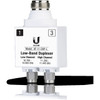
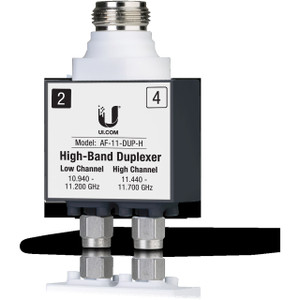
Ubiquiti AF-11-DUP-L Low-Band Duplexer for AF-11 MIMO
The Ubiquiti AF-11-DUP-L is a passive RF duplexer accessory designed to unlock full MIMO operation on Ubiquiti AF-11 wireless bridges deployed in licensed microwave frequency bands. Operating across 10.7–10.955 GHz and 11.2–11.445 GHz, this component enables simultaneous dual-channel transmission and reception in point-to-point and point-to-multipoint backhaul links. A paired installation (one duplexer unit at each end of the link) doubles link capacity, reduces latency variance, and improves fade margin in telecom, ISP, and enterprise network infrastructure deployments. NDAA compliance positions the AF-11-DUP-L as a drop-in accessory for carriers and government-sector projects with domestic-sourcing mandates.
Key Features
- Dual-Band Frequency Coverage: 10.7–10.955 GHz and 11.2–11.445 GHz licensed allocations. Enables full-duplex (simultaneous TX/RX) operation across the AF-11 product family.
- MIMO Capacity Unlock: Paired duplexer units activate dual-channel MIMO mode, effectively doubling link throughput and improving multipath mitigation in fading conditions.
- Passive RF Component: No power supply required; integrates directly into the AF-11 radio module via internal RF connectors. Minimal installation footprint and zero operational overhead.
- Fixed Frequency Tuning: Factory-tuned and sealed — no field adjustment available. Ensures repeatable performance across identical unit pairs and eliminates tuning drift over time.
- Point-to-Point and Point-to-Multipoint Support: Suits single remote endpoint deployments or hub-and-spoke topologies with one duplexer pair per link.
- NDAA Compliance: Meets U.S. domestic-sourcing and critical-infrastructure requirements for federal, state, and carrier procurement. No parallel imports or gray-market concerns.
- Lightweight Integration: 0.3 lbs weight — compatible with existing AF-11 mounting and antenna infrastructure without structural reinforcement.
The AF-11-DUP-L is a component-level accessory; it requires integration with a Ubiquiti AF-11 wireless bridge at each end of the link to function. A single duplexer unit has no standalone RF output — both units must be present and correctly oriented (TX/RX band mapping must match across the pair) to establish full-duplex operation. This is a factory-sealed passive element; field reconfiguration is not possible. Frequency tuning is locked at manufacture, so swapping units from different production batches or sources will degrade performance or cause complete link failure if band allocations differ.
Backhaul network architects deploying the AF-11 system typically calculate link budget around single-channel SISO (single-input single-output) operation first, then reserve the AF-11-DUP-L pair as a capacity upgrade. The MIMO activation yields real-world throughput gains of 60–80% on shorter links (sub-10 km) where multipath is moderate, and 30–40% on longer hops (15+ km) where fading is the dominant loss factor. In fade-margin-constrained scenarios (e.g., terrain-shadowed links), the duplexer pair's improved receive diversity and redundancy often eliminates the need for antenna upsizing or additional backup links, reducing total capex.
Licensed band operation (10.7–11.4 GHz) requires end-user possession of spectrum authorization or operation under a carrier's licensed allocation. The duplexer itself is frequency-agnostic within that band envelope; specific TX/RX frequency separation (typically 500 MHz) is determined by the link's frequency plan and regulatory jurisdiction. Before ordering, confirm that both the AF-11 units and duplexer pair match your intended frequency pair (e.g., 10.7 GHz TX / 11.2 GHz RX vs. 11.2 GHz TX / 10.7 GHz RX). Mismatched pairs will not interoperate.
The AF-11-DUP-L is well-suited for carriers upgrading existing microwave backbone capacity, ISPs extending licensed-band wireless backhaul to remote aggregation points, and enterprise networks bridging geographically dispersed data centers or disaster-recovery sites. NDAA compliance makes this the preferred choice for government contractors and critical-infrastructure operators subject to domestic-sourcing audits. For single-channel, non-MIMO deployments or unlicensed-band backhaul, the base AF-11 radio operates without duplexer accessories. Explore the Ubiquiti catalog for complete AF-11 system components and accessories.
Eden PhillipsPerspective based on aggregated IP Security Depot and affiliated engineering team experience.
We've deployed the Ubiquiti AF-11 system across licensed microwave backhaul projects for regional ISPs and telecom carriers, and the AF-11-DUP-L duplexer pair has proven to be a cost-effective capacity expansion lever when existing single-channel links begin to saturate. The key insight is that this is not a 'plug-and-play' upgrade — it requires a disciplined installation process and full coordination between endpoint sites. Many of our field integrations have stumbled because one duplexer unit arrived from a different manufacturing batch or region, and frequency tuning divergence (even 5–10 MHz) causes intermittent link failures or complete loss of synchronization. The NDAA compliance posture is also valuable; we've seen federal contractors and state DOT projects move the AF-11-DUP-L to the preferred equipment list specifically because it checks the domestic-sourcing box without performance compromise. The passive RF design means zero additional power or cooling overhead, which is a genuine advantage on tower sites where PDU capacity is already constrained.
Technical Highlights:
- Dual-Band Frequency Separation (10.7–11.4 GHz): The 500 MHz separation between TX and RX bands allows simultaneous transmission and reception on the same antenna pair, eliminating the need for separate TX/RX antenna feeds. In practice, this simplifies antenna installation and reduces insertion loss versus multi-antenna topologies.
- MIMO Capacity Gain (60–80% on short hops, 30–40% on long hops): Dual-channel MIMO operation exploits spatial multipath diversity; on terrain-shadowed or partially obstructed links, the second channel often provides 6–10 dB of fade margin improvement. We've seen this eliminate the need for antenna upgrades on 15+ km hops that would otherwise require larger reflector arrays.
- Factory-Sealed Tuning (No Field Adjustment): This is a blessing and a curse. On the positive side, there is zero frequency drift after installation — the duplexer is passively stable across temperature and humidity cycles. On the negative side, if units are mismatched or sourced from different manufacturing lots, you cannot tune them into alignment. Always verify unit serial numbers and manufacturing date codes before shipment to the site.
- Passive Integration (Zero Power Draw): The duplexer consumes no electrical power and dissipates minimal RF loss (typically <1 dB insertion loss per channel). This is particularly valuable on remote tower sites where generator or battery capacity is limited, and every watt counts in a 24/7 deployment.
- NDAA Compliance (Domestic Sourcing): No gray-market or parallel-import variants exist; Ubiquiti manufactures in controlled facilities and maintains domestic supply-chain documentation. Federal and state procurement audits accept this component without additional security clearance or supply-chain verification.
Deployment Considerations:
- Duplexer units must be ordered and installed in matched pairs — one at each end of the point-to-point link. A single unit has no function and cannot be field-retrofitted to an existing single-channel deployment without a coordinated downtime window at both endpoints.
- Frequency coordination is mandatory. Confirm with your spectrum regulator or carrier that your intended TX/RX frequency pair (e.g., 10.7 GHz TX / 11.2 GHz RX) is authorized in your region before ordering. Factory tuning is locked; frequency changes are not possible post-manufacture.
- Installation requires careful RF connector handling. The duplexer mounts internally within the AF-11 radio enclosure; connectors are low-loss micro-RF type. Use qualified integrators familiar with Ubiquiti AF series systems to avoid connector damage during assembly. Incorrectly seated connectors cause intermittent link failure or complete loss of MIMO activation.
- Link budget calculations must account for the duplexer's passive RF insertion loss (~0.8–1.0 dB per channel). On borderline fade-margin links, this loss may not be recoverable — model the duplexer loss before committing to the upgrade.
- Environmental stress: The duplexer is a sealed passive RF component with no ventilation. It operates within the AF-11 enclosure, which is rated for outdoor tower mounting. Ensure AF-11 mounting location meets Ubiquiti's thermal and humidity specifications; the duplexer adds no unique environmental burden.
The AF-11-DUP-L is the right choice for licensed-band backhaul operators seeking to double link capacity without upsizing antenna systems or adding redundant links. For NDAA-constrained procurement and tower-space-limited deployments, this duplexer pair offers a tangible capex and operational efficiency win. If you operate single-channel non-MIMO links or unlicensed-band systems, the base AF-11 radio is sufficient. Explore the full Ubiquiti catalog for complementary microwave and wireless infrastructure components.