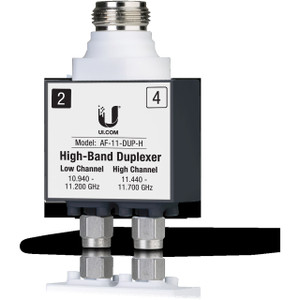
Ubiquiti AF-5U airFiber Wireless Bridge
Overview
The Ubiquiti AF-5U is a compact point-to-point wireless bridge engineered for high-throughput, long-distance connectivity in enterprise and service provider networks. Operating in the unlicensed 5 GHz spectrum, the AF-5U delivers 1.2+ Gbps sustained throughput with sub-millisecond latency — a real advantage when bridging geographically separated sites where fiber installation is expensive or impractical. Weighing 54 pounds, the unit is designed for secure outdoor mounting and arrives ready for deployment with minimal configuration overhead. The airFiber platform is mature and field-proven across thousands of installations, making it a low-risk choice for integrators building campus backhaul or remote office connectivity.
Key Features
- 1.2+ Gbps Throughput: Delivers sustained data rates that eliminate bandwidth bottlenecks on point-to-point links — far exceeding typical bonded copper or single-radio 2.4 GHz deployments. Ensures video backhaul, data center replication, and live traffic forwarding can sustain line-rate performance even under peak load.
- Sub-Millisecond Latency: Packet forwarding latency measured in fractions of a millisecond means VoIP, remote desktop, and real-time applications experience no perceptible delay — critical in carrier-grade or financial trading environments.
- 1+ Million Packets Per Second Forwarding Capacity: Handles bursty traffic and small-packet workloads without frame loss. Relevant when bridging IoT sensor networks, VoIP PBX systems, or database replication traffic that generates frequent small frames.
- Programmable Uplink/Downlink Ratio: Allows you to optimize bandwidth allocation based on traffic patterns. If a site sends 80% upstream and receives 20% downstream, configure the ratio accordingly — eliminates wasteful symmetric splitting and maximizes usable throughput for your specific workflow.
- GPS Synchronization: Enables precise timing alignment across distributed network segments. Beneficial in carrier-grade deployments, financial networks, or any environment where packet timestamps or event correlation across sites must be deterministic.
- Passive PoE 50V 1.2A Power Delivery: Consumes a maximum of 40W via passive PoE — simpler than standard 48V PoE infrastructure and reduces the need for external power supplies or dedicated electrical runs to rooftop antenna mounts. Simplifies site provisioning and reduces total cost of ownership.
- Dual Ethernet Interfaces: Primary Gigabit Ethernet port handles production traffic. Auxiliary 10/100 Mbps port supports management connectivity or failover uplinks without disrupting forwarding on the main link.
- RJ-12 Alignment Tone Port: Dedicated field commissioning port enables technicians to validate antenna alignment and RF signal quality before enabling traffic — reduces troubleshooting time during initial deployment.
Deployment Scenarios
The AF-5U excels in point-to-point bridging between separate network segments. Common use cases include connecting a remote office branch to headquarters (eliminating monthly ISP costs for a dedicated circuit), bridging across city blocks or campuses where underground fiber is prohibited by zoning or cost, and providing high-speed backhaul for distributed Wi-Fi access points or cellular infrastructure. Integrators often deploy the AF-5U in pairs — one unit at each end of the link — for transparent Layer 2 bridging. The compact form factor and integrated antenna design reduce installation labor compared to assembling separate radio and antenna components on-site.
Network Integration
The AF-5U integrates into existing Ethernet networks without protocol translation or middleware. Both the primary Gigabit Ethernet port and auxiliary 10/100 Mbps port support standard switch and firewall configurations. GPS synchronization aligns the AF-5U with other timing-sensitive infrastructure, a requirement in network planning for carrier or latency-critical applications. For wireless bridge deployments, the unit pairs transparently — traffic forwarding requires no special configuration beyond setting the uplink/downlink ratio and confirming RF lock.
Installation & Commissioning
Deployment begins with secure outdoor mounting on a pole, mast, or building facade, using appropriate weatherproofing seals. Inject passive PoE 50V power via the power port. Connect the primary Gigabit Ethernet interface to your network. Use the RJ-12 alignment tone port and field alignment tools to confirm antenna orientation and RF signal strength. Configure uplink/downlink ratio via the management interface, confirm GPS lock on the management display, and enable traffic forwarding. Typical commissioning takes 30–60 minutes per unit. Integrators should validate the specific RF path distance and expected link budget before ordering to ensure this model meets distance and throughput requirements.
Frequently Asked Questions
Q: What is the maximum distance the AF-5U can bridge?
A: The AF-5U supports long-distance point-to-point links; actual range depends on antenna selection, RF environment, and Fresnel zone clearance. Integrators must perform a path study and link budget calculation before deployment. Ubiquiti provides planning tools and reference distances in the datasheet.
Q: Does the AF-5U require a license to operate?
A: The AF-5U operates in the unlicensed 5 GHz spectrum, eliminating FCC license fees in most countries. Regional regulations vary — confirm local wireless authority rules before deployment.
Q: Can I use the AF-5U indoors?
A: The AF-5U is designed for outdoor point-to-point deployment. Indoor use is not recommended due to RF interference from walls and other radio sources, and the 54-pound weight makes indoor mounting impractical.
Q: What power supply do I need for the AF-5U?
A: The AF-5U draws 40W maximum and is powered via passive PoE 50V 1.2A injection. A standard 48V PoE injector or passive injector module rated for 50V supplies the power. No external 12VDC supply is required.
Q: Does the AF-5U support management via SNMP or SSH?
A: Management and configuration are performed via the Ubiquiti AirControl software or web interface accessible on the auxiliary Ethernet port. Specific protocol support is documented in the product datasheet.
Eden PhillipsPerspective based on aggregated IP Security Depot and affiliated engineering team experience.
The AF-5U (MPN AF-5U) remains a workhorse for point-to-point bridging where unlicensed 5 GHz deployment meets range and throughput requirements. The 1.2+ Gbps sustained rate and 1+ million packet-per-second forwarding capacity address the backhaul requirements of mid-scale enterprise and ISP networks. The airFiber platform maturity and passive PoE 50V approach simplify power infrastructure at remote rooftop sites — no need to run 48V PoE+ injectors or dedicated electrical circuits when standard passive 50V injection covers the 40W maximum draw.
Technical Highlights:
- Sub-Millisecond Latency + 1.2+ Gbps Throughput: Eliminates buffering delays on long-distance links and sustains high-speed backhaul for video distribution, database replication, and real-time applications without noticeable lag or frame loss.
- Programmable Uplink/Downlink Ratio: Allows asymmetric bandwidth allocation instead of wasting capacity on unused direction. If a deployment is 70% downstream, 30% upstream, configure accordingly — maximizes usable throughput for the actual traffic pattern.
- GPS Synchronization: Critical for carrier-grade deployments where multiple sites must align timing for redundancy failover or compliance audits. Precise timestamps across distributed segments enable correlation and troubleshooting.
Deployment Considerations:
- The 54-pound weight requires robust outdoor mounting infrastructure (mast, pole, or building structural member) and weatherproofing seals — don't underestimate installation labor on rooftop sites.
- Link budget and path clearance are non-negotiable. Perform a detailed RF path study and Fresnel zone calculation before ordering. Buildings, trees, or terrain between the two units will severely degrade throughput and range. Ubiquiti provides planning tools; use them.
- The auxiliary 10/100 Mbps port is convenient for management, but it is NOT a redundant uplink — it is management-only. If you need failover, provision a secondary wireless link on a separate frequency band.
Position the AF-5U for campus interconnect, remote office backhaul, or distributed access point aggregation where fiber is unavailable. This is not a consumer mesh radio — it is a carrier-grade bridge for experienced integrators deploying deterministic, high-speed links across distance.