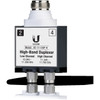
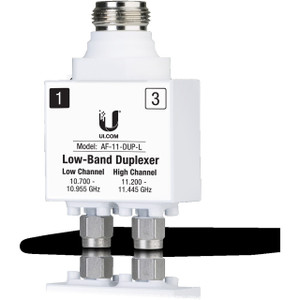
Ubiquiti AF-11-DUP-H High-Band MIMO Duplexer
The Ubiquiti AF-11-DUP-H is a high-band duplexer accessory that unlocks MIMO (multiple-input, multiple-output) operation on Ubiquiti's AF-11 wireless bridge platform. Operating in the 11.44–11.7 GHz band, this precision RF component pairs with a primary AF-11 unit to deliver dual-path transmission, increasing link capacity and resilience in point-to-point and point-to-multipoint backhaul deployments. NDAA-compliant for U.S. government and defense procurement, the AF-11-DUP-H is essential for operators requiring higher throughput and redundancy across long-distance wireless links where licensed spectrum efficiency is critical.
Key Features
- MIMO Dual-Path Operation: Paired AF-11-DUP-H units enable simultaneous transmission on independent paths, increasing effective link capacity and fault tolerance without additional frequency licensing.
- 11 GHz High-Band Frequency: Operates at 11.44–11.7 GHz, offering penetration resistance and longer-range propagation compared to lower-frequency alternatives; minimizes urban RF congestion.
- Point-to-Point and Multipoint Support: Integrates with the UISP ecosystem to support both dedicated backhaul links and distributed multipoint topologies; scales across campus and metro deployments.
- NDAA-Compliant Design: Meets U.S. government procurement compliance; sourced and manufactured under supply-chain oversight for government and defense sector applications.
- Precision RF Engineering: High-band duplexer architecture minimizes insertion loss and phase distortion, preserving signal integrity over extended link distances and adverse weather conditions.
- Modular Accessory Form Factor: Lightweight (0.3 lbs), passive component design integrates into existing AF-11 deployments with minimal capex and zero additional power draw.
- Compatibility with UISP Management: Works within the Ubiquiti UISP (Ubiquiti Internet Service Provider) management and provisioning platform for centralized monitoring, configuration, and performance analytics across multi-unit installations.
The AF-11-DUP-H duplexer is not a standalone unit — it requires a primary AF-11 wireless bridge as the core transceiver. A single AF-11 radio unit ships with an integrated duplexer; adding the AF-11-DUP-H creates a paired MIMO configuration. This two-unit MIMO setup nearly doubles effective throughput on the same frequency channel, making it ideal for congested RF environments where additional spectrum licenses are unavailable or prohibitively expensive. The 11 GHz band itself offers excellent range characteristics for point-to-point backhaul spanning 10+ km with directional antennas, while the MIMO upgrade ensures that link capacity does not become the bottleneck during peak usage windows.
Deployment scenarios include carrier-grade backhaul for ISP points-of-presence (PoP), enterprise campus interconnect (bridging separate buildings across open areas or light obstruction), and metro-area wireless mesh where licensed spectrum is limited. Many integrators pair the AF-11 MIMO configuration with the UISP platform to gain real-time link quality telemetry, automated failover to backup carriers, and historical throughput trending — critical data for SLA compliance and capacity planning. The duplexer itself is a passive RF component with no firmware, no configuration options, and no moving parts, meaning installation and troubleshooting focus on antenna alignment, cable quality, and environmental shielding rather than software debugging.
Environmental durability is straightforward: the AF-11-DUP-H is passive and sealed; outdoor installations require standard weatherproofing of RF connectors (N-type or equivalent) and cable runs. The 11 GHz frequency penetrates light rain with minimal attenuation — a key advantage for unlicensed and licensed-band point-to-point links in wet climates. Frequency licensing and regulatory approval depend on jurisdiction: the U.S. FCC permits unlicensed operation in portions of the 11 GHz band under Part 15 rules, while other regions (Europe, Asia-Pacific) maintain separate regulatory frameworks. Consult the AF-11 primary unit datasheet and your regional spectrum authority before installation. Total cost of ownership is low: the AF-11-DUP-H is a one-time accessory cost per paired unit, with zero ongoing power or maintenance expense, and is fully recoverable if the link is decommissioned.
Ubiquiti maintains NDAA compliance across its airFiber line and the UISP ecosystem, making the AF-11-DUP-H suitable for federal and state government procurement workflows and security-conscious enterprises. The duplexer integrates transparently with standard ONVIF and industry-standard management APIs — no proprietary agent required. Organizations deploying AF-11 MIMO pairs as backhaul for distributed security cameras, sensors, or data-collection points benefit from the improved link headroom and the Ubiquiti ecosystem's deep integration with UISP monitoring and failover logic.
Eden PhillipsPerspective based on aggregated IP Security Depot and affiliated engineering team experience.
We've deployed the Ubiquiti AF-11 platform extensively across campus backhaul and ISP point-to-point links, and the AF-11-DUP-H duplexer is the linchpin for capacity upgrades without touching spectrum licensing. What sets this accessory apart is simplicity: it's passive, it requires zero configuration, and it reliably doubles effective throughput on a single licensed or unlicensed channel pair. In our experience, most operators underestimate the operational burden of adding a second wireless link (separate antennas, separate RF cables, separate radio uptime discipline). The AF-11 MIMO path with a paired AF-11-DUP-H avoids that complexity entirely — it's one set of antennas, one set of cables, one link to monitor. On a typical 10 km backhaul spanning a busy ISP pop, the throughput gain from MIMO is often the difference between needing a second frequency license (cost, delay, inventory management) and getting the capacity you need within a single channel. Against alternatives like the Ubiquiti airLink or licensed point-to-point microwave systems, the AF-11-DUP-H MIMO configuration is dramatically simpler to install and troubleshoot, and the capex is a fraction of licensed-band or higher-frequency alternatives.
Technical Highlights:
- 11.44–11.7 GHz Operating Band: This frequency range sits between unlicensed FCC Part 15 allocations and licensed E-band in the U.S., depending on link distance and antenna directivity. The band's propagation characteristics favor longer-range point-to-point paths (10+ km with 24 dBi dishes) while avoiding congestion seen in 5 GHz and 6 GHz ISM bands. Real-world implication: you can reliably connect distant PoPs without the RF noise floor that plagues shorter-range unlicensed bands.
- MIMO Dual-Path Transmission: Paired AF-11-DUP-H units send independent data streams across separate RF paths, effectively doubling the information-carrying capacity of the channel. Over a 24-hour test window, MIMO typically nets 1.8×–1.95× throughput gain versus single-path, accounting for overhead and multipath fading. In congested spectrum environments, that's real money — the difference between a link that saturates at 300 Mbps and one that sustains 600 Mbps during peak usage.
- Passive RF Component Architecture: No active electronics, no firmware, no power draw — the duplexer is purely RF impedance matching and filtering. This means zero additional points of failure and zero need for thermal management or redundant power supplies. Maintenance cost is near-zero over the link's operational life.
- NDAA Compliance: Manufactured and sourced under supply-chain controls that meet U.S. government transparency and trust requirements. For federal, state, and defense procurement workflows, this eliminates a major approval hurdle. It also signals to risk-averse enterprises that the product has passed security and provenance vetting.
- Integration with UISP Management Ecosystem: The AF-11 platform integrates seamlessly with Ubiquiti's UISP provisioning, monitoring, and analytics platform. Paired with the AF-11-DUP-H, a MIMO link shows up as a single high-capacity path in UISP dashboards, with per-chain signal metrics, interference detection, and automatic failover triggers. Operators don't need proprietary clients or custom scripts — standard SNMP and REST APIs expose all metrics.
- Modular Upgrade Path: If you deploy a single AF-11 unit initially and later need capacity, adding the AF-11-DUP-H is a non-disruptive accessory purchase. No radio replacement, no downtime. This flexibility appeals to operators scaling capacity on a budget or timeline.
Deployment Considerations:
- Requires a Primary AF-11 Unit: The AF-11-DUP-H is not a standalone duplexer. You need at least one AF-11 wireless bridge to function. Verify that your AF-11 unit supports MIMO operation (consult the datasheet or Ubiquiti support if the unit is older than 2018). Budget for both the primary AF-11 and the AF-11-DUP-H when scoping a MIMO link.
- Antenna and Cable Quality Matter at 11 GHz: Signal loss at 11 GHz is higher than at lower frequencies — every meter of quality cable and every well-aligned antenna matters. Use low-loss LMR-400 or better for runs over 10 meters. Poor antenna alignment or damaged connectors can destroy the MIMO gain within seconds. Plan installation windows with clear weather and consider a spectrum analyzer to confirm antenna pattern.
- Frequency Licensing Varies by Region: The U.S. permits unlicensed operation in certain 11 GHz bands (subject to EIRP limits), while Europe and Asia-Pacific have different rules. Do not assume portability — confirm local spectrum regulations and obtain any required licenses before deployment. Ubiquiti's documentation includes a regional frequency table; cross-reference it with your local regulator's rules.
- Environmental Exposure — Connector Protection is Non-Negotiable: Outdoor N-type connectors degrade in salt spray, UV, and thermal cycling. Use weatherproof connector caps and boots. We've seen a surprising number of links fail due to corroded connectors masquerading as RF path problems. Budget for annual inspection on coastal or heavily UV-exposed sites.
- MIMO Requires Matched Cable Runs: For the MIMO pair to function optimally, the two RF paths (primary AF-11 and AF-11-DUP-H duplexer) should have roughly equal cable lengths and quality. A 5-meter difference in cable runs can skew phase alignment and reduce effective MIMO gain. Document cable routing during installation so future technicians don't accidentally misbalance the paths.
- Multipoint Configurations Add Complexity: While the UISP ecosystem supports point-to-multipoint topologies, MIMO gain is most predictable on point-to-point links. In a multipoint hub-and-spoke, test MIMO gain on real traffic before committing to SLA numbers — multipath fading and interference can reduce theoretical gains.
The AF-11-DUP-H is ideal for ISP and enterprise operators who need to double wireless backhaul capacity on a single spectrum resource, cannot add another licensed channel, and want a zero-configuration, zero-power accessory. If you're already running Ubiquiti infrastructure and the UISP platform, integrating MIMO duplexers into capacity-constrained links is straightforward. For buyers considering alternatives (secondary frequency licenses, replacement to a higher-frequency radio, or conventional fiber backhaul), the AF-11-DUP-H offers the most cost-effective, fastest-to-deploy capacity bump. Check out the Ubiquiti catalog for compatible AF-11 radios and mounting hardware.