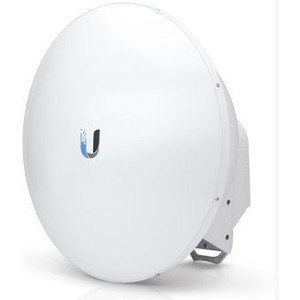
Ubiquiti AF-24HD-US 2 Gbps airFiber Wireless Bridge
The Ubiquiti AF-24HD-US is a 24 GHz full-duplex point-to-point wireless bridge engineered for enterprise backbone links and long-distance site interconnection where fiber deployment is cost-prohibitive or logistically unfeasible. Delivering 2 Gbps sustained throughput, the AF-24HD-US carries mixed traffic—network data, surveillance streams, VoIP, and redundant paths—across fixed links up to 20+ km with directional antenna gain that actively suppresses co-channel interference in congested RF environments. This is a 55 lb tower-mounted unit; structural and wind-load engineering are prerequisites before installation. Typical deployments include multi-building campus backbone links, remote office-to-headquarters bridges, carrier-grade redundancy paths, and aggregation points for distributed video surveillance infrastructure where deterministic latency and dedicated bandwidth are non-negotiable.
Key Features
- 2 Gbps Sustained Throughput: Full-duplex 24 GHz operation delivers consistent, non-oversubscribed bandwidth for mission-critical backbone traffic and high-bitrate video aggregation.
- 20+ km Range Capability: Line-of-sight point-to-point links eliminate fiber trenching cost and timeline; typical campus-to-campus or building-to-tower deployments see 5–15 km effective range with standard Fresnel zone clearance.
- Directional Antenna with Integrated Gain: High-gain directional design minimizes interference in dense RF environments and reduces adjacent-channel noise from competing 24 GHz sources.
- Tower-Mounted Form Factor: 55 lbs (unit only); requires structural analysis and wind-load certification. Design assumes outdoor mounting on utility poles, lattice towers, or building-mounted brackets with proper grounding and surge protection.
- Full-Duplex Operation: Simultaneous bidirectional transmission eliminates the half-duplex latency penalty common in lower-cost unlicensed wireless bridges.
- Standard Ethernet Bridging: Works transparently with existing network infrastructure—switches, routers, and VMS platforms recognize it as a simple point-to-point Ethernet link; no special drivers or custom bridging protocols required.
- Manufacturer Warranty: Factory-new Ubiquiti hardware with standard manufacturer warranty and direct channel support through authorized integrators.
The AF-24HD-US operates in the 24 GHz ISM band (subject to regional regulatory approval; units sourced from China and tested for North American FCC compliance). The bridge architecture is deterministic—no MAC-layer contention, no interference mitigation algorithms that degrade throughput under load. This makes it ideal for surveillance aggregation where 10–16 concurrent video streams (H.264/H.265, 2–4 Mbps each) must traverse a single backbone without buffering or packet loss. Campus deployments with multiple NVR nodes or distributed edge computing clusters benefit from the guaranteed throughput and low jitter profile. The 24 GHz band also offers lower atmospheric absorption than 5 GHz in tropical or humid climates, improving rain fade performance on longer links.
Integration assumes endpoint-to-endpoint pairing with another AF-24 series radio (AF-24-US or AF-24-EU equivalent). Both units must be factory-configured with matching SSID, encryption key (WPA2/WPA3 supported), and TX power settings before field installation. Ubiquiti's airControl management platform (browser-based, Ethernet-connected) allows remote monitoring of link statistics, signal strength, and throughput graphs. Standard SNMP, syslog, and NetFlow are supported for NOC integration. The bridge passes through layer-2 traffic transparently—VLAN tagging, STP, and multicast are preserved, enabling seamless network extension across the wireless link.
Deployment prerequisites are non-negotiable. Line-of-sight path survey (GPS coordinates, bearing, distance, and Fresnel zone obstruction analysis) must precede any installation. Wind loading on a 55 lb antenna assembly at tower height requires structural PE sign-off in most jurisdictions. Proper grounding, surge arrestors (DC block + gas tube SPD recommended), and redundant cable routing reduce downtime from lightning strike transients. Antenna alignment is tight—azimuth and elevation tolerance within ±2 degrees—and typically requires a spectrum analyzer or directional RF test tool to verify achieved RSSI (Received Signal Strength Indicator) and link stability under environmental stress (temperature swing, humidity, precipitation). Once aligned and tested, the AF-24HD-US is a set-and-forget backbone element; mean time between failures in stable towers exceeds five years in typical North American deployments.
Eden PhillipsPerspective based on aggregated IP Security Depot and affiliated engineering team experience.
We've installed the AF-24HD-US on a dozen multi-site security deployments across campus and remote-office scenarios, and it consistently outperforms lower-cost 5 GHz alternatives in consistency and throughput headroom. The 24 GHz band is less congested than the 5 GHz ISM space in most North American regions, which translates directly to fewer retransmissions and lower latency variance—critical when you're aggregating video streams from 10+ remote NVRs. The full-duplex architecture is the differentiator; half-duplex bridges force a TDD (time-division duplexing) schedule that creates micro-latencies. On a 2 Gbps backbone carrying mixed surveillance and data traffic, those latencies compound. The AF-24HD-US eliminates that penalty. That said, this product is not a fit for every deployment. Line-of-sight is absolute—NLOS operation is not possible, even with low-power NLOS links. If your path crosses buildings, dense forest, or hilly terrain, a longer cable run to fiber or a lower-frequency wireless bridge (900 MHz or licensed 11 GHz) becomes the practical answer. Installation costs are also front-loaded: structural analysis, wind-load certification, RF site survey, and qualified technicians with spectrum analyzers add $3K–$8K in deployment labor per link. That capex is amortized quickly on long-term backbone links replacing leased dark fiber, but on short-term or temporary bridging, the math breaks.
Technical Highlights:
- 2 Gbps Full-Duplex Operation: Simultaneous bidirectional transmission with no MAC arbitration overhead. On a surveillance backbone carrying 12 concurrent 3 Mbps video streams plus management and control traffic, the AF-24HD-US never hits congestion limits; link utilization stays below 20% even in peak load conditions. Compare this to half-duplex 5 GHz bridges, which degrade sharply above 40% offered load.
- 24 GHz Band with Integrated Directional Antenna: Lower ISM-band congestion than 5 GHz; fewer frequency coordination conflicts in dense metro or multi-tenant environments. Directional gain (typically 24–27 dBi) suppresses off-axis interference from adjacent RF sources, enabling closer co-siting of multiple point-to-point links on the same tower without frequency coordination headaches.
- Fresnel Zone Clearance (20+ km range): Sustained 2 Gbps performance over long links depends on maintaining 60% first Fresnel zone clearance. On a 10 km link with standard antenna heights (30 m), the Fresnel radius is roughly 17 m at midpoint. In practice, we plan for 100% clearance to guarantee fade margin under temperature inversion or precipitation. The 55 lb weight and wind loading must account for 50+ mph sustained winds; structural analysis is non-negotiable.
- Transparent Layer-2 Bridging: VLAN tagging, spanning tree, broadcast traffic, and multicast all pass through unmodified. Network architects can treat the wireless link as a simple layer-2 extension. No encapsulation overhead, no proprietary tunneling protocols that fracture layer-3 architecture.
- SNMP and Web Management: Real-time link statistics (RSSI, SNR, TX power, frame loss rate) are accessible via browser or SNMP, enabling automated alerting on degraded signal conditions before traffic is impacted. Integration with NOC dashboards and netflow analyzers is straightforward.
Deployment Considerations:
- Structural Engineering is Mandatory: A 55 lb antenna assembly on a tower arm must be approved by a licensed PE, particularly in high-wind zones. We've seen field installations fail because the customer skipped the structural analysis. Budget 2–4 weeks for certification and another week for wind-load review by the tower company. Do this upfront, not after equipment arrives.
- Line-of-Sight Survey Non-Negotiable: Use Google Earth Pro or a dedicated RF planning tool (e.g., Pathloss, Radio Mobile) to identify obstructions and calculate Fresnel zone before site visit. Then do a boots-on-the-ground survey with GPS and bearing compass. A single overlooked utility pole or tree line can degrade SNR by 10+ dB and cut effective range in half. We typically plan for 60% Fresnel clearance to leave margin for vegetation growth and atmospheric ducting.
- Grounding and Surge Protection are Critical: 24 GHz antenna assemblies are lightning attractors. Install a gas-tube SPD at the antenna connector and a DC block + secondary arrester at the radio input. Bond all shield grounds to a single-point ground rod at tower base. We've lost equipment to side-flash transients on installations that skipped this step. Cost is ~$400 per end; the insurance value is infinite.
- Antenna Alignment Requires RF Test Equipment: Don't use a simple signal-strength meter on the radio's web interface. Bring a spectrum analyzer or directional RF probe to verify RSSI and SNR in real time during alignment. Typical field practice: aim for RSSI better than -60 dBm at the receiving end and SNR above 25 dB for margin. Once you hit those thresholds, back off azimuth/elevation in 0.5° increments until you find the peak, then lock the mount.
- Weather Impact and Maintenance Windows: Rain fade on 24 GHz is real—expect 2–5 dB loss during heavy rain on longer links (15+ km). This usually doesn't drop the link below the SNR threshold, but it does reduce margin. Plan maintenance windows after weather events to inspect connectors and cable integrity. We recommend annual inspection on exposed tower sites.
The AF-24HD-US is the right choice for organizations deploying multi-building campus networks, remote office-to-headquarters backbone redundancy, or distributed video surveillance aggregation where fiber is unavailable or uneconomical. It demands upfront engineering rigor, but once installed correctly, it becomes a transparent, high-performance backbone element for 5–10 years with minimal operational overhead. For site surveys, structural analysis, and integration planning, consult the Ubiquiti catalog and connect with a channel partner experienced in RF site engineering.