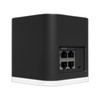
Ubiquiti ACB-ISP Wireless Access Point
Overview
The Ubiquiti ACB-ISP is a compact, low-cost WiFi access point designed for small-scale and residential deployments where cost efficiency and centralized management matter more than multi-gigabit throughput. Operating at 2.4 GHz with a maximum throughput of 300 Mbps, it delivers adequate coverage for light commercial and home automation networks. The device integrates with Ubiquiti's UISP management platform, enabling remote provisioning, monitoring, and firmware updates across distributed sites without on-site technician visits—a real time saver when you're managing dozens of small branch locations.
Key Features
- 2.4 GHz, 300 Mbps throughput: Sufficient for web browsing, video streaming, and VoIP in small footprint deployments; not suitable for bandwidth-intensive applications like 4K video streaming or high-density user scenarios.
- 4 dBi antenna gain: Provides modest coverage extension over a standard dipole—expect reasonable range in open floor plans, but expect degradation through dense walls or metal structures.
- 24V PoE input on LAN port 1 or 5V Micro-USB: Dual power options mean you can integrate this into existing 24V PoE infrastructure (common in access control and site automation) or use a standalone USB adapter—flexibility that reduces the need for separate power supplies on small jobs.
- 24V PoE output on WAN port with daisy-chain capability: Critical for warehouse and outdoor automation: you can power a second compatible device (such as an airMAX CPE endpoint) from the ACB-ISP's WAN port, eliminating the need for a second PoE injector and simplifying cable runs in retrofit scenarios.
- Maximum power consumption 5W: Negligible draw means this won't strain a standard 802.3af PoE port (which delivers up to 15.4W), leaving headroom on your switch for other devices.
- Transmit power 20 dBm: Standard regulatory limit for unlicensed 2.4 GHz—meets FCC and CE constraints without modification; no edge case advantages, just compliance-locked performance.
- ±24 kV ESD/EMP protection on RJ45 interfaces: Protects against static discharge and induced transients during installation and maintenance—meaningful in warehouse environments or outdoor sites where cable handling or lightning proximity is a concern.
- Operating temperature -10 to 50°C; humidity 5–95% non-condensing: Handles unheated sheds, outdoor enclosures, and humid environments (but not condensing conditions); if you need submersion tolerance or extreme cold, you'll need a different design.
- NDAA-compliant, certified CE/FCC/IC: Meets U.S. defense supply chain requirements if your project involves federal procurement or security-cleared integrators; no gray-market risk.
- Interoperates with airMAX CPE devices: If you're already deployed on Ubiquiti's airMAX wireless backbone (common in ISP and rural broadband), this AP integrates without firmware forks or compatibility middlemen.
Integration and Management
The ACB-ISP integrates with Ubiquiti's UISP platform for centralized management across multiple sites. This means one dashboard for provisioning, monitoring uptime, and pushing firmware updates to dozens of APs simultaneously—a major operational win if you're managing SMB or branch networks. The device also supports standard SNMP monitoring, allowing integration into your existing NOC infrastructure if you prefer to avoid Ubiquiti's cloud console.
When to Choose a Different Model
If you need higher throughput (5 GHz band, dual-band support, or 802.11ac/ax speeds), or if you require advanced features like integrated mesh networking or client steering, consider Ubiquiti's higher-end WiFi product lines. The ACB-ISP is optimized for point-to-point backhaul and small-footprint coverage—not high-density user environments. For warehouse automation scenarios requiring both point-to-multipoint bridging and PoE powered endpoints, pair this with airMAX sector or CPE equipment rather than treating it as a standalone solution.
Frequently Asked Questions
Q: Is the ACB-ISP suitable for outdoor deployment?
A: The operating temperature range of -10 to 50°C and non-condensing humidity tolerance (5–95%) allow use in unheated outdoor enclosures or overhangs, but the device is not rated IP67 (submersion-proof). Mount it in a weatherproof box or under a shelter if rain exposure is direct and sustained.
Q: Can I power the ACB-ISP from my existing 802.3af PoE switch?
A: Yes. The ACB-ISP accepts 24V PoE input on LAN port 1 and consumes a maximum 5W, well within 802.3af limits (15.4W). No injector or special switch required.
Q: What's the difference between the ACB-ISP's WAN and LAN ports?
A: The WAN port provides 24V PoE output for daisy-chaining compatible devices (like airMAX CPE units); LAN port 1 accepts 24V PoE input to power the AP itself. The remaining LAN port is a standard 10/100 Ethernet connection with no PoE output.
Q: Does the ACB-ISP integrate with UISP, or do I need separate management software?
A: Native UISP integration is built-in. Remote provisioning, monitoring, and firmware pushes all work through the UISP platform. SNMP is also supported if you want to pull metrics into a third-party NOC tool.
Q: Is the ACB-ISP NDAA-compliant?
A: Yes, the ACB-ISP is NDAA Section 889 compliant and certified FCC, CE, and IC. It meets U.S. government procurement standards.
Q: What happens if I need 5 GHz coverage or higher throughput?
A: The ACB-ISP is 2.4 GHz only and maxes out at 300 Mbps. For dual-band, 802.11ac, or higher speeds, you will need a different access point from Ubiquiti's product line.
Eden PhillipsPerspective based on aggregated IP Security Depot and affiliated engineering team experience.
The ACB-ISP (often searched as ACB ISP) is a deliberately constrained design—2.4 GHz, 300 Mbps, 5W draw—but that constraint is actually the product's strength. It's built for cost-per-node scalability in small deployments where throughput isn't the limiting factor. The real differentiator is the 24V PoE output on the WAN port, which lets you daisy-chain downstream endpoints without burning an extra power port on your switch. That matters in warehouse and site automation where cable runs and power budgets are tight.
Technical Highlights:
- 24V PoE output on WAN port: Enables daisy-chain deployment of airMAX CPE or other compatible 24V devices, eliminating redundant injectors and simplifying cabling in field retrofits—directly cuts your BOM and labor cost per node.
- 5W maximum consumption on 802.3af: This leaves roughly 10W of headroom on a standard 15.4W PoE port, so you won't need a PoE+ switch and can mix other low-power devices on the same circuit without negotiation.
- ±24 kV ESD/EMP protection on RJ45: Non-trivial in outdoor or semi-exposed installations where static and induced transients are real risks during cable termination or near lightning-prone structures.
Deployment Considerations:
- 300 Mbps is a hard ceiling—fine for IoT, access control, and site management traffic, but don't expect to stream 4K video or handle dense WiFi client loads. This is a last-mile node, not a primary network backbone.
- Dual power input (24V PoE or 5V Micro-USB) is handy for flexibility, but the Micro-USB adapter is not included; factor that into your first-unit cost if you're prototyping or testing.
- NDAA compliance and UISP integration mean you can deploy across federal/defense-adjacent projects without supplier approval delays, but that's only valuable if your customer or integrator actually has those constraints—don't pay for compliance you don't need.
Best fit: small branch sites, warehouse automation backhaul, outdoor IoT gateways, and distributed access control where low cost per node, daisy-chainable power, and centralized UISP provisioning outweigh raw throughput. If your next project is a dense office WiFi deployment, look elsewhere.