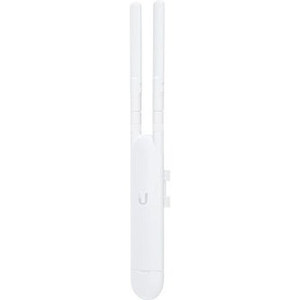
Ubiquiti ACB-AC WiFi 5 Access Point
Overview
The Ubiquiti ACB-AC is a compact dual-band WiFi 5 access point designed for distributed network deployments where you need straightforward coverage without oversized enterprise hardware. It operates across 2.4 GHz (delivering 300 Mbps maximum) and 5 GHz (up to 866.7 Mbps), making it suitable for small-to-medium coverage areas in warehouses, retail locations, or branch facilities. The device integrates with Ubiquiti's broader ecosystem and supports interoperability with airMAX CPE devices, so if you're already running Ubiquiti infrastructure, the ACB-AC slots into your architecture without complications. Remote management via UISP platform centralizes provisioning, monitoring, and troubleshooting across multiple units — a real time-saver when you're deploying dozens of access points across a multi-site operation.
Key Features
- Dual-band WiFi 5 (802.11ac): The 2.4 GHz band handles legacy devices and coverage at distance; the 5 GHz band delivers the speed (866.7 Mbps) for bandwidth-heavy tasks like video streaming or file transfers. In congested RF environments, WiFi 5 is far less crowded than WiFi 6, so channel interference is typically easier to manage.
- Four Gigabit Ethernet ports: Each port runs at full gigabit speed, allowing you to wire up cameras, door controllers, or printers without bottlenecking your throughput. One port supports 24V PoE output, meaning the ACB-AC can power downstream devices like access control readers or IP phones without a separate injector.
- Flexible power input (PoE or Micro-USB): Accept 24V PoE on port 1 for hardwired installations, or use the included Micro-USB adapter for locations without PoE infrastructure. This flexibility matters in retrofit scenarios where running new power runs is costly or impractical.
- 22 dBm maximum transmit power with directional antenna gains: 4 dBi on 2.4 GHz and 5 dBi on 5 GHz mean the device focuses RF energy more effectively than isotropic antennas, extending usable range in open spaces like warehouse floors. In practice, expect reliable coverage across 30–50 meters depending on obstacles and interference.
- Operating range -10°C to 50°C with 5–95% humidity tolerance: These specs cover most indoor warehouses and climate-controlled retail environments. If your facility drops below freezing or exceeds 50°C regularly, verify site conditions before committing. High humidity (up to 95% non-condensing) works for humid storage areas but not wet/spray environments — that requires sealed enclosures or higher-rated hardware.
- UISP remote management: Provisioning, monitoring, and firmware updates happen over the network without on-site technician visits. For 10+ units, this aggregated visibility and control is essential; for 2–3 units, it's convenient but not mandatory.
- FCC, CE, and IC certified; NDAA compliant: NDAA compliance is critical if your buyer is a U.S. federal agency, state/local government, or a prime contractor. If you're selling into that space, this check-box matters. If not, it's a non-factor.
Integration & Compatibility
The ACB-AC pairs seamlessly with 802.11ac-compatible client devices — phones, tablets, laptops, and wireless IoT sensors. It supports standard DHCP and static IP assignment, so integration with your existing VLAN and firewall architecture is straightforward. The 24V PoE output port enables you to power external devices, reducing the number of power supplies cluttering your rack or wall.
When to Choose a Different Model
If you need WiFi 6 (802.11ax) for higher throughput, lower latency, or denser client counts (30+ simultaneous connections), consider a higher-spec variant from Ubiquiti's WiFi 6 line. If you require outdoor-rated housing with IP67 enclosure or extreme temperature tolerance beyond -10°C to 50°C, you'll need a ruggedized access point or outdoor-specific enclosure. If your site runs legacy 802.11n equipment that cannot upgrade, WiFi 5 backward compatibility is strong, but verify with a site survey first.
What's in the Box
- airCube AC access point (1x)
- 24V Micro-USB power adapter (1x)
Frequently Asked Questions
Q: Can the ACB-AC power cameras or other PoE devices directly?
A: Yes. The WAN port provides 24V PoE output, allowing you to power IP cameras, door readers, or similar devices. Check your device's power requirements — 24V PoE limits are typically around 30W per port, so confirm your downstream device won't exceed that.
Q: Is the ACB-AC suitable for outdoor mounting?
A: The operating temperature range is -10°C to 50°C, which covers most temperate climates. However, the unit itself is not IP67-rated, so direct rain exposure requires a weatherproof enclosure. If you need true outdoor WiFi, consider a weather-sealed access point variant from Ubiquiti's catalog.
Q: Does the ACB-AC work with Ubiquiti cameras?
A: The ACB-AC is a network-layer device and integrates with any ONVIF-compliant camera over Ethernet. Ubiquiti cameras work fine, as do cameras from other vendors. The access point doesn't restrict camera brand — it simply provides WiFi and wired connectivity.
Q: Can I manage the ACB-AC without UISP?
A: Yes. UISP centralizes management and makes multi-unit deployments easier, but the ACB-AC can be configured and monitored through its web interface on a single machine. For small deployments (1–3 units), UISP is optional.
Q: What is the maximum number of concurrent clients the ACB-AC can handle?
A: Ubiquiti does not publish a hard client limit in the primary specifications. In practice, WiFi 5 access points handle 20–40 simultaneous clients comfortably; performance degrades with each additional client. For warehouse IoT or camera networks, this is usually adequate — confirm your expected client count against a site survey if you're deploying 50+ devices per access point.
Q: Is the ACB-AC NDAA Section 889 compliant?
A: Yes, the ACB-AC carries NDAA compliance, making it suitable for U.S. federal and state/local government procurement.
Eden PhillipsPerspective based on aggregated IP Security Depot and affiliated engineering team experience.
The Ubiquiti ACB-AC is a straightforward workhorse for small-to-medium WiFi 5 deployments where you don't need enterprise-class hardware or WiFi 6 complexity. The dual 300 Mbps / 866.7 Mbps band split with PoE input flexibility makes it practical for retrofits and greenfield installs alike. The built-in 24V PoE output on the WAN port eliminates a separate injector in many camera or access-control scenarios.
Technical Highlights:
- WiFi 5 dual-band (2.4 GHz / 5 GHz): The 866.7 Mbps maximum on 5 GHz is adequate for bandwidth-sensitive deployments (video streams, file transfers), while the 2.4 GHz band at 300 Mbps extends range and handles legacy clients. In RF-congested venues, the reduced channel density compared to WiFi 6 often means easier tuning and fewer interference headaches.
- Flexible power (PoE or Micro-USB) with PoE output: Accept power via 24V PoE on port 1 or the included Micro-USB adapter. More importantly, the WAN port outputs 24V PoE, so you can daisy-chain downstream devices — cameras, readers, IP phones — without additional power supplies. This simplifies wiring and reduces clutter in wall cabinets.
- UISP centralized management: Provisioning, monitoring, and OTA firmware updates across dozens of units eliminates tedious on-site SSH sessions. For integrators managing 20+ sites, UISP's aggregated view and alert capability justified the Ubiquiti ecosystem choice. For single-location or 2–3 access point jobs, the web UI is sufficient.
Deployment Considerations:
- Temperature and humidity limits: The -10°C to 50°C operating window and 5–95% non-condensing humidity tolerance work for indoor warehouses and climate-controlled retail. Unheated loading docks or outdoor storage sheds below freezing will not support this device without enclosure or auxiliary heating. Verify site conditions before procurement.
- Not outdoor-rated: No IP67 or equivalent environmental sealing, so rain exposure requires weatherproof enclosure. If your project calls for outdoor WiFi, Ubiquiti's outdoor-hardened access points are purpose-built for that; don't force the ACB-AC into an unprotected mount.
- WiFi 5 is not WiFi 6: Throughput and latency are solid for most warehouse IoT and camera backhaul, but if you're planning for 50+ concurrent wireless clients per access point, WiFi 6 density and efficiency will serve you better. Survey your RF environment and client density before committing.
Best fit: warehouse WiFi mesh extensions, retail POS backhaul, small branch office connectivity, and camera/reader wireless bridging in climate-controlled spaces. The ACB-AC is overkill for a single home office and undersized for a dense corporate campus, but it occupies the sweet spot for mid-market distributed deployments where NDAA compliance and UISP manageability matter.