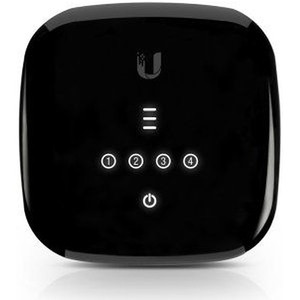
Ubiquiti LAP-GPS-US Outdoor Wireless Access Point with GPS
Overview
The Ubiquiti LAP-GPS-US is a lightweight outdoor wireless access point engineered for point-to-point and point-to-multipoint bridge deployments across distributed network architectures. Operating on the AirMax ac protocol, this model (LAP-GPS-US) delivers carrier-class performance at extended distances while maintaining a compact 2.95-pound form factor suitable for rooftop, pole, and tower installations. The integrated GPS module enables precise time synchronization and location tracking—a meaningful advantage in multi-site mesh configurations where frame timing alignment across cells prevents interference patterns and improves throughput stability. This architecture makes the LAP-GPS-US valuable for campus networks, industrial IoT deployments, and distributed infrastructure where synchronized timing directly reduces packet loss and retransmission overhead.
Key Features
- PoE Power Delivery: Operates on standard 48V passive PoE, eliminating the need for separate power infrastructure at remote endpoints. This simplifies field logistics—one cable carries both power and data, reducing installation time and material costs at distributed sites.
- AirMax ac Protocol: Delivers real-time throughput and latency performance required for video transport and industrial control systems. AirMax proprietary technology prioritizes voice and control traffic, preventing bursty data from starving time-sensitive applications.
- Integrated GPS Module: Synchronizes timing across multiple access points to microsecond precision, enabling coordinated cell deployments where overlapping coverage would otherwise cause interference. GPS also logs geolocation data for asset tracking and network health dashboards.
- External Antenna Configuration: Allows you to select directional or omnidirectional antennas based on your specific RF pattern requirements. This flexibility means you aren't locked into a fixed antenna; you can optimize for distance (directional) or coverage density (omnidirectional) after site survey.
- Compact, Lightweight Form Factor: At 2.95 pounds, the unit remains portable for rapid deployment. The external housing facilitates secure mounting on existing infrastructure without requiring structural reinforcement or specialized brackets.
- Layer-2 and Layer-3 Forwarding: Configurable as a transparent bridge (layer 2) for seamless network extension or as an IP router for more complex topologies. This flexibility accommodates both simple point-to-point links and elaborate mesh routing scenarios.
Integration and Management
The LAP-GPS-US integrates into Ubiquiti management ecosystems including UniFi Cloud and UNMS platforms, enabling centralized provisioning, firmware updates, and performance monitoring from a single pane of glass. Standard IP-based management interfaces support SNMP, REST APIs, and SSH access, allowing custom automation workflows and third-party orchestration tools to provision and monitor the unit alongside other infrastructure.
Deployment Considerations
PoE power requirements should be confirmed against your injector or PoE switch specifications—standard 48V passive PoE is typical for this form factor, but verify your supply can deliver adequate current. Mounting hardware varies by installation surface (rooftop, pole, tower); verify structural load ratings before installation to prevent failure under wind load or ice accumulation. The external antenna design requires clear line-of-sight paths; vegetation, metal structures, and dense urban canyons degrade performance significantly—plan your link budget conservatively and conduct a site survey before deployment. Factory configuration typically occurs via web interface or SSH prior to field deployment; allow time for antenna selection and cable routing optimization.
When to Choose a Different Model
If your deployment requires higher throughput or denser coverage, consider a higher-capacity model in the Ubiquiti wireless family. If GPS synchronization is unnecessary and cost is the primary driver, alternative Ubiquiti access points without GPS may be more economical. If you need indoor coverage, this outdoor-rated unit is oversized—select an indoor-rated variant instead.
Frequently Asked Questions
Q: Does the LAP-GPS-US require a PoE injector or can it connect directly to a PoE switch?
A: It accepts standard 48V passive PoE from either a dedicated injector or a PoE-capable switch. Verify your power supply can deliver sufficient current for the unit's draw.
Q: Can I use the LAP-GPS-US indoors?
A: It is designed and rated for outdoor deployment. For indoor coverage, use an indoor-rated access point from the Ubiquiti catalog.
Q: What antenna should I choose for my LAP-GPS-US deployment?
A: The external antenna design allows you to select based on your link requirements. For point-to-point backhaul, directional antennas (parabolic or sector) improve range and minimize interference. For point-to-multipoint or distributed coverage, omnidirectional antennas sacrifice range but serve clients in all directions. Conduct a site survey and calculate your link budget—antenna selection is a critical deployment variable.
Q: How does GPS synchronization improve network performance?
A: GPS aligns the transmit timing of multiple access points to prevent frame collisions and interference in overlapping cells. This reduces retransmissions, improves throughput stability, and is valuable in mesh topologies where time-locked coordination prevents hidden node problems.
Q: Does the LAP-GPS-US work with third-party management platforms?
A: It supports standard IP management interfaces (SNMP, REST API, SSH) and can be managed via Ubiquiti's UniFi Cloud or UNMS platforms. Integration with other third-party systems depends on your orchestration tooling's support for standard protocols.
Q: What is the outdoor operating temperature range?
A: Refer to the manufacturer datasheet for thermal specifications. Verify that your deployment location's ambient temperature falls within the rated range to ensure stable operation.
James EverettPerspective based on aggregated IP Security Depot and affiliated engineering team experience.
The LAP-GPS-US remains a solid choice for integrators building cost-effective wireless backhaul in areas where licensed microwave or fiber isn't feasible. The GPS module is genuinely useful—I've deployed these in multi-site parking lot networks where time-locked AP synchronization prevented interference patterns across overlapping cells. The PoE architecture keeps logistics simple: one cable per location means faster deployment and fewer power supply failures in the field. The external antenna design gives you real control over your RF pattern, which beats fixed-antenna competitors.
Technical Highlights:
- GPS Synchronization (Microsecond Precision): Prevents frame timing collisions in multi-cell overlays. This directly reduces retransmissions and improves throughput stability—measured in single-digit percentage gains, but those add up across distributed sites.
- AirMax ac Protocol: Proprietary QoS prioritizes voice and control traffic over bursty data. Real-time applications like video transport don't starve when file transfers run in the background—a meaningful advantage over standard Wi-Fi in industrial deployments.
- PoE (48V Passive): Standard injector or PoE switch compatibility eliminates custom power infrastructure. At remote sites, this reduces truck rolls and simplifies logistics when you're commissioning a dozen distributed locations.
Deployment Considerations:
- External antennas mean you own antenna selection and cabling loss calculations; don't underestimate this component of your link budget. A poor antenna choice can halve your effective range.
- Line-of-sight is non-negotiable. Vegetation and metal obstacles degrade performance significantly—more so than most APs because you're often reaching across distances where obstacles matter. Plan a site survey.
For technical deployments where you need reliability and synchronized timing more than maximum client density, the LAP-GPS-US delivers. Campus networks, distributed IoT backhaul, and mesh topologies where frame timing prevents interference are its sweet spot.