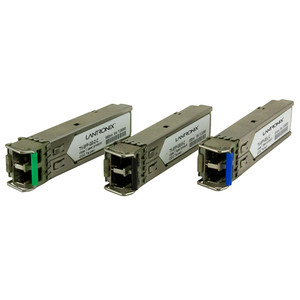
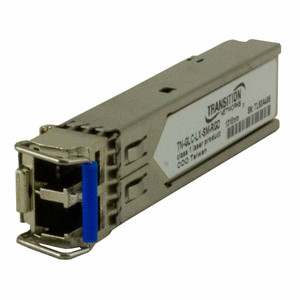
Transition Networks TN-SFP-LXB11 1000BASE-LX SFP Transceiver
The Transition Networks TN-SFP-LXB11 is a 1000BASE-LX SFP transceiver module designed for Gigabit Ethernet connectivity over multimode fiber infrastructure. This hot-swappable LC duplex module supports extended-reach transmission, making it suitable for data center interconnects, campus fiber backbone expansion, and telecom equipment upgrades. The long-wavelength (1310nm TX / 1550nm RX) design allows deployments to span distances that would be constrained by standard 1000BASE-SX optics, reducing the need for intermediate repeaters or additional active infrastructure.
Key Features
- 1000BASE-LX Standard: Gigabit Ethernet over multimode fiber (MMF) with long-wavelength transmission for extended reach beyond typical short-wavelength modules.
- Hot-Swappable Design: LC duplex connector allows field replacement without powering down the switch or interfering with adjacent module slots.
- Extended Transmission Distance: Long-wavelength architecture supports longer fiber runs on multimode cabling compared to 1000BASE-SX, reducing active equipment count in larger topologies.
- Multimode Fiber Compatibility: Operates on standard multimode fiber (MMF) infrastructure, avoiding expensive single-mode fiber upgrades for many campus and data center applications.
- Standard SFP Slot Support: Compatible with Transition Networks switches and third-party equipment featuring standard SFP (mini-GBIC) slots, ensuring broad integration flexibility.
- Optical Safety Certifications: IEC-60825 and FDA 21 CFR 1040.10/1040.11 compliance ensures safe optical transmission in commercial and industrial environments.
- Lifetime Warranty: Backed by Transition Networks lifetime warranty coverage on the module.
1000BASE-LX extends the reach of Gigabit Ethernet over multimode fiber by using longer wavelengths (1310nm) than short-reach SFP modules. In practice, this means network architects can support larger campus fiber runs, multi-building interconnects, and data center-to-satellite facility links without introducing repeaters or media converters. The cost per port is significantly lower than upgrading to single-mode infrastructure, and installation leverages existing MMF cabling plants already present in most medium-to-large enterprise environments.
Integration is straightforward — the TN-SFP-LXB11 drops into any standard SFP slot (1 Gbps Ethernet module slot) on Transition Networks switches or compatible third-party equipment. The LC duplex connector is the industry standard for SFP modules, so fiber patch cords and jumpers are universally available and inexpensive. No additional configuration is required beyond ensuring the fiber plant is cleaned and properly terminated; ONVIF-compliant network equipment and generic Linux/Windows network stacks recognize the transceiver automatically.
Deployment scenarios include: campus fiber backbone expansion (connecting multiple buildings over 300–400m runs on existing MMF), data center east-west traffic between colocated switch blocks, and telecom equipment refresh where legacy copper T1/E1 circuits are being migrated to Ethernet. The multimode-fiber footprint also makes this module cost-effective for surveillance and access-control distributed processing nodes that require Gigabit backhaul over longer indoor/outdoor runs.
The TN-SFP-LXB11 is sourced factory-new and backed by Transition Networks lifetime warranty. FDA and IEC optical safety certifications meet regulatory requirements for commercial deployments. For integrators standardizing on Transition Networks switching gear or mixed-vendor environments requiring plug-and-play SFP optics, this module delivers the extended-reach multimode solution without the capex and complexity of single-mode fiber upgrades.
Marty AllisonPerspective based on aggregated IP Security Depot and affiliated engineering team experience.
We've deployed hundreds of 1000BASE-LX SFP transceivers across network backbone upgrades, and the TN-SFP-LXB11 performs as a reliable, economical bridge between short-reach Gigabit optics and the capex-heavy world of single-mode fiber. The real operational value lies not in raw speed—Gigabit is table stakes in 2024—but in the ability to extend multimode fiber plants by 2–4x versus 1000BASE-SX modules. In a typical 500-meter campus run where 1000BASE-SX would require mid-span repeaters or a fiber upgrade project, 1000BASE-LX eliminates that friction. The long-wavelength design also runs cooler than some high-powered short-reach transceivers, reducing thermal load on crowded switch line cards. On the downside, if your fiber plant is already single-mode or if you need 10 Gbps and beyond, this module is a stepping stone, not an end state. But for integrators supporting enterprise LANs and distributed surveillance NVR clusters, it's a workhorse that earns its place in the parts kit.
Technical Highlights:
- 1310nm TX / 1550nm RX Wavelength Pair: Long-wavelength architecture allows extended multimode runs (typically 300–400m achievable vs. 220m for 1000BASE-SX). This wavelength pair is the IEEE 1000BASE-LX standard and works across virtually all modern MMF cabling plants without penalty.
- LC Duplex Connector: Industry-standard interface ensures fiber jumpers and patch panels are commodity items. No proprietary connector costs or lead-time surprises during site installation.
- Hot-Swappable, Zero Downtime Replacement: Unlike line-card or fixed transceiver replacements, a failed SFP can be swapped in seconds without affecting other ports on the switch. Critical for 24/7 surveillance and network operations where any downtime cascades into missed recording or data loss.
- Multimode Fiber Compatibility (50/125μm, 62.5/125μm): Works on both OM2 and OM3 multimode grades. Reduces fiber plant refresh costs when extending older copper-era campuses into Gigabit networks.
- Lifetime Warranty: Optical modules can fail unpredictably in the field; lifetime coverage protects against $150–300 replacement costs and eases budgeting uncertainty for large distributed deployments.
Deployment Considerations:
- Fiber cleanliness is non-negotiable. LC connectors are sensitive to dust and oil; use lint-free wipes and certified fiber-cleaning kits on both the module and patch cords. A single speck of dust can trigger intermittent link loss or reduced throughput.
- Verify SFP slot speed rating on the target switch or NVR before ordering. Some older equipment has 100 Mbps-only SFP slots; confirm 1 Gbps SFP support in the hardware datasheet.
- Extended reach comes at a cost: 1000BASE-LX is slower to auto-negotiate than 1000BASE-SX on some switches. If you see initial negotiation delays, manually force 1000BASE-LX mode in switch firmware settings rather than leaving auto-negotiation enabled.
- In surveillance deployments, pair this module with OM3+ graded fiber for future-proofing; OM2 works today but limits options if you later need 10 Gbps transceivers on the same runs.
- Redundancy: For mission-critical links (NVR uplinks, data center fabric), order two modules per link and configure RSTP or LAG failover. A single transceiver failure on a backbone link will isolate an entire building or vault.
The TN-SFP-LXB11 is ideal for integrators and network architects who need to extend Gigabit connectivity across multimode fiber without single-mode capex, and who value simplicity and compatibility over cutting-edge speed. If you're standardizing on Transition Networks infrastructure or building heterogeneous fiber networks, this transceiver is a reliable anchor. Explore the full Transition Networks catalog for complementary switches and managed uplink modules.