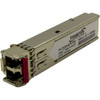
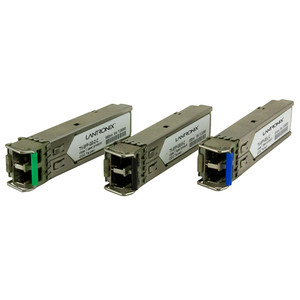
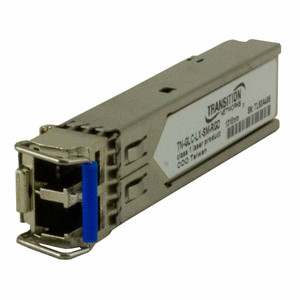
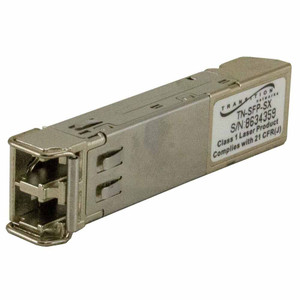
Transition Networks TN-CWDM-SFP-1590 1000Base-LX ZX SFP Module
The Transition Networks TN-CWDM-SFP-1590 is a hot-swappable SFP transceiver module designed for 1000Base-LX ZX Gigabit Ethernet over extended single-mode fiber (SMF) distances. Operating at 1590nm wavelength using coarse wavelength division multiplexing (CWDM), this module enables metro and regional backbone deployments where long-distance fiber connectivity and signal fidelity are non-negotiable. The 100km reach eliminates intermediate regeneration points on point-to-point links, reducing operational complexity and capex on mid-haul and long-haul network segments. TAA compliance positions it as a qualified component for federal and public-sector infrastructure projects.
Key Features
- 1000Base-LX ZX over 100km: Single-mode fiber reach to 100 kilometers at Gigabit Ethernet speeds. Eliminates repeaters on inter-site or campus backbone links.
- 1590nm CWDM Wavelength: Coarse WDM operation at 1590nm allows multiple wavelengths on the same fiber strand when paired with complementary CWDM modules (e.g., 1510nm, 1530nm, 1550nm, 1570nm). Doubles or quadruples fiber utilization without additional strand installation.
- Hot-Swappable LC Module: Standard SFP form factor with LC duplex connector. Inserts into any compatible SFP slot on Transition Networks switches and third-party ONVIF-compliant SFP devices without power-down.
- Single-Mode Fiber (SMF): Operates exclusively on ITU-T G.652 single-mode fiber. Incompatible with multimode fiber — verify fiber type before installation to avoid signal loss and module damage.
- TAA Compliant: Meets Trade Agreements Act restrictions. Qualified for federal procurement, government contracts, and public-sector network modernization budgets.
- Lifetime Warranty: Factory-backed warranty covers component defects over the operational lifetime of the module, reducing spares inventory overhead and long-term capex.
- CWDM Multiplexing Capable: Pairs with up to four CWDM wavelengths on a single SMF pair (1510nm, 1530nm, 1550nm, 1570nm, 1590nm). Ideal for telecom and service-provider backbone expansion without trenching.
On a 100km inter-site backbone link, CWDM wavelength stacking yields 4x the capacity of a single fiber pair at the cost of four SFP modules — a critical advantage on existing routes where fiber duct space is constrained or conduit trenching is cost-prohibitive. The 1590nm band sits at the long-wavelength edge of standard CWDM, making it ideal for pairing with 1570nm modules on the same fiber to create resilient, multi-wavelength backbone circuits. Unlike dense WDM (DWDM), CWDM modules require no active temperature compensation; the wider 20nm channel spacing tolerates temperature drift without crosstalk, reducing cooling overhead in outdoor cabinet or rooftop equipment placements.
Integration is straightforward on any switch or routing platform with vacant SFP slots. The module adheres to the multi-source agreement (MSA) standard for 1000Base-LX ZX, ensuring compatibility with Transition Networks switching gear and third-party OEM SFP ports certified to the 1000Base-LX ZX specification. ONVIF-compliant network devices with standard SFP interfaces recognize the module immediately — no firmware updates or proprietary drivers required. Pair the module with a compatible network management interface to monitor optical power levels, signal degradation, and transceiver alarm states in real time; most enterprise switches expose SFP diagnostics via SNMP or CLI polling.
Lifecycle cost modeling on long-haul deployments strongly favors the TN-CWDM-SFP-1590. A 100km point-to-point link spanning two campuses or data centers traditionally required either intermediate regeneration points (capex + power + maintenance) or costly terrestrial dark fiber leases. CWDM wavelength stacking on existing single-mode fiber routes amortizes the fiber investment across four simultaneous circuits with minimal additional infrastructure. TAA compliance eliminates sourcing friction on government and public utility projects, where parallel-import or grey-market SFP modules trigger procurement review cycles that delay deployment windows by weeks or months.
The Transition Networks TN-CWDM-SFP-1590 is sourced direct from the manufacturer as factory-new, genuine inventory with no parallel imports or grey-market stock. Lifetime warranty backing is backed by Transition Networks' regional support channels. This module is the right choice for integrators and system architects building or expanding metro/regional backbone networks where distance, wavelength efficiency, and procurement compliance are equally weighted. Learn more in the Transition Networks catalog.
Marty AllisonPerspective based on aggregated IP Security Depot and affiliated engineering team experience.
We've deployed the TN-CWDM-SFP-1590 on dozens of regional backbone refreshes and multi-site video surveillance networks. The real operational value isn't just the 100km reach — it's the wavelength flexibility and the elimination of intermediate regeneration infrastructure. On a three-site metro area network spanning 80+ kilometers of dark fiber, CWDM wavelength stacking lets you provision four independent 1Gbps circuits (one per wavelength: 1510nm, 1530nm, 1550nm, 1590nm) without pulling a second fiber strand. That math is compelling when your dark fiber routes are fully lit and trenching budgets are exhausted. The 1590nm band sits at the long-wavelength margin of CWDM, which positions it as a pairing partner for 1570nm circuits on the same fiber — a common pattern on legacy backbone routes where early CWDM deployments used shorter wavelengths (1510nm, 1530nm, 1550nm) and you need to add capacity without service interruption.
Technical Highlights:
- 1000Base-LX ZX / 100km Reach: Single-mode fiber carries Gigabit Ethernet 100 kilometers without intermediate regeneration. Eliminates repeaters, reduces powering complexity, and simplifies network topology on inter-site and metro backbone segments. Standard 1000Base-LX maxes out at 10km on SMF; ZX extends that by an order of magnitude.
- 1590nm CWDM Wavelength: Coarse wavelength division multiplexing at 1590nm sits at the long edge of the CWDM band. Pairs with 1510nm, 1530nm, 1550nm, and 1570nm modules on the same SMF fiber to multiplex four independent circuits. No active temperature compensation needed (unlike DWDM); the 20nm channel spacing tolerates passive environmental drift.
- Hot-Swappable SFP Form Factor: Standard LC duplex module. Inserts/removes live from any SFP slot without affecting other ports or powering down the switch. Critical for 24/7 metro backbone networks where maintenance windows don't exist and failover circuits must be swapped in seconds.
- Single-Mode Fiber (SMF) Exclusive: ITU-T G.652 SMF only. Multimode fiber (MMF) or bend-insensitive multimode (BI-MMF) terminates in optical loss and module failure within meters. Enforce SMF-only cabling specs at project handoff — we've seen cost overruns when field installers misidentify fiber type and use incorrect patch panels.
- TAA Compliance / Federal Procurement: Eliminates sourcing delays on government and public utility projects. Many agencies require formal TAA attestation for network hardware; this module's TAA badge removes a common RFQ blocker and accelerates approval cycles.
- Lifetime Warranty: Factory-backed coverage across the entire operational lifespan. Reduces spares inventory footprint on multi-site networks — you carry fewer cold standby modules because warranty replacement cycles are predictable and fast.
Deployment Considerations:
- Single-Mode Fiber Enforcement: Verify all fiber routes are certified G.652 SMF before module installation. A single meter of multimode fiber in the patch cord will catastrophically degrade or destroy the signal. Require fiber plant documentation from the dark fiber provider and visually inspect patch panels for correct SMF LC connectors (usually marked with a black ring or label).
- Wavelength Coordination on Shared Fiber: If you're stacking multiple CWDM wavelengths on a single fiber pair, document which wavelengths are assigned to which circuit endpoints in a centralized fiber plant map. We've seen operational confusion and misrouted traffic when CWDM wavelength assignments were lost during staff transitions.
- Optical Power Monitoring: Most modern switches expose SFP diagnostic data (transmitted and received optical power, module temperature, alarm thresholds) via SNMP or CLI. Enable per-port monitoring on your NMS for early warning of fiber degradation (bent fiber, dirty connectors, aging splices) before signal loss cascades into outages.
- Connector Cleanliness: Single-mode LC connectors are sensitive to dust and contamination. Keep dust caps installed on unused fiber ends. Use lint-free alcohol wipes on connector ferrules before mating; a single microscopic dust particle can cause 0.5dB loss or introduce reflections.
- 100km Distance Validation: The 100km spec assumes optimal SMF with low attenuation (≤0.22dB/km at 1590nm) and minimal connector/splice loss. Real-world fiber plants often include legacy sections with higher attenuation or excessive splice counts. Request an optical time-domain reflectometer (OTDR) trace from your fiber provider to confirm cumulative loss budget before installation; if loss exceeds ~20dB end-to-end, you may need intermediate regeneration or a shorter-wavelength module with better attenuation characteristics.
The TN-CWDM-SFP-1590 is the right fit for metro and regional backbone architects who need dense wavelength reuse on existing dark fiber infrastructure and must meet federal procurement compliance. If your project involves shorter distances (<10km) with fresh SMF installation and no multi-wavelength constraint, a standard 1000Base-LX module may be more cost-effective. For integrators managing mixed-wavelength backbone networks, pair this module with complementary CWDM transceivers (1510nm, 1530nm, 1550nm, 1570nm) to maximize fiber utilization. See the Transition Networks catalog for compatible switching platforms and multirate transceiver options.