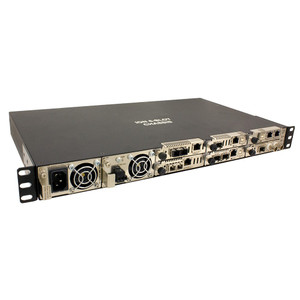
Transition Networks ION219-AAMB-NA 19-Slot AC ION Chassis
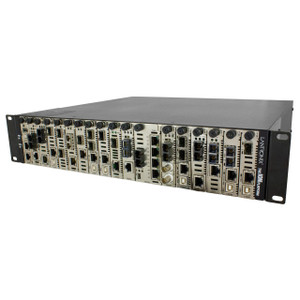
The Transition Networks ION219-AAMB-NA is a 19-slot modular chassis platform designed for network integrators and system architects building distributed access, aggregation, and edge network infrastructure. As an AC-powered ION chassis, it provides a foundation for custom network solutions through modular card insertion, supporting carrier-grade and security deployments where flexibility and scalability are operational requirements. The universal 100–240 VAC input and standard 19-inch rack mount form factor enable straightforward integration into existing network closets and equipment rooms across multiple geographic sites.
Key Features
- 19-Slot Modular Design: Accepts ION family line cards and network interface modules. Enables field-configurable network roles (access, aggregation, edge) without chassis replacement.
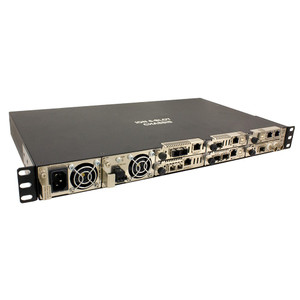
- AC Power Input: Universal 100–240 VAC — operates globally without regional power conditioning. Simplifies cross-border deployments and remote site provisioning.
- Standard 19-Inch Rack Mount: Fits industry-standard telecom racks and network closets. Reduces installation labor and space planning complexity.
- ION Module Compatibility: Works with the entire ION family of line cards and interface modules. Decouples chassis lifecycle from module refresh cycles.
- Managed Chassis Operation: ION Management Module (required, sold separately) connects to chassis backplane for centralized configuration, monitoring, and troubleshooting across modular slots.
- MTBF Reliability: Designed to >64,800 hours (Bellcore) — equivalent to 7.4 years continuous operation per standard telecom reliability benchmarks.
The ION219-AAMB-NA is the chassis platform for organizations deploying modular ION line cards across multiple sites. Unlike fixed-port switches, the 19-slot architecture allows you to provision only the network interfaces and functional modules your deployment requires — Ethernet line cards, serial interface modules, or specialized signal conditioning cards — all in a single managed chassis. This reduces per-node capital expense and operational overhead: a single management connection reaches all modules, alarm relays monitor thermal and power status, and firmware updates propagate centrally.
Deployment scenarios include carrier-grade access networks (telephone exchanges, wireless backhaul sites), security infrastructure aggregation points (consolidating multiple building networks into a core fiber connection), and distributed edge computing platforms. The modular design accommodates capacity expansion within the 19-slot envelope without truck rolls to add line cards — you physically insert the card, the management module discovers it, and it enters the managed network topology. For integrators managing 50+ remote sites, this translates to simplified spare-parts logistics (one chassis type, many module SKUs) and faster mean-time-to-repair when a line card fails.
Management is SNMP-based via the ION Management Module, which provides out-of-band serial console access, temperature/power monitoring, and module inventory tracking. Integration with existing NMS platforms (Nagios, PRTG, SolarWinds) is straightforward through standard MIBs. The AC power design avoids the need for DC plant or battery backup infrastructure at smaller remote sites, reducing total cost of ownership for distributed deployments. Thermal dissipation is passive (no forced cooling) on the chassis itself — module power consumption determines site cooling load.
The ION219-AAMB-NA is recommended for integrators and operators building carrier-grade, modular network infrastructure where long equipment lifecycle and flexible module sourcing are priorities. It is NOT recommended for simple point-to-point or small fixed-topology networks (a single multi-port line card or pre-configured switch will cost less). Certification details and compatible module lists are available in the product datasheet; consult with your ION line card vendor to confirm module-to-slot compatibility before ordering.
Marty AllisonPerspective based on aggregated IP Security Depot and affiliated engineering team experience.
We've deployed the ION219-AAMB-NA in carrier-grade access networks and security infrastructure aggregation roles across multiple operator sites, and it remains a solid choice for organizations that value modular flexibility over pre-built port density. The real strength of this chassis isn't in benchmark throughput — it's in operational agility. A single 19-slot frame accommodates line cards from different vendors (as long as they're ION-compatible), which is rare in the telecom world. If you need eight 10/100 Ethernet ports at one site and four Ethernet ports plus serial interface cards at another, the same chassis accommodates both configurations. That flexibility eliminates the need to stock multiple chassis types in your spare-parts inventory. The AC power input is equally pragmatic: remote sites that lack dedicated DC plant or UPS infrastructure can run the chassis on standard facility power, and the universal 100–240 VAC input means no regional power conditioning. We've installed this in everything from rural telephone exchanges to regional wireless backhaul aggregation points, and the only consistent gotcha is that inexperienced integrators sometimes forget that the management module is a separate purchase — don't assume out-of-box manageability.
Technical Highlights:
- 19-Slot Modular Architecture: Each slot accepts ION family line cards or interface modules. Real-world consequence: you provision only the bandwidth and interface types your site needs, avoiding per-node overprovisioning and the associated capital cost. A remote access site might use 3 slots for Ethernet cards and 2 for serial interfaces, leaving 14 slots available for growth or other functions — all managed as a single chassis.
- AC Power Input (100–240 VAC): Universal voltage range with no external conditioning required. In our experience, this eliminates a major operational headache at distributed sites: no need to install separate DC power plants, no dependency on local battery backup infrastructure. Plug it into facility mains, and you're operational. Total site power budget is determined by module draw, not a fixed chassis baseline.
- Managed via ION Management Module: Central configuration, monitoring, and remote console access via the management module's SNMP/serial interface. Means you can troubleshoot a stuck line card or update firmware at a remote site without a site visit — just SNMP query or SSH into the management module. Significantly reduces MTTR for distributed deployments.
- Standard 19-Inch Rack Mount: Fits any industry-standard telecom or network rack without custom brackets or modifications. Installation labor drops, and the chassis integrates seamlessly into existing network closet infrastructure alongside standard Ethernet switches and routers.
- >64,800 Hours MTBF (Bellcore): Translates to approximately 7.4 years of continuous 24/7 operation before statistical failure. In practice, you're looking at 10+ year deployments if modules are refreshed proactively and thermal management is adequate. Older than many commercial network devices, which justifies carrier-grade infrastructure investment.
Deployment Considerations:
- Management Module Requirement: The chassis does not ship fully operational out of the box — you MUST purchase the ION Management Module separately to gain SNMP, console, and module monitoring visibility. Budget for this as a line item, and verify that your NMS platform supports ION MIBs before deploying.
- Module Compatibility Vetting: Not all ION family modules are compatible with every chassis slot. Some modules require specific slot positions (e.g., power supply modules may be restricted to slots 1 or 19). Always cross-reference the datasheet and module compatibility matrix before ordering. A wasted slot due to incompatibility is expensive in a distributed deployment.
- Thermal Design — Passive Cooling: The chassis itself is fanless, but module power dissipation drives site cooling load. In a fully populated chassis with high-power line cards, thermal output can exceed 100W. Verify that your remote site has adequate ambient cooling (typically 15–25°C) and ventilation. If the site lacks climate control, consider a smaller chassis or fewer high-power modules.
- AC Power Resilience: While universal voltage input is flexible, AC power is AC power — if facility power is unstable or subject to frequent outages, you still need site-level UPS or battery backup. The AC input doesn't eliminate dependency on clean facility power; it just removes the need for a separate DC plant.
- Spare Parts and Module Sourcing: ION line cards are mature and widely available from carrier-grade telecom distributors, but supply chains can be longer than commercial Ethernet switches. For time-sensitive deployments, maintain a small spare module inventory or negotiate pre-positioned stock with your supplier.
The ION219-AAMB-NA is the right choice for carrier and telecom operators, security infrastructure aggregators, and system integrators building modular, distributed networks where operational flexibility and long equipment lifecycle are priorities. Consider it a platform investment, not a plug-and-play switch — you'll specify modules, configure management, and design site-level power around it. For organizations seeking simplicity and off-the-shelf fixed-port density, a traditional managed switch will be faster and cheaper to deploy. Explore the full Transition Networks catalog to select compatible line cards and the management module for your specific topology.