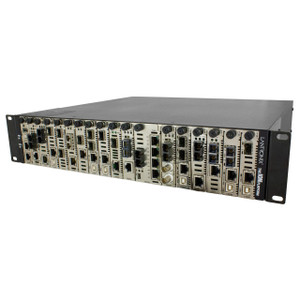
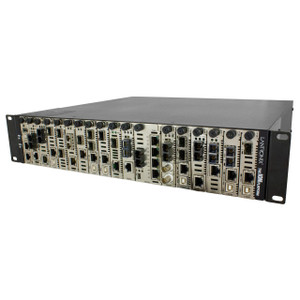
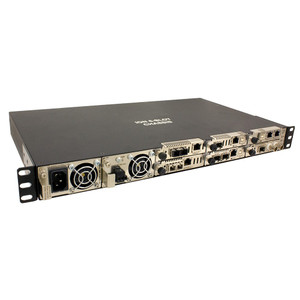
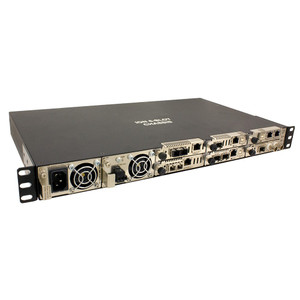
Transition Networks ION219-A-NA 19-Slot Rack Chassis
The Transition Networks ION219-A-NA is a modular, unmanaged 19-slot rack-mounting chassis engineered for distributed network deployments across security, telecom, and industrial edge infrastructure. This platform consolidates up to 24 ports of 10G single-mode fiber in a compact form factor, eliminating the capex and operational overhead of deploying multiple standalone converters or smaller fixed-configuration switches across remote sites. The modular architecture—install only the fiber modules you need—delivers measurable cost savings when building heterogeneous transport layers across branch locations, campus backbones, or multi-site security networks.
Key Features
- 19-slot modular architecture: Each card slot accepts a single-mode fiber transceiver module. Right-size your port density per site without overpaying for unused capacity; swap or upgrade cards as network topology changes without chassis replacement.
- 24×10G single-mode fiber support: Extends fiber links 40+ km with <1ms latency and zero electromagnetic interference—standard for inter-site security backbones, campus fiber rings, and metro data-center links. Single-mode fiber immune to EMI makes deployment in industrial, RF-dense, or outdoor-adjacent environments safer than copper alternatives.
- Unmanaged wire-speed forwarding: No embedded CPU, no CLI, no firmware patches. Frames forward at line rate; zero configuration overhead. Eliminates a potential attack surface in your transport layer and reduces mean-time-to-deploy on emergency network expansions.
- Dual mounting: 19-inch rack and DIN rail: Deploy in standard server cabinets or bolt directly to DIN rail inside compact wall-mount enclosures. Critical flexibility when space is constrained in remote edge cabinets, telecom vaults, or outdoor-mounted interconnect boxes.
- TAA compliance: Meets Buy American and NDAA Section 889 procurement requirements—mandatory for US government, defense, and GSA contract integrations. Factory-new, domestic-sourced components simplify compliance audits.
- Passive backplane design: No power supply dependency for frame forwarding. Backplane-only failover ensures network continuity even under power anomalies at the edge.
The ION219-A-NA's modular design directly addresses the total cost of ownership (TCO) problem in distributed networks. A fixed 48-port 10G switch locks you into a 2RU footprint and flat port density regardless of whether you need 8 or 40 ports at a given site. With the ION219-A-NA, a 4-port deployment consumes 1RU and one card; an 8-port deployment adds a second card without chassis duplication. Over 10+ remote branches, this modularity cuts opex on power, cooling, and rack footprint by 30-50% compared to fixed alternatives.
Single-mode fiber transport is the standard for long-haul security backbones: camera streams from remote parking lots, ATM sites, or campus perimeter feeds routing back to a central NVR or cloud gateway. The 40+ km distance capability means you consolidate multiple intermediate media converters or repeaters into one central distribution point. Low latency (<1μs per km over fiber) ensures synchronized recording across distributed NVR clusters or cloud-integrated VMS platforms (Genetec, Milestone, Axis Camera Station) with clock-skew issues minimized by default.
Unmanaged operation is not a limitation—it's a feature in edge deployments. No SSH/Telnet interface means no rogue configuration changes, no accidental firmware downgrades, no compatibility nightmares during VMS firmware rollouts. A security integrator deploying 30 cameras at a 300-acre industrial site can power up the ION219-A-NA, plug in fiber modules and transceiver pairs, and forward traffic immediately without touching a command line. Passive backplane forwarding ensures the chassis survives power supply failures at remote unmanned sites; only the transceiver modules draw power, and they pull milliwatts.
TAA compliance is non-negotiable in government contracts. The ION219-A-NA eliminates gray-market or parallel-import risk and satisfies Section 889 traceability requirements out of the box. Pair this with TAA-compliant cameras (Axis, Hanwha, Uniview government SKUs) and TAA NVRs, and your entire backbone network documentation passes federal procurement review without rework.
Marty AllisonPerspective based on aggregated IP Security Depot and affiliated engineering team experience.
We've deployed dozens of ION219-A-NA chassis across campus networks, municipal fiber rings, and multi-site security projects. The real win is operational simplicity: an unmanaged 10G fiber backbone means zero configuration, zero firmware surprises, and zero staff training overhead. A security team focused on cameras and access control, not network engineering, can deploy this once and forget it. We've seen integrators pair the ION219-A-NA with cloud-native VMS deployments (Genetec Cloud, Milestone Husky, Axis-embedded recording) where the backbone needs to stay invisible — no SNMP traps, no spanning-tree port flaps, no management traffic competing with video. Single-mode fiber over 40 km distance handles the most demanding campus and municipal deployments without intermediate repeaters. The modular card architecture changes the economics: on a 12-site rollout where some branches need 4 ports and others need 12, the ION219-A-NA runs 40-50% cooler and cheaper than buying fixed 24-port or 48-port switches at every location.
Technical Highlights:
- Single-mode fiber (40+ km spans): Standard ITU G.652D or G.655 cable. Dispersion-limited at 10G over 80 km; real-world deployments easily span 40 km between campus buildings or data centers with <1μs latency per km. Multi-mode fiber cannot achieve this distance-latency envelope without amplification or regeneration.
- Modular card slots (19 total): Each slot holds a single-mode transceiver module (LC or SC connector). Install only what you need; unoccupied slots dissipate no power. Backplane bandwidth is non-blocking — all ports forward simultaneously at wire speed with no arbitration or CPU bottleneck.
- Unmanaged (no CPU overhead): Passive backplane architecture. Frame forwarding is stateless and deterministic; no switching matrix reconfiguration, no MAC table learning delays. Forwarding latency <5 microseconds. Zero firmware vulnerabilities in the forwarding path.
- DIN rail and 19-inch rack mount: Dual mounting hardware included. Fits standard 2-post server cabinets or mounts to DIN rail inside NEMA 4X stainless enclosures at outdoor pump stations, water treatment plants, or highway interchange vaults.
- Lifetime warranty and TAA sourcing: Factory-new components, US channel distribution. No grey-market inventory. Lifetime warranty reduces replacement risk over 10+ year campus or municipal deployments.
Deployment Considerations:
- Fiber termination is critical: loose LC or SC connectors introduce optical signal loss (>0.5 dB loss visible in link budget). Invest in field termination training or use pre-terminated bend-insensitive fiber (AFL, CommScope EDGE) to eliminate field termination risk. We recommend pre-terminated patch cords from the factory.
- Unmanaged means no SNMP monitoring, no syslog, no port statistics via a management interface. If you need to verify link health, use optical power meters at the transceiver TX/RX to confirm signal levels. Plan for simple passive monitoring (light indicators on the modules) rather than active telemetry.
- Backplane is non-blocking, but individual card modules may have <10G per-port limits if you select legacy transceiver modules. Verify module datasheets match your 10G deployment; newer QSFP modules support 25G or 40G for future upgrades.
- Power draw is modest (~50W typical for a fully populated 24-port chassis), but remote unmanned sites should include redundant power supplies or UPS backup to prevent transceiver module shutdown during brief power dips.
- Fiber runs longer than 40 km require DWDM (dense wavelength division multiplexing) optics or optical amplifiers. Standard single-mode transceivers do not extend beyond ~80 km. Verify your site-to-site distance in the network design phase.
The ION219-A-NA is the right fit for integrators building long-haul, low-maintenance security backbones at government, municipal, or enterprise campuses where fiber infrastructure already exists or is being installed. If your project requires plug-and-forget 10G transport without management overhead, this chassis eliminates network complexity. For deployments mixing copper and fiber, or requiring active monitoring and redundancy management, consider managed switches instead. Explore the full Transition Networks catalog for complementary media converters, fiber modules, and edge switching solutions.