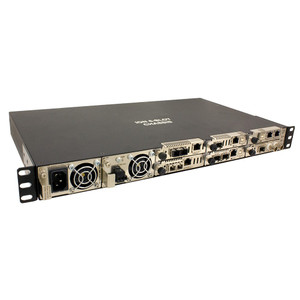
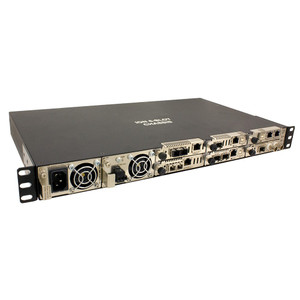
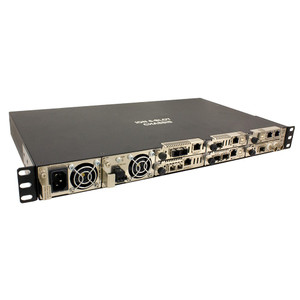
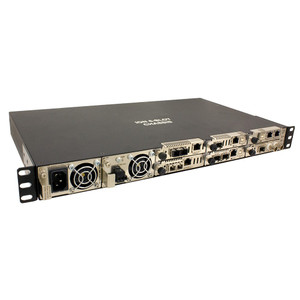
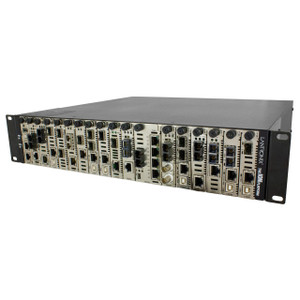
Transition Networks ION106-A-NA 6-Slot Modular Chassis
Overview
The Transition Networks ION106-A-NA is a 6-slot rackmount chassis purpose-built for fiber-based network backbones in security operations centers, industrial facilities, and distributed surveillance deployments. This unmanaged platform supports single-mode fiber connectivity across up to 24 ports operating at 10 Gigabit speeds, delivering the throughput required for multi-camera or multi-sensor installations without configuration overhead. The integrated single AC power supply (ACPS) simplifies provisioning in control rooms and telecom rack environments where power distribution is already standardized.
The ION106-A-NA (often searched as ION106 A NA) accepts interchangeable line cards, making it well-suited for integrators who need to customize port counts and fiber types on a per-deployment basis—a real advantage when you're building backbone networks for different facility layouts without maintaining multiple SKUs in inventory.
Key Features
- 6-Slot Modular Architecture: Accepts compatible line cards, so you configure exactly the port count and fiber type your installation requires. This modularity means you're not overprovisioning unused ports or undercutting your throughput.
- Up to 24 Ports at 10 Gbps: Single-mode fiber connectivity scales from two-camera remote sites to large campus backbones. 10G capacity ensures latency-free, real-time video transport even when aggregating multiple camera streams or integrating third-party sensors.
- Unmanaged Operation: No SNMP, no VLAN tagging, no spanning-tree protocols to configure. Point-to-point or ring topology deployments work out of the box—critical when you need fast commissioning and cannot afford configuration delays on-site.
- Single-Mode Fiber Support: Single-mode fiber spans distances up to 10+ km without repeaters, enabling remote surveillance outposts, perimeter monitoring, and distributed industrial networks where copper PoE runs are impractical. Eliminates EMI/RFI immunity concerns in harsh electrical environments.
- DIN Rail Mounting: Fits standard control-room equipment racks and wall-mounted DIN rails, reducing the need for custom cable trays or separate power distribution panels. Simplifies integration into existing automation and security infrastructure.
- Compact Single AC Power Supply: Integrated ACPS removes external power supply dependencies—no separate PSU cable management, no redundant power module negotiation. Suitable for installations where line power is already protected by UPS or generator backup.
Integration and Deployment Context
The ION106-A-NA integrates directly into network switch infrastructure, serving as a dedicated fiber aggregation point for IP cameras, access control systems, and industrial IoT devices in environments where twisted-pair copper carries PoE to cameras and fiber carries video upstream to the data center. This architecture is common in large campuses, manufacturing plants, and utility facilities where fiber runs isolate surveillance traffic from operational technology (OT) networks.
Unmanaged operation means the ION106-A-NA requires no firmware updates, no management IP, and no SNMP traps—reducing your Security Operations Center (SOC) staffing load. This simplicity is a liability only if you need per-port statistics, QoS enforcement, or dynamic routing; for static backbone rings or point-to-point links, it is an asset.
When to Choose a Different Approach
If your deployment demands managed services—SNMP statistics, VLAN segmentation, or failover monitoring—evaluate managed modular chassis from the Transition Networks portfolio or consider a traditional managed switch with dedicated fiber uplinks. If your site requires PoE power delivery on the same link (converged cabling), the ION106-A-NA is a fiber-only aggregator and must pair with a copper-based PoE distribution switch upstream.
Frequently Asked Questions
Q: Is the ION106-A-NA managed or unmanaged?
A: It is fully unmanaged. No SNMP, no web interface, no CLI. Plug it in, connect line cards, and it forwards traffic. This simplicity suits static backbone deployments but rules it out for environments requiring per-port monitoring or dynamic failover.
Q: Can I mix different line card types in the same ION106-A-NA chassis?
A: Yes. The 6-slot modular design allows different compatible line cards (subject to Transition Networks specifications), so you can combine single-mode and multi-mode fiber modules or different port densities in a single chassis—useful for heterogeneous facilities.
Q: What is the maximum distance I can achieve with single-mode fiber on the ION106-A-NA?
A: Single-mode fiber supported by this chassis typically spans 10–20 km without active repeaters, depending on the specific line card and light-source specifications. Consult the ION106-A-NA datasheet or Transition Networks for exact module reach.
Q: Does the ION106-A-NA require redundant power supplies?
A: The ION106-A-NA includes a single integrated AC power supply. For mission-critical deployments, use UPS or dual AC mains with a manual transfer switch upstream; the chassis itself does not support hot-swappable or redundant PSU modules.
Q: Is the ION106-A-NA DIN-rail mountable?
A: Yes, it supports DIN-rail mounting, making it ideal for control-room enclosures and standardized equipment racks. Verify clearance for cable routing and verify thermal ventilation—fiber chassis generate minimal heat, but airflow is still recommended in enclosed racks.
Q: What is the power consumption of the ION106-A-NA?
A: Exact power draw depends on the installed line cards and operating load. Consult the product datasheet or contact Transition Networks for worst-case and idle-state power specifications.
Ted PerryPerspective based on aggregated IP Security Depot and affiliated engineering team experience.
The Transition Networks ION106-A-NA is a workhorse for facilities that have already committed to single-mode fiber backbone infrastructure. This is not a switch for every deployment—it's a specialist tool. If you're building or extending a fiber ring or point-to-point link in a security or industrial environment, the modular 6-slot architecture and unmanaged simplicity mean you configure once and don't touch it for years.
Technical Highlights:
- 6-Slot Modularity: Populate only the line cards you need—whether that's two 12-port modules or six 4-port single-mode cards. This flexibility beats deploying a fixed 48-port switch when your actual requirement is 12 ports; you save cost, power, and rack space.
- 10 Gbps Full-Duplex Throughput: Single-mode fiber at 10G handles multiple simultaneous H.265 video streams plus metadata and sensor traffic without congestion. Real-world example: a 16-camera 4K installation at 5 Mbps per camera consumes 80 Mbps—leaving headroom for future expansion and burst traffic.
- No Configuration Overhead: Unmanaged operation eliminates firmware patch windows, SNMP trap troubleshooting, and VLAN misconfigurations. In a security deployment, that translates to faster Mean-Time-to-Recovery (MTTR) if a line card fails—just swap it and you're back online.
Deployment Considerations:
- Single AC Power: The integrated ACPS is convenient for standard data-center or control-room racks, but it's a single point of failure. For Tier 1 uptime requirements, provide UPS backup or dual AC feeds with a manual transfer switch upstream. The ION106-A-NA itself cannot switch between power sources automatically.
- Lack of Management Visibility: You cannot SNMP-poll this chassis for port statistics, temperature, or power draw. If your SOC demands real-time health dashboards for every upstream device, the ION106-A-NA will feel like a black box. Budget for optical power-level monitoring equipment at both ends of the link instead.
- Line Card Compatibility: The 6-slot architecture is modular only if compatible line cards exist for your fiber type and port-density requirements. Before ordering, confirm that Transition Networks offers the exact modules you need—modularity doesn't help if the card SKU is discontinued or backordered.
The ION106-A-NA shines in mature perimeter security networks, utility SCADA sites, and multi-building campuses where fiber backbones are already planned and the need for unmanaged simplicity outweighs the desire for real-time management telemetry. It is not a replacement for managed aggregation switches in dynamic environments, but in static fiber topologies it delivers reliable, low-overhead transport that your integration team can install confidently and forget about for five years.