Marty AllisonPerspective based on aggregated IP Security Depot and affiliated engineering team experience.
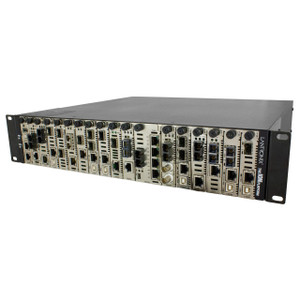
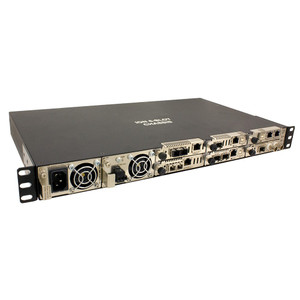
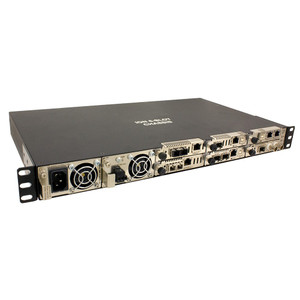
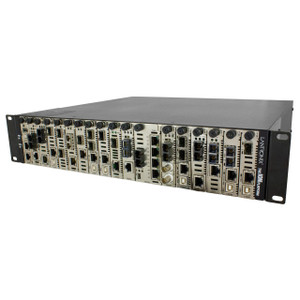
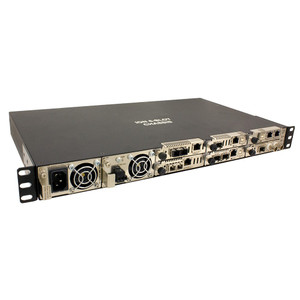
The ION001-A-NA is a specialist product that shines in one specific operational context: multi-site fiber-backbone networks where cabinet space, power budgeting, and distance are all constraints simultaneously. We've deployed these in utility SCADA networks, large-format surveillance campuses (parking lots, perimeter fence lines, building perimeters), and telecom edge nodes where fiber is already the backbone medium. The unmanaged architecture is the selling point — no field technician needs to learn another switching platform, no configuration drift, no firmware patching cycles. For integrators building fiber-fed networks, the ION001-A-NA eliminates the overhead of jamming a managed switch into a cabinet already packed with UPS, breakers, and transceiver modules. Plug fiber, apply power, move on.
The trade-off is obvious: if your network needs VLAN isolation, redundancy, or traffic shaping at the edge, this chassis is not your tool. A managed line card from Transition Networks, Extreme, or Cisco belongs in that role. But if you're aggregating 20 fiber camera drops into a single 10G uplink at a perimeter node, and your only requirement is "pass traffic, don't drop packets", the ION001-A-NA delivers uncluttered simplicity.
Technical Highlights:
- 24x 10G Single-Mode Fiber: Every port operates at full line rate simultaneously — no blocking, no backplane contention. Single-mode fiber reaches 10+ km per link without active repeaters; multi-mode tops out around 400m. For campus-scale deployments, single-mode is non-negotiable, and this chassis commits to it across all 24 ports.
- DIN Rail Mechanical: Mounts to standard 35mm DIN rail with simple bracket hardware. No need for rack shelves, cage nuts, or power distribution units. Fits into electrical enclosures, traffic signal control cabinets, and utility boxes where racks are impractical.
- Unmanaged Switching Fabric: All traffic forwarded at wire rate with zero CPU overhead. No latency creep from management overhead, no packet loss due to SNMP polling, no firmware updates required. Industrial deployments often demand deterministic behavior; unmanaged hardware delivers that.
- External Power Input: Field supply voltage (typically 48 VDC) is standard in remote surveillance and utility networks. No requirement for AC power feed — a game-changer on unmanned tower sites or solar-powered remote nodes where DC power is already present.
- Modular 1-Slot Chassis: Current configuration uses one card for 24 ports; future Transition Networks cards may occupy the remaining slots without replacing the entire chassis. Scalability path built in.
Deployment Considerations:
- Single-mode fiber connectors (typically LC or SC) require careful field termination or factory-installed pigtails; don't plan on hot-swapping fiber connectors on-site without proper fusion-splice equipment or pre-terminated patch cables. Budget installation labor accordingly.
- Unmanaged operation means no SNMP polling, no web interface, and no visibility into port statistics. If port-level troubleshooting becomes necessary, you'll rely on fiber power meters and manual link testing — consider managed aggregation elsewhere in your topology if full visibility is required.
- External power input requires a regulated field supply; verify voltage and current specs from the datasheet before connecting non-standard power architectures. Transient over-voltage on unstable solar or generator feeds can damage the internal power module.
- The 1-slot form factor is compact but inflexible within a single chassis. If expansion or redundancy is needed later, plan for a second ION001-A-NA or a larger managed platform — no in-place upgrade path on this model.
- DIN rail mounting assumes available 35mm rail in your cabinet. Verify clearance for fiber jumpers exiting the rear connectors before installation — tight cable management can impair fiber bend-radius limits and introduce signal loss.
The ION001-A-NA is purpose-built for integrators and site engineers deploying fiber-fed edge networks in industrial, utility, and large-scale surveillance environments where simplicity and distance overcome the need for managed switching features. If that matches your topology, this is a bulletproof choice with lifetime warranty backing. For further exploration of Transition Networks' ION ecosystem and modular switch options, visit the Transition Networks catalog.