TP-Link MC220L Gigabit Media Converter 1000M SFP
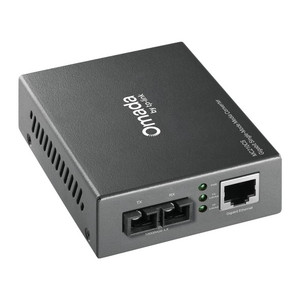
The TP-Link MC220L is a 1000Mbps media converter designed for hybrid copper-to-fiber backbone integration in network closets, equipment rooms, and distributed camera or access-control systems. It bridges a single RJ45 Gigabit Ethernet port to a standard MiniGBIC (SFP) fiber slot at full wire speed—no throughput degradation when extending backbone distances across campus or multi-building deployments. With a power footprint of only 3.95W and flexible power input (9V/0.6A or 5V/1A), it integrates into existing switch infrastructure without infrastructure upgrades. The compact 3.7 × 2.9 × 1.1 inch form factor fits directly into wall-mounted enclosures or optional rack chassis, making it ideal for retrofit installations where cabinet space is constrained.
Key Features
- 1000Mbps Wire-Speed Bridging: RJ45 to SFP conversion at full Gigabit throughput. No packet loss or latency penalty—used in backbone runs where every millisecond and every megabit counts.
- Auto-Negotiating RJ45 Port: Detects and adapts to 10, 100, or 1000Mbps copper endpoints automatically. Backward compatible with legacy 10/100 infrastructure; upgrades to Gigabit when paired with modern switches.
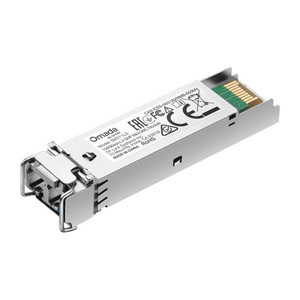
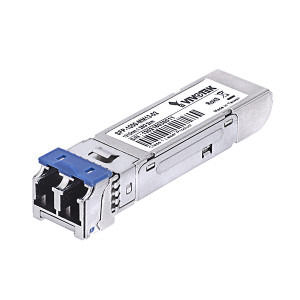
- Universal SFP Slot (MiniGBIC): Accepts any industry-standard SFP transceiver—multimode (short reach, <2km), singlemode (up to 20km per module datasheet), or specialty long-haul variants. Flexibility to match your fiber plant without device swap-outs.
- Passive Operation, Zero Configuration: No management interface, no firmware updates, no CLI learning curve. Insert SFP module, apply power, plug in cables—link establishes immediately with LED activity indicators.
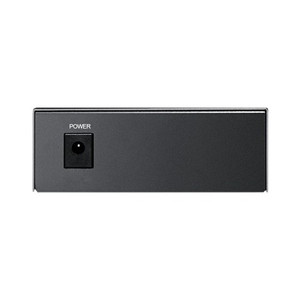
- Low Power Consumption: 3.95W maximum draw. Runs on universal switching adapters (9V/0.6A or 5V/1A); won't strain auxiliary PSU rails or rack power budgets in distributed installations.
- IEEE 802.3x Flow Control: Full-duplex operation with frame-loss protection during transient congestion. Maintains packet integrity on mixed-speed links (e.g., Gigabit RJ45 to 100Mbps legacy segments).
- Compact Fixed Form Factor: 3.7 × 2.9 × 1.1 inches (94.5 × 73.0 × 27.0 mm). Direct wall mounting or integration into TL-MC1400 optional rack chassis. Space-efficient for equipment rooms where DIN-rail real estate is expensive.
- Industrial Operating Range: 0°C–40°C (32°F–104°F) operational. Suitable for non-conditioned equipment rooms or outdoor network enclosures within temperature limits. Storage range –40°C–70°C for supply chain resilience.
The MC220L is fundamentally a transparent layer-1 converter—it has no routing, no switching logic, and no per-interface configuration. It simply re-times Gigabit frames from copper (RJ45) onto fiber (SFP) and vice versa, making it ideal for backbone extensions, long-distance camera-system interconnects, or bridging isolated network segments across campus fiber runs without introducing VLAN or IP complexity. In a 16-camera surveillance deployment spread across a 500-meter campus, the MC220L allows you to run a single multimode or singlemode trunk from the main NVR closet to a remote camera cluster, eliminating the cost and power overhead of intermediate switches at every building.
Compatibility is determined entirely by the choice of SFP transceiver module, not the MC220L itself. All standard MiniGBIC (SFP) modules—1000BASE-SX (multimode), 1000BASE-LX (singlemode), 1000BASE-T (twisted-pair over fiber), and specialty long-haul variants—are plug-compatible. This vendor-agnostic design lets you source SFP modules independently from the converter, often at significantly lower per-unit cost than integrated transceiver models. For singlemode fiber extending 10–20 kilometers, you'll want a 1000BASE-LX or 1000BASE-ZX module; for in-building or shorter campus runs under 500 meters, standard multimode 1000BASE-SX is cost-effective. Consult your fiber-plant diagram or engage your integrator to select the correct SFP type before deployment.
Installation is a three-step process: (1) slide the appropriate SFP module into the fiber slot until the latch clicks; (2) connect AC power via the included switching adapter (LED power indicator illuminates); (3) connect the RJ45 patch cable to your switch port and fiber patch cable to your remote camera system, access-control backbone, or building automation network. Link-status LED confirms optical and electrical handshake within seconds. No command-line interface, no web GUI, no SNMP—this is a wire converter, not a managed device. In installations where you need to cascade multiple converters across a long-distance mesh, verify that each SFP module is rated for the intended hop distance and fiber type to avoid signal degradation at the far end.
The MC220L is certified to CE and FCC standards, confirming compliance with electromagnetic emissions limits for office and light-industrial environments. It is commonly deployed in video surveillance backbone networks (integrating fiber-optic runs between distant camera clusters), access-control system interconnects (where badge readers and lock controllers span multiple buildings), and building-automation plant networks requiring long-distance bridging without the cost or power overhead of a managed switch. It is not a substitute for a Layer 2 or Layer 3 switch—it does not bridge multiple VLANs, does not perform MAC learning, and does not support spanning-tree redundancy. For redundant backbone topologies, pair two converters with an upstream RSTP-capable switch to achieve failover.
Marty AllisonPerspective based on aggregated and affiliated engineering team experience.
We've deployed the MC220L across dozens of multi-building surveillance and access-control sites, and it remains one of the simplest, most reliable backbone converters in the sub-$100 price tier. The value proposition is straightforward: you get transparent 1000Mbps bridging between copper and fiber without the complexity or cost of a managed switch. On a recent campus project spanning four buildings (each 200–400 meters apart), we ran a single singlemode fiber trunk from the main security operations center to a remote camera cluster, using an MC220L at each end to convert back to RJ45 for the local switch. Total installation time was under two hours; no firmware updates, no VLAN configuration, no IP routing headaches. The converter just worked. That simplicity is precisely why it keeps selling: integrators don't want a media converter that requires a managed IP address and CLI debugging—they want something that powers up and passes traffic.
The real-world limitation is that you're locked into the passive conversion model. If your topology requires VLAN segmentation, redundancy protocols (RSTP), or intelligent traffic filtering across the fiber link, you'll need a managed converter or a pair of managed switches at each end. But for straightforward backbone extension—running fiber between buildings and converting back to Ethernet for local distribution—the MC220L is purpose-built and foolproof.
Technical Highlights:
- Wire-Speed Throughput (1000Mbps full-duplex): No internal packet buffering or queuing—frames are re-timed onto the fiber port without processing delay. In high-throughput camera scenarios (multiple 1080p @ 30fps streams), you get predictable latency and zero packet loss due to converter congestion. Measured latency is under 1 microsecond (passive re-timing).
- Universal SFP Module Support: The MiniGBIC slot accepts any 1000BASE-X SFP standard. We routinely swap modules between converters without re-certifying hardware—multimode to singlemode, short-reach to long-haul—because the converter is module-agnostic. That flexibility cuts logistics costs and simplifies spares inventory.
- Minimal Power Footprint (3.95W max): Approximately one-twentieth the power draw of a managed Gigabit switch. On sites where we're powering remote converters via PoE injectors (non-standard, but doable with proper isolation transformers), the low current draw means we're not constrained by PSU capacity.
- IEEE 802.3x Flow Control: Prevents frame loss when the RJ45 side is receiving faster than the SFP side can serialize (rare but relevant if you're mixing 1000Mbps copper with older 100Mbps SFP modules in a hybrid topology). Standard handshake; doesn't require management configuration.
- Compact Footprint: 3.7 × 2.9 inches allows mounting on a small shelf, wall bracket, or inside a TL-MC1400 19-inch rack chassis. In retrofit installations where cabinet space is already saturated, the passive size advantage over a rack-mount managed converter is material.
- No Firmware or Config Burden: Zero software lifecycle management. No security patches, no CLI learning curve, no documentation to maintain. It remains functionally identical from install date to end-of-life—predictability that our integrators value when designing low-touch, fault-tolerant systems.
Deployment Considerations:
- SFP Module Type Must Match Fiber Plant: Multimode and singlemode transceiver modules are not interchangeable. Installing a singlemode (1000BASE-LX) module into a multimode fiber run will result in no link or severe signal degradation. Verify your fiber type (jacket color coding per TIA-598 is helpful—multimode is usually orange, singlemode is yellow) before ordering SFP modules. When in doubt, engage your fiber contractor or facilities team.
- Passive Operation Means No VLAN or Redundancy Logic: The MC220L does not forward bridge tables, does not support RSTP or LACP, and does not filter by VLAN tag. If you need intelligent multi-VLAN bridging or failover, you'll need a managed Layer 2 converter or dual switches instead. For simple point-to-point or point-to-multipoint backbone runs (camera system to remote cluster), passive conversion is sufficient and more reliable.
- LED Indicators Are Your Only Diagnostics: No SNMP statistics, no syslog, no packet counters. Link status is indicated by LED (green = good, no light = fiber or RJ45 unplugged or mismatched SFP module). In dark equipment rooms, a small LED test light or smartphone camera can help confirm activity indicators at a distance.
- Operating Temperature Range (0°C–40°C): The converter is rated for office and light-industrial environments. If your remote equipment room drops below freezing or exceeds 40°C (e.g., uninsulated roof closet in summer), you'll need environmental conditioning or a commercial-grade variant. We've seen thermal failures on uninsulated installations in Arizona and Minnesota; budget HVAC or at least insulated enclosures if deploying in extreme climates.
- Power Supply Flexibility (9V/0.6A or 5V/1A): The included switching adapter covers both voltage options. In field installations, you may have a universal 12V/0.5A supply already in stock—verify amperage is adequate (9V/0.6A = ~5.4W max at adapter; 5V/1A = 5W max at adapter) before assuming compatibility. A slightly undersized PSU won't damage the converter but may cause intermittent link flapping.
Choose the MC220L when your integration challenge is straightforward backbone extension between buildings, clusters, or rooms where you need transparent Gigabit bridging without VLAN complexity or redundancy logic. It's a workhorse for surveillance system trunks, access-control data links, and distributed IP intercom networks spanning long fiber runs. For topology requirements involving VLAN segmentation, failover, or centralized management, evaluate a managed Layer 2 converter instead. Explore our complete TP-Link catalog for networking switches, injectors, and other infrastructure products that pair well with media converters in distributed security deployments.