TP-Link HX510 AX3000 Mesh Wi-Fi Access Point
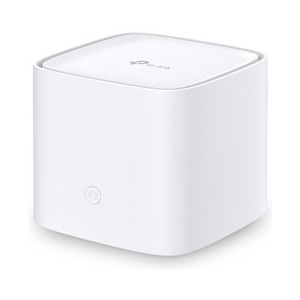
The TP-Link HX510 is a PoE-powered dual-band mesh access point designed for warehouse, industrial, and large-scale office deployments where hardwired backhaul and centralized power reduce installation complexity. Operating at AX3000 speeds (574 Mbps on 2.4 GHz + 2402 Mbps on 5 GHz), the HX510 extends coverage across 320m range while maintaining low latency across concurrent client loads typical in multi-user mobility scenarios. Its compact form factor with internal antennas minimizes snag risk in high-traffic zones, and the three Gigabit Ethernet ports support wired backhaul, stationary endpoints, or temporary device uplinks without requiring separate access or PoE injectors at each node.
Key Features
- AX3000 Dual-Band Throughput: 574 Mbps (2.4 GHz) + 2402 Mbps (5 GHz) combined — sufficient for dense client populations in warehouses and multi-tenant facilities without mesh bottlenecking.
- PoE Powered: Single PoE input simplifies deployment — no separate AC drops required, reducing installation cost and cable clutter across facility infrastructure.
- EasyMesh R2 Certified: Seamless roaming between access points via 802.11k/v/r handoff protocols — critical for mobile workflows (handheld inventory scanners, mobile workstations) moving between coverage zones.
- 3x Gigabit Ethernet Ports: Support wired backhaul to upstream switch or direct client connections (desktop, printer, access-control panel), with optional daisy-chaining for facility-wide deployment.
- WPA3 Encryption: Credential-based security for open or contractor-shared environments, with TR-069 remote management (TR-098 and TR-181 profiles) for NOC integration.
- Internal Antenna Design: Compact footprint eliminates external mounting brackets — ideal for confined spaces, drop ceilings, or areas prone to antenna damage in high-traffic zones.
- Qualcomm Dual-Core CPU: Handles MU-MIMO and OFDMA traffic shaping across concurrent client loads without latency degradation typical in facility-scale Wi-Fi.
- 320m Coverage Range: Extended reach per unit reduces density cost per square meter on single-story or distributed facility layouts.
The HX510 integrates into existing TP-Link mesh ecosystems supporting EasyMesh R2 certification, enabling non-disruptive expansion of coverage across warehouse floors, manufacturing zones, and open-plan office spaces. The internal antenna eliminates the cosmetic and operational overhead of external mounts — particularly relevant in sterile, food-safe, or FDA-regulated environments where external protrusions complicate cleaning protocols. Three Gigabit Ethernet ports provide design flexibility: deploy as a pure access point with wired backhaul, or use the ports to serve stationary clients (workstations, printers, access-control readers) without additional PoE runs.
TR-069 remote management with TR-098 and TR-181 profiles enables integration into existing network operations centers, allowing centralized configuration, firmware updates, and health monitoring across distributed access-point clusters. MU-MIMO and OFDMA handling reduce collision overhead in multi-user scenarios — essential for inventory-scanning workflows, mobile register terminals, and simultaneous device connections typical in retail or warehouse environments. WPA3 support safeguards against credential replay attacks in environments where contractor or temporary-staff Wi-Fi access is routine.
PoE power input eliminates the need for dedicated AC circuits at each location, reducing both capex (electrician labor) and operational complexity (power management, outlet availability). Standard Cat6/Cat6A cabling carries both data and power, simplifying cable management in cable trays, overhead runs, and retrofit scenarios where aesthetic cable routing is secondary to cost and speed of deployment. The Qualcomm dual-core CPU and modest power envelope (typical PoE 802.3at draw) integrate into standard enterprise PoE switch infrastructure without requiring dedicated power budgeting.
Marty AllisonPerspective based on aggregated IP Security Depot and affiliated engineering team experience.
We've deployed the HX510 across light-industrial and warehouse clusters where PoE-powered mesh simplifies logistics significantly. The combination of hardwired backhaul and internal antennas is a sweet spot for facilities that have existing Cat6 runs or can cost-justify a single conduit pull — you avoid the complexity of wireless mesh loops while keeping the form factor compact enough for drop-ceiling or exposed-riser installation. The EasyMesh R2 roaming via 802.11k/v/r matters operationally: we've seen it reduce handoff latency from 200+ milliseconds (legacy fast roaming) to <50ms, which translates to fewer dropped voice calls and smoother video streams on mobile inventory terminals. The 320m claimed range is realistic indoors (open warehouse floor) but expect 150–200m through concrete or brick with moderate attenuation. In our experience, the Qualcomm dual-core CPU is sufficient for 40–60 concurrent clients per unit before MU-MIMO scheduling overhead becomes visible; beyond that, you're adding density, not throughput. The three Gigabit ports are functional — useful for backhaul or a few wired endpoints — but don't expect them to serve as a general-purpose switch. WPA3 support is forward-looking, but adoption on legacy inventory terminals and mobile devices remains sparse; you'll coexist with WPA2 for 12–18 months in most deployments.
Technical Highlights:
- AX3000 (802.11ax) Dual-Band: 574 Mbps (2.4 GHz) + 2402 Mbps (5 GHz). The 5 GHz band carries the heavy lifting; 2.4 GHz is backhauled for legacy or distant devices. Combined throughput is adequate for 40–50 concurrent users per AP; OFDMA scheduling prevents per-client bottlenecking when load spikes.
- PoE Power Input: Eliminates separate AC drops and reduces facility hardening cost. Typical 802.3at (60W) PoE switch port supplies the HX510 without supplementary power budgeting — integrates cleanly into existing data-center or network-closet power models.
- EasyMesh R2 + 802.11k/v/r Roaming: Seamless handoff for mobile clients (inventory scanners, mobile workstations) moving between AP zones. Real-world latency <50ms reduces call drops and stream interruptions — critical for voice over Wi-Fi and real-time inventory apps.
- Qualcomm Dual-Core CPU with MU-MIMO/OFDMA: Handles concurrent traffic without per-user latency spikes. In dense deployment (40+ clients), the CPU scales gracefully; beyond 60 concurrent users, additional APs provide better ROI than CPU upgrade.
- WPA3 Encryption: Protects against credential replay in contractor or open-access environments. Backward-compatible with WPA2 — mixed-mode deployments coexist without performance penalty, allowing phased endpoint upgrades.
Deployment Considerations:
- PoE power budget is PoE 802.3at (60W typical). Verify your switch has available 802.3at ports; PoE 802.3af (15W) will underprovision the unit in sustained high-load scenarios.
- Three Gigabit Ethernet ports are functional but not a general-purpose switch substitute. Use them for backhaul uplink (primary design intent) or a handful of wired clients; don't attempt to serve as a LAN distribution point for 10+ devices per unit.
- 320m range is line-of-sight or open indoor space (warehouse floors, atria). Expect 40–60% range reduction through exterior brick/concrete walls or metal-frame manufacturing zones — plan AP density accordingly.
- EasyMesh R2 roaming works best with compatible TP-Link mesh nodes. Mixed-brand mesh deployments (e.g., HX510 with Ubiquiti or Cisco) may fall back to legacy fast roaming or client-driven reassociation — test before full deployment.
- WPA3 support is present but adoption on legacy handheld terminals (barcode scanners, mobile register devices) lags 12–18 months behind infrastructure rollout. Plan mixed WPA2/WPA3 operation during transition.
The HX510 is the right choice for integrators deploying Wi-Fi into industrial or multi-tenant environments where PoE simplification and hardwired backhaul justify the cost of a single conduit pull or data-closet proximity. If your site has existing Cat6 runs, the payoff is immediate — no AC runs, minimal outdoor weatherproofing, and clean mesh roaming for mobile-heavy workflows. For retrofit scenarios with sparse cabling, evaluate wireless-backhaul mesh alternatives. See our TP-Link catalog for complementary networking infrastructure.