TP-Link EAP690E HD Quad-Band Wi-Fi 6E Access Point
Overview
The TP-Link EAP690E HD is an AXE11000 quad-band Wi-Fi 6E ceiling-mount access point engineered for high-density enterprise deployments. Built around a single 10Gbps Ethernet port and quad-band architecture (2.4 GHz, 5 GHz-1, 5 GHz-2, 6 GHz), this unit delivers 11 Gbps aggregate throughput across four bands while handling 2000+ simultaneous wireless clients — the spec to focus on if you're deploying across multi-floor office buildings, hospitality venues, or hybrid retail environments where client density exceeds traditional dual-band limits.
Key Features
- 10Gbps Ethernet uplink: Single RJ45 port eliminates bottleneck risk on backhaul — full AXE11000 throughput reaches your network infrastructure without capping at multi-gig speeds. Matters most in campus environments where multiple APs feed into a core switch.
- 802.3bt PoE++ or 12V/4.5A DC: Powers the EAP690E HD from standard PoE infrastructure (50.5W max in US, full 6 GHz band active) or standalone 12V supply. 802.3bt eliminates the need for separate midspan injectors on newer switches — one cable delivers both data and power to ceiling locations.
- Quad-band spectrum (2.4 GHz + 5 GHz-1 + 5 GHz-2 + 6 GHz): Total rated speed 1148 Mbps (2.4 GHz) + 2402 Mbps (5 GHz-1) + 2402 Mbps (5 GHz-2) + 4804 Mbps (6 GHz). The 6 GHz band alone carries nearly 5 Gbps, useful for offloading congestion away from legacy 5 GHz clients — 6E-capable devices see lower contention, latency drops on fast SSIDs.
- 2000+ client capacity: Hardware and firmware designed to service thousands of associated devices simultaneously. Avoids the throughput collapse seen in dual-band APs when client count exceeds 500–800 in high-density venues.
- Smart antenna system with beamforming and MU-MIMO: Four internal antennas per band (4.0–5.5 dBi depending on band) apply transmit beamforming and multi-user MIMO to steer signals toward active clients. Reduces wasted air time and improves signal-to-noise ratio in crowded RF environments — real benefit where you have dense seating, cubicle farms, or concurrent video calls.
- 802.11ax Wi-Fi 6 and 6E (802.11be ready with firmware): Supports full IEEE 802.11a/b/g/n/ac/ax suite, ensuring backward compatibility with older devices while native Wi-Fi 6 features like OFDMA and spatial reuse lower latency for 802.11ax clients. 6 GHz spectrum on compatible endpoints removes interference from congested 2.4 and 5 GHz bands entirely.
- Seamless roaming and band steering: Built-in roaming logic and band steering automatically move clients to the least-congested band as they move through coverage. Client doesn't drop connection during transitions between APs — important in venues with users on mobile carts, wheelchairs, or walking through spaces during calls.
- Load balancing and airtime fairness: Prevents fast clients from hogging radio time at the expense of slower ones. Distributes air time fairly based on SSID and client capability — crucial when mixing Wi-Fi 6 laptops with older Wi-Fi 5 tablets on the same network.
- Centralized Omada SDN management: Controller-based provisioning, captive portal, MAC filtering, VLAN isolation, and wireless mesh support. Web, SSH, and SNMP interfaces allow integration with existing network monitoring. 32 SSIDs (8 per band) enable segmentation by floor, department, or guest access tier.
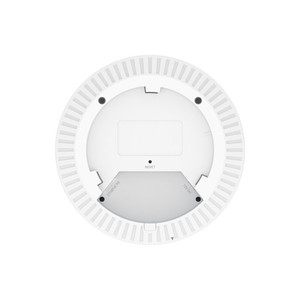
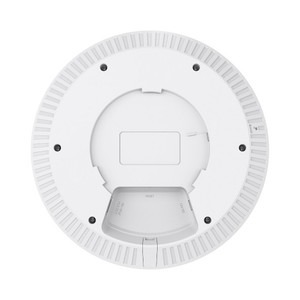
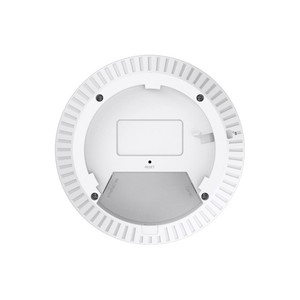
- Wired ceiling mount with included kits: Compact 280 × 280 × 59.1 mm form factor fits standard ceiling tiles. Wall-mount hardware included — drops into existing drop ceilings without custom fabrication.
- WPA3 and enterprise encryption: Supports WPA-Personal/Enterprise, WPA2-Personal/Enterprise, WPA3-Personal/Enterprise, and Opportunistic Wireless Encryption (OWE). 802.1X allows RADIUS-backed credential validation — integrates with Active Directory or enterprise identity systems without extra appliances.
Integration and Compatibility
The EAP690E HD integrates with the TP-Link Omada SDN Controller (hardware or software) for centralized management across multiple sites. Web-based configuration, SNMP v1/v2c/v3 traps, and SSH access allow integration with network monitoring systems. The unit supports static IP or dynamic DHCP provisioning, email alerts, and scheduled reboot/radio enable/disable — fits into change control workflows for enterprise network teams. Firmware updates via web interface. 802.1X RADIUS and MAC authentication enable device-level or user-level access control integration with existing directory services.
Wireless Performance and Coverage
Maximum data rates per band range from 8 Mbps (MCS0, lowest modulation) to full rate depending on modulation and channel width. The 6 GHz band achieves up to 4804 Mbps using 160 MHz channels (MCS0–MCS11, NSS 1–4 in HE20/40/80/160 modes). Actual real-world throughput depends heavily on client capability, distance, and interference — 6E devices see near line-rate performance on short-range backhauls, while legacy 802.11g clients on the 2.4 GHz band will see 54 Mbps maximum. Transmit power varies by region (CE: <20 dBm on 2.4 GHz, <23 dBm on 5 GHz band 3, <30 dBm on 6 GHz; FCC: <28 dBm on 2.4 GHz, <25 dBm on 6 GHz).
Power Consumption and Environmental Considerations
Power draw scales with band usage: 44.9W (802.3bt, full functionality, EU); 25.5W (802.3at mode, 5 GHz-2 and 6 GHz disabled). Minimum power with radio off is 12.95W (802.3af, LAN only). This matters for PoE switch budgeting — a 48-port 802.3bt switch with 1440W budget can power roughly 30 EAP690E HD units at full power. Operating temperature range 0–40°C (32–104°F) fits indoor commercial buildings; storage to −40°C. Operating humidity 10–90% non-condensing supports data centers, warehouses, and temperature-controlled retail spaces. CE, FCC, RoHS, and IC certifications confirm regional compliance.
What's in the Box
Ceiling and wall mounting kits are included with the EAP690E HD. Check your purchase documentation or contact support for exact kit contents (typically includes ceiling clips, wall brackets, and hardware fasteners).
Frequently Asked Questions
Q: Can the EAP690E HD handle 2000+ clients without significant throughput degradation?
A: The unit is rated for 2000+ client capacity with quad-band architecture and MU-MIMO. Real performance depends on client distribution across bands, application type (light web browsing vs. video streaming), and backhaul capacity. A single 10G uplink is sufficient backhaul for typical enterprise loads, but high-bandwidth scenarios (e.g., simultaneous video conferencing for 500+ users) require oversizing or mesh extensions.
Q: What's the difference between using 802.3bt PoE++ and a 12V DC supply?
A: 802.3bt PoE++ powers the unit from a PoE++ switch and eliminates the need for separate DC supply cabling to the ceiling. A 12V/4.5A DC supply is useful if your ceiling location doesn't have PoE access or if you're upgrading older non-PoE infrastructure. Both deliver the same performance; choose based on available infrastructure.
Q: Does the EAP690E HD support 160 MHz channel widths on all bands?
A: Yes — the 6 GHz band supports 160 MHz channels natively, and 5 GHz bands support 80 MHz channels with 160 MHz available in some regions (check local regulations). The 2.4 GHz band supports up to 40 MHz channels. Wider channels increase peak throughput for capable clients but increase interference risk in crowded RF environments.
Q: Can I integrate the EAP690E HD with non-TP-Link network switches or security appliances?
A: Yes. The AP supports standard protocols: SNMP v1/v2c/v3, SSH, 802.1X RADIUS, VLAN tagging, and DHCP. It integrates with any enterprise management system that consumes SNMP traps or polls via standard REST/web APIs. The Omada Controller is optional — you can manage the AP standalone via web interface for smaller deployments.
Q: What wireless standards does the EAP690E HD support?
A: Full legacy support for 802.11a/b/g/n/ac plus native 802.11ax (Wi-Fi 6) on all bands and 802.11be (Wi-Fi 7) on 6 GHz with firmware update. Older devices (802.11g, 802.11n) remain associated and function on their respective bands — no forced upgrade required.
Q: Is the EAP690E HD NDAA Section 889 compliant?
A: TP-Link products generally fall outside NDAA Section 889 restrictions (the rule targets certain Chinese-origin equipment). Verify current status with TP-Link or your procurement team — compliance status can change based on component sourcing. When in doubt, request a formal NDAA certification letter.
The EAP690E HD addresses a real gap in enterprise wireless density — if you're running a multi-floor office, hospitality property, or high-traffic retail environment and your legacy dual-band APs are choking at 500–800 simultaneous clients, the quad-band architecture and 2000+ client capacity on the EAP690E HD is a measurable upgrade. The 10G uplink eliminates backhaul as a bottleneck, and 802.3bt PoE++ power means you're not running extra cabling to ceiling locations.
Technical Highlights:
- 10Gbps Ethernet port: Delivers full AXE11000 throughput (11 Gbps aggregate across four bands) to your core network without capping at 2.5G or 5G multi-gig limits. Matters in campus deployments where each floor may have 4–6 APs feeding into a single core switch.
- Quad-band spectrum with 6 GHz (4804 Mbps band rate): The 6 GHz band alone carries nearly 5 Gbps and removes interference pressure from legacy 5 GHz clients. Wi-Fi 6E devices see measurably lower contention — real improvement for video conferencing and large file transfers on compatible endpoints.
- 802.3bt PoE++ (50.5W max, US): Powers full functionality including all four bands active from standard PoE infrastructure on modern switches. Eliminates separate 12V supply runs to ceiling — one cable does data and power, reduces installation time and recurring cable management headaches.
- MU-MIMO and beamforming across four bands: Smart antenna system with 4–5.5 dBi internal antennas per band directs transmit power toward active clients, not empty space. Reduces wasted air time in crowded venues and improves signal quality for clients at range.
Deployment Considerations:
- A single 10G uplink is sufficient backhaul for typical enterprise loads, but if you're planning 50+ APs in a large campus, verify your core switch has enough 10G ports or multi-gig uplinking — don't create a different bottleneck at aggregation.
- 6 GHz band availability depends on client device support — Wi-Fi 6E capability is still uncommon in legacy laptops and older handsets. On-board measurement (band steering, load balancing) helps, but expect legacy 802.11ac clients to remain on 5 GHz even with band steering active.
- Power consumption at full functionality (50.5W, US) is non-trivial — confirm your PoE switch budget before deploying 30+ units across a building. Fallback to 12V DC or power budgeting by disabling bands (e.g., 5 GHz-2 and 6 GHz off = 25.5W) if needed.
- Omada Controller is optional but recommended for more than 5 APs — centralized provisioning, roaming optimization, and firmware updates across a fleet is worth the operational overhead in multi-building deployments.
Position the EAP690E HD for high-density hospitality, corporate campuses, or healthcare networks where client density exceeds 500 per AP and you need native 6 GHz offload for latency-sensitive applications (telemedicine, VoIP, video conferencing). Skip this model if your deployment is single-story retail or SMB environments with <200 concurrent clients — a standard dual-band AP does the job at lower cost.