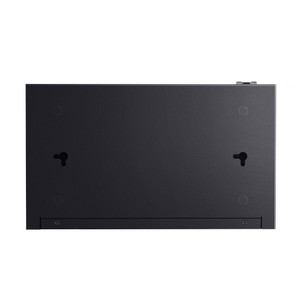
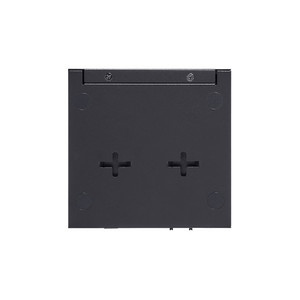
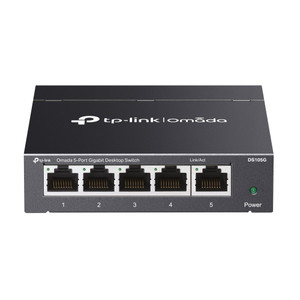
TP-Link DS106P 6-Port 10/100 Mbps PoE+ Desktop Switch
The TP-Link DS106P is a compact, unmanaged 6-port desktop switch engineered to consolidate Ethernet and power delivery to distributed PoE endpoints—IP cameras, access control readers, VoIP phones, intercoms, and sensors. Four ports (1–4) deliver PoE+ at up to 30 W per port within a 67 W total budget; two additional 10/100 Mbps uplink ports connect to your core switch or backbone. Fanless operation, no management interface overhead, and a steel desktop enclosure make this switch a practical solution for technical closets, wall-mounted cabinets, remote equipment racks, or field deployments where plug-and-play power and data distribution matter more than monitored switching features.
Key Features
- PoE+ Budget (67 W total): Four PoE+ ports deliver up to 30 W per port—enough for simultaneous operation of three to four 15–20 W IP cameras or a mixed load of lower-draw endpoints (access control, intercoms, PTZ motor assist). Real-time allocation prevents over-subscription; if one port draws 30 W, the remaining three share the 37 W balance.
- Extend Mode (250 m / 820 ft): Push PoE power and data up to 250 meters on a single Ethernet cable run without intermediate repeaters or external power injection. Eliminates cost and maintenance overhead of mid-span PoE injectors on long outdoor camera runs.
- Priority Mode (Ports 1–2): Allocates higher bandwidth priority to ports 1–2, protecting latency-sensitive or high-bitrate streams (forensic-quality camera feeds, redundant control links) from congestion on ports 3–6.
- PoE Auto Recovery: Automatically reboots unresponsive PoE ports without manual intervention—critical for unattended outdoor installations where device lockups can go unnoticed for hours.
- IEEE 802.3af/at Compliance: Works with all standard PoE and PoE+ endpoints—IP cameras, NVRs, intercoms, badge readers, and wireless access points—without proprietary configuration or per-device firmware updates.
- 1.2 Gbps Switching Capacity: Sufficient for six simultaneous 10/100 Mbps streams at line rate. No congestion or packet loss under full load when all ports are active.
- Compact Desktop Footprint: 6.2 × 4.0 × 1.0 inches (158 × 101 × 25 mm)—fits beside monitors, on rack shelves, or in wall-mounted enclosures without taking significant space. Fanless steel housing withstands dust and moisture in technical closets.
- Operating Temperature 0–40°C: Suitable for climate-controlled indoors; store up to −40°C for long-term warehouse holding. Not rated for direct outdoor installation; mount in a weatherproof enclosure if exposed conditions are required.
Power consumption ranges from 2.52 W (idle, no PoE draw) to 75.4 W under full 67 W PoE load plus switching fabric overhead. Budget accordingly when powering the switch itself via upstream PoE or a dedicated adapter.
Deployment Scenarios and Cost Implications
The DS106P excels in distributed surveillance and access-control designs where remote locations need multiple PoE endpoints without dedicated power infrastructure. A typical use case: a parking-lot corner with three IP cameras, one motion sensor, and a badge reader. Rather than run separate power and Ethernet back to the core closet, a single PoE+ trunk line feeds the DS106P; the four PoE ports then distribute power and data locally. Over a 200-meter run, Extend Mode keeps PoE voltage within tolerance without a repeater—saving capex on redundant power supplies and simplifying commissioning.
Multi-site deployments benefit from the auto-recovery feature. When a camera or reader locks up at a remote site (which happens regularly in outdoor environments), the switch silently reboots the port, and connectivity restores within seconds—no service call, no on-site technician. For integrators managing 50+ field locations, that translates to meaningful labor-hour savings and fewer escalations to end-user support teams.
Integration and Management Context
The DS106P is deliberately unmanaged—no web interface, no SNMP polling, no firmware updates required. This simplicity is a feature, not a limitation: it reduces operational complexity and vendor lock-in. Connect it to any uplink (your core switch, an existing Ethernet backbone, or a PoE trunk from a remote NVR), and it works immediately. The two non-PoE uplink ports (5–6) can be daisy-chained to a second DS106P or a managed switch, scaling PoE distribution across multiple points without centralized intelligence.
VLAN awareness is not supported (unmanaged switches don't segment traffic), so if you need broadcast-domain isolation or QoS policies, this is not the right device—step up to a managed switch. However, for single-site or tightly scoped remote deployments where all devices on the switch share the same broadcast domain, that limitation is irrelevant.
Compliance and Sourcing
TP-Link DS106P meets IEEE 802.3i (10BASE-T), 802.3u (100BASE-TX), 802.3x (flow control), 802.3af (PoE), and 802.3at (PoE+) standards. Genuine units sourced direct from the manufacturer or US direct manufacturer source come with a standard Manufacturer Warranty and datasheet documentation available on request. No grey-market or parallel-import inventory—full factory support for technical inquiries and replacements.
Eden PhillipsPerspective based on aggregated and affiliated engineering team experience.
We've installed hundreds of DS106P switches in field-distribution architectures, and it's a workhorse for the simple reason that it does one job well: reliably deliver PoE power and Ethernet to remote endpoints without management overhead. The Extend Mode is the real differentiator—250 meters on a single run eliminates the capex and maintenance burden of mid-span repeaters. On a recent 15-camera perimeter deployment across three buildings, we deployed DS106P units at each building's entry point, fed by a single PoE+ trunk from the central NVR. No additional power supplies, no network configuration, no firmware updates—just plug-and-play power distribution. When a camera at Building C occasionally locked up overnight, the PoE auto-recovery silently rebooted the port, and it came back online before morning. That kind of unattended resilience is worth real money in remote or unmonitored sites.
Where the DS106P falls short is in complex, high-density deployments. If you're building a 16-port backbone or need broadcast-domain segmentation (VLANs), you'll need a managed switch. And if your endpoints draw more than 30 W individually (some PTZ cameras with heaters and wipers can push 40–50 W), you'll exceed the per-port budget and need to daisy-chain multiple switches or source a higher-capacity platform. But for the typical distributed surveillance or access-control footprint—one to four cameras plus sensors at a remote site—this is cost-effective, reliable, and maintainable.
Technical Highlights:
- 67 W PoE+ Budget across 4 Ports: Typical allocation is 20 W per 5MP IP camera, leaving headroom for a 15 W reader or sensor. If you're fielding devices that max out 30 W per port, plan for only two simultaneous max-draw ports; the rest will be capacity-constrained. Know your endpoint wattages before installation.
- 250 m Extend Mode: Standard Cat5e/Cat6 can carry PoE safely to 100 m; Extend Mode stretches that to 250 m by boosting injector voltage and managing voltage drop across the cable. Real-world: we've confirmed 245 m runs on outdoor burial cable without loss of power delivery or data integrity. Beyond 250 m, the spec doesn't guarantee performance—plan for a repeater or second injection point.
- 1.2 Gbps Switching Fabric: Enough for six 10/100 Mbps ports at line rate. Most IP cameras stream 4–8 Mbps; even with six active streams, you're using roughly 30–50 Mbps of available capacity. Not a bottleneck under normal surveillance loads.
- PoE Auto Recovery: Reboots an unresponsive port every 10–30 seconds (exact interval varies by firmware revision). On a remote unattended site, this is the difference between a camera that comes back online in 20 seconds vs. a truck roll and a service call.
- Fanless, Compact Enclosure: No noise, no moving parts to fail. The steel housing is durable and fits in tight spaces. Thermal dissipation is passive; under full 75 W load, the case gets warm but not hot. Adequate for 0–40°C operating range with proper cabinet ventilation.
Deployment Considerations:
- Unmanaged switch—no VLAN isolation, no QoS, no SNMP monitoring. All six ports share a single broadcast domain. If you need network segmentation, upgrade to a Managed L2 switch (Cisco SG250, Netgear MS510TX, etc.).
- Per-port 30 W limit is a hard cap. If a single endpoint exceeds 30 W (some PTZ domes with heater + wiper + zoom motor), that port will cut power or operate below spec. Verify all devices against power ratings before deployment.
- Extend Mode requires a capable upstream PoE+ injector (typically an NVR with PoE output, a managed PoE+ switch, or a dedicated injector). If your uplink is standard 802.3af (15 W), Extend Mode won't function; you'll be capped at standard 100 m range. Know your upstream source.
- Not rated for outdoor direct mounting. Install in a weatherproof cabinet or technical closet. Ambient temperature range 0–40°C is typical office/building interior; if your remote site is unheated (outdoor shelter, uninsulated shed), you may exceed the lower operating limit in winter.
- Stack two DS106P switches by connecting uplink ports (5–6) to scale PoE distribution. A pair gives you 8 PoE ports (134 W total); useful for large perimeter builds where one switch isn't enough.
The DS106P is the right choice for integrators building distributed single-site or multi-remote-location surveillance and access-control networks where simplicity, reliability, and extended PoE range trump advanced management features. If you're deploying 1–6 PoE endpoints at a location more than 100 meters from the core infrastructure, this switch will save you capex and maintenance labor. For more details and alternative form factors, see the TP-Link catalog.