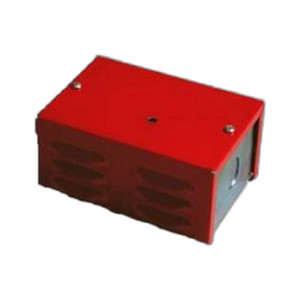
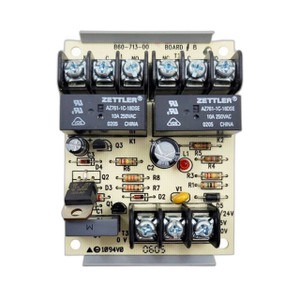
System Sensor EOLR-1 End-of-Line Power Supervision Relay
Overview
The System Sensor EOLR-1 is an end-of-line power supervision relay engineered to detect circuit faults in fire alarm and security system branches where continuous operational status verification is non-negotiable. Deployed at the terminal point of a supervised circuit, the EOLR-1 immediately reports open-circuit or short-circuit conditions to the fire alarm control panel—preventing undetected failures that could compromise life-safety responsiveness. This relay bridges conventional fire alarm architectures and hybrid addressable/conventional system designs, making it applicable across a broad range of retrofit and new-construction installations.
Key Features
- End-of-Line Circuit Supervision: Actively monitors circuit continuity at the branch terminal. An open or short condition—whether caused by wire breakage, connector failure, or component disconnection—triggers an immediate fault signal to the panel. This is critical because undetected opens can mask device failures in downstream detection circuits.
- Power Supervision Capability: Dedicated power monitoring ensures voltage remains within operational tolerance on supervised branches. Power loss or degradation is reported to the panel, alerting technicians to partial system failure before it impacts detector response.
- Conventional and Addressable Compatibility: Works in both conventional (hardwired zone) and hybrid addressable/conventional architectures, reducing the need for separate relay hardware during system upgrades or mixed-technology deployments.
- Relay Contact Output: Standard relay contacts (normally open / normally closed configurable) interface directly with panel input modules, eliminating the need for signal conversion or protocol translation. No software configuration required on the relay itself.
- Compact Form Factor: Space-efficient design suits retrofit installations where panel-adjacent or remote mounting space is constrained. Reduces footprint compared to older modular supervision modules.
- Industry-Standard Wiring: Uses conventional 18–22 AWG branch circuit wiring and panel input module connections. Technicians familiar with hardwired fire alarm systems deploy this with minimal training overhead.
Integration & Compatibility
The EOLR-1 mounts at the end-of-line position on a supervised detection branch and connects to a panel-resident input module that interprets relay state changes. When the relay detects a circuit fault, it signals the module, which reports the condition to the fire alarm control panel via its existing supervision logic. The relay supports both normally open (NO) and normally closed (NC) contact configurations, allowing installers to match the panel's input expectations without adding external logic.
System design must reserve a dedicated panel input for each EOLR-1 relay. Panels with limited addressable input channels may require upgrade to accommodated multiple supervised circuits if retrofit scope is large. Integration with fire alarm system architectures is straightforward because the EOLR-1 operates independently of detector type—it supervises the circuit infrastructure, not the detectors themselves.
Typical Applications
- Conventional hardwired fire alarm systems requiring end-of-line loop supervision
- Multi-zone facilities where each detection branch must report circuit integrity independently
- Hybrid conventional/addressable system deployments where retrofit constraints prevent full addressable migration
- Modernization projects upgrading legacy analog circuits to include active supervision without replacing the control panel
- Compliance-driven environments requiring documented, automated circuit integrity verification for audit and inspection
When to Choose a Different Approach
If your fire alarm panel already includes native end-of-line supervised inputs and you are deploying only addressable devices, an external relay is unnecessary—your panel's supervision circuitry handles the task. For addressable-only system architectures, consider integrated device supervision capabilities built into addressable detector modules, which eliminate the need for separate relays. If system design calls for remote supervision of circuits exceeding 6–8 branches, evaluate modular supervised loop controllers designed for larger circuit counts.
Frequently Asked Questions
Q: Can the EOLR-1 supervise multiple branches?
A: No. Each EOLR-1 unit supervises one branch circuit and requires one dedicated panel input module. Multiple branches require multiple relays.
Q: Does the EOLR-1 work with addressable fire alarm panels?
A: Yes. The EOLR-1 integrates with addressable panels that include conventional input modules or hybrid supervision inputs. However, panels with addressable-only input architecture may not have compatible input slots without module addition.
Q: What happens if the EOLR-1 circuit itself fails?
A: The relay monitors its own circuit continuity. A fault in the wiring between the relay and the panel is detected and reported as an open-circuit condition—preventing masked failures.
Q: Is the EOLR-1 suitable for retrofit installations?
A: Yes. Its compact size and standard wiring compatibility make it well-suited for retrofit projects where existing panel infrastructure and detector branches are retained.
Q: Does the EOLR-1 require programming or commissioning on the relay itself?
A: No. The relay requires no programming. Configuration occurs at the panel level during input module setup and supervision parameter assignment.
Q: What power supply does the EOLR-1 require?
A: The EOLR-1 derives power from the supervised branch circuit itself. No external power supply is required, simplifying installation and reducing wiring overhead.
Ted PerryPerspective based on aggregated IP Security Depot and affiliated engineering team experience.
The System Sensor EOLR-1 (often searched as EOLR 1) solves a specific and persistent problem in conventional fire alarm system design: how to detect circuit faults at the branch terminal without rewriting your entire control panel logic. In my experience commissioning retrofits across older hardwired systems, the EOLR-1 consistently performs this function with minimal integration effort and zero false-alarm burden.
Technical Highlights:
- End-of-line relay contact output: Standard NO/NC contact configuration interfaces directly with conventional panel input modules—no protocol translation, no addressable network required. This is why it works in 20-year-old panels without controller upgrades.
- Self-powered circuit supervision: The relay derives power from the branch circuit itself, eliminating the need for dedicated 12VDC or 24VDC supply lines. In retrofit scenarios where power routing is already constrained, this is a material simplification.
- Immediate fault reporting: Open-circuit or short-circuit detection is instantaneous at the relay contact—no polling delay, no addressable latency. Panel sees the fault as soon as the contact state changes.
Deployment Considerations:
- Each relay handles one branch only. If you have eight supervised zones, you need eight EOLR-1 units and eight corresponding panel input slots. Audit your panel's available conventional inputs before ordering.
- Panel compatibility is the gating factor: the EOLR-1 works only with panels that accept conventional input modules or hybrid input cards. Full addressable-only systems do not have compatible input hardware unless modules are added—plan for retrofit cost if that applies.
- Wiring distance: use 18–22 AWG twisted pair for branch circuits up to typical building spans (600 feet per code). Longer runs or impedance-sensitive installations may require signal conditioning—consult panel documentation for input impedance specs.
The EOLR-1 is the right choice for fire alarm retrofits where panel replacement is not feasible, detection branch supervision is required, and the installation base is predominantly conventional hardwired. It is not a fit for greenfield addressable deployments or systems where native supervision is already built into detector logic.