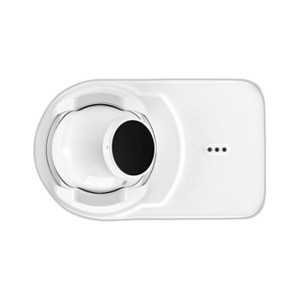
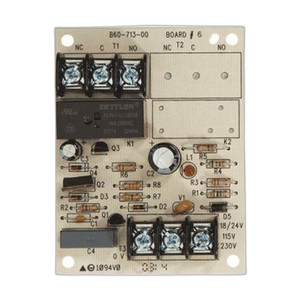
System Sensor R-10E Single SPDT Relay with EOL Supervision
Overview
The System Sensor R-10E is a single SPDT (Single Pole Double Throw) relay module designed for supervised relay control in networked security and fire detection systems. Operating at 12 VDC, the R-10E integrates with TCP/IP-based architectures to deliver circuit integrity monitoring and reliable switching across multi-door access control, alarm, and automation environments. End-of-line (EOL) supervision means the system continuously verifies relay circuit health — if a wire breaks or connection fails, the control panel detects the fault immediately rather than discovering it during an incident.
Key Features
- Single SPDT Relay Output: One changeover relay (normally open, common, normally closed contacts) handles standard switching tasks — door strikes, magnetic locks, siren drivers, and gate motors. SPDT configuration lets you control two separate loads or reverse polarity-sensitive circuits from a single module.
- End-of-Line (EOL) Supervision: Built-in EOL resistor and monitoring protocol detect open or short circuits in the relay wiring. Catches cable cuts, terminal corrosion, and solder joint failures before they become security vulnerabilities.
- TCP/IP Integration: Network-based control and status reporting eliminate the need for dedicated hardwired loops to a central panel. Simplifies wiring in large facilities and enables remote monitoring via standard IP infrastructure — valuable when security cabinets are distant from controlled devices.
- 12 VDC Operation: Standard industrial voltage reduces transformer requirements and integrates easily with existing 12V security system power supplies. Low voltage also reduces arc risk at relay contacts and meets most fire code wiring rules.
- Industrial & Commercial Compatibility: Designed for integrators deploying centralized control systems with networked relay management. Suits multi-building campuses, warehouse automation, and fire alarm networks where circuit integrity reporting is mandatory.
- Compact Modular Form: Mounts in standard electrical enclosures alongside other networked security modules, simplifying cabinet layout and reducing panel footprint compared to relay racks or hardwired control stations.
Integration & Compatibility
The R-10E (often searched as R 10E) integrates with TCP/IP-based security system architectures including fire alarm networks and centralized access control platforms. It is compatible with standard industrial and commercial security installations where supervised relay outputs are required. Network integration via TCP/IP means the R-10E communicates status and faults to a control panel or VMS running on the same IP infrastructure — no separate hardwired supervision loop needed. This architecture scales efficiently across large properties and allows monitoring from remote workstations.
Integrators deploying the R-10E should confirm that their control panel or relay control module supports the specific TCP/IP protocol and command set used by the relay. EOL supervision assumes the control panel is programmed to monitor and report circuit integrity events; without that configuration, the supervision feature provides no benefit.
Deployment Considerations
The R-10E is most valuable in deployments where circuit faults pose a risk — locked doors that fail open, or alarms that don't trigger. In simple applications with a single relay and short cable runs in controlled environments, unsupervised relays often suffice. The R-10E adds cost and requires TCP/IP infrastructure; both are justified when reliability matters. Verify that terminal blocks accept your wire gauge (typically 14–18 AWG in security installations) and that the control panel firmware version supports R-10E command protocols. EOL supervision works only if the panel is configured to poll and interpret the supervision signal; consult integration documentation before deployment.
Frequently Asked Questions
Q: What does EOL (end-of-line) supervision do on the R-10E?
A: EOL supervision continuously monitors the relay circuit for opens (broken wires, loose terminals) and shorts. If a fault is detected, the control panel receives an alert immediately, rather than discovering the problem when the relay is needed. This is critical in life-safety and security applications where a relay failure could prevent a door from locking or an alarm from sounding.
Q: Can the R-10E control both a door strike and a siren from a single module?
A: Yes. The SPDT configuration provides three terminals: common, normally open, and normally closed. You can wire one load (e.g., door strike) to the common and normally open contacts, and a second load (e.g., siren) to the common and normally closed contacts. When the relay energizes, one load activates and the other deactivates.
Q: Does the R-10E require a separate power supply?
A: Yes, the R-10E operates on 12 VDC and must be powered from a dedicated 12V security system power supply. It does not draw power from the TCP/IP network (PoE is not supported). Ensure your panel's power supply has sufficient capacity for the relay coil current draw.
Q: Is the R-10E compatible with my fire alarm control panel?
A: The R-10E is designed for TCP/IP-based fire alarm and security networks. Compatibility depends on whether your panel supports the same TCP/IP protocol and relay control command set. Consult your panel manufacturer's integration guide and the R-10E datasheet to confirm compatibility before purchasing.
Q: What's the maximum current the R-10E relay contacts can handle?
A: Refer to the R-10E datasheet for exact contact ratings (voltage and amperage limits). Oversizing the relay contact current can shorten relay life; undersizing causes contact resistance and heat. Size the relay for your load and verify limits in the technical documentation.
Ted PerryPerspective based on aggregated IP Security Depot and affiliated engineering team experience.
The R-10E fills a genuine gap in networked security deployments: it brings circuit supervision to TCP/IP relay control without forcing you to maintain separate hardwired monitoring loops. In access control and fire alarm integration, that matters. A relay failure discovered after an incident is expensive and, in life-safety contexts, indefensible. The R-10E's EOL supervision catches faults in real time.
Technical Highlights:
- Single SPDT Configuration: One changeover relay lets you control two independent loads or reverse-polarity circuits from a single module — reduces module count and cabinet space versus deploying two single-relay units.
- TCP/IP Integration with EOL: Network-based supervision eliminates the need for a dedicated hardwired EOL loop back to a panel. All status and fault reporting flows over the same IP infrastructure, simplifying wiring on multi-building sites and enabling remote monitoring from any workstation on the network.
- 12 VDC Standard: Operates on common industrial 12V, integrating cleanly with existing security power supplies and reducing arc risk at contacts compared to higher voltages.
Deployment Considerations:
- EOL supervision is only effective if the control panel is configured to poll the R-10E and interpret circuit-fault signals; verify panel firmware and integration documentation before deployment.
- The R-10E does not support PoE; it requires a separate 12VDC power feed from the security system's main power supply. Confirm power supply capacity before installation.
Deploy the R-10E in facilities where relay failure creates risk — multi-tenant buildings, campus access control, life-safety systems, and warehouse automation with networked door locks. Skip it in small single-relay applications or environments where supervised wiring is already in place.