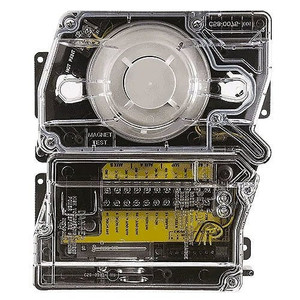
System Sensor D4S 4-Wire Duct Smoke Detector
The System Sensor D4S is a 4-wire duct-mounted smoke detector designed for integration into fire alarm and building automation systems. This sensor mounts directly inside commercial HVAC ductwork to provide early-warning smoke detection in air handling environments. The D4S operates at 29VDC and communicates via TCP/IP protocol, enabling centralized monitoring and alarm reporting through network-connected building management or fire alarm control panels.
Key Features
- 4-Wire Configuration: Standard hard-wired connection to fire alarm control panels. This topology integrates with existing addressable or conventional panel architectures without requiring proprietary signaling, making retrofit and replacement straightforward in established systems.
- 29VDC Operating Voltage: Operates directly from typical fire alarm panel power supplies. This voltage range is standard across institutional and commercial fire alarm systems, so no external DC converter or dedicated power supply is required at the sensor location.
- TCP/IP Network Connectivity: In addition to 4-wire hardwired signaling, the D4S supports TCP/IP communication for network-based monitoring and reporting. This dual-path architecture allows integration with modern building automation systems (BAS) and remote monitoring platforms, enabling real-time alerts to networked workstations or mobile devices without replacing existing hardwired infrastructure.
- Compact Duct-Mount Form Factor: Measuring 14.38 inches length × 5 inches width × 2.5 inches depth and weighing 2.5 lbs, the D4S fits within standard commercial ductwork without restricting airflow or requiring extensive modification to the HVAC plenum. The rectangular profile is engineered to seat securely in rectangular ducts common in office and institutional buildings.
- Early Detection in HVAC Airstreams: Duct-mounted placement allows smoke detection before contaminated air circulates throughout the building. This positioning is critical for life safety in facilities with centralized air handling, where early warning enables faster evacuation and can prevent smoke spread through interconnected spaces.
- Commercial HVAC Integration: Purpose-built for ducted air handlers in commercial buildings. The sensor is positioned to sample air directly from the ductwork, making it suitable for detecting smoke in return air plenums, supply ducts, and large-volume air handling units typical of warehouses, data centers, office complexes, and institutional facilities.
Integration and Compatibility
The D4S integrates with standard fire alarm control panels via its 4-wire connection. Before deployment, verify that your panel supports the sensor's addressability and signaling protocol. Network integration via TCP/IP requires a connection to an active Ethernet network and compatible BAS or fire alarm platform that supports ONVIF or the manufacturer's proprietary protocol. Consult the system integrator or control panel documentation to confirm wiring and network configuration requirements for your specific installation.
Deployment Considerations
The D4S is sized for rectangular ductwork in commercial HVAC systems. Verify duct dimensions and mounting location during design to ensure the sensor can be safely installed without obstructing airflow or creating pressure drops. Installation requires coordination with HVAC contractors and fire alarm technicians to ensure compliance with local fire codes and NFPA 72 standards. TCP/IP connectivity requires network access and configuration; ensure IT infrastructure is prepared to accommodate the sensor on the building network if network monitoring is planned.
Frequently Asked Questions
Q: Does the D4S require a separate power supply?
A: No. The D4S operates at 29VDC, which is supplied directly from standard fire alarm control panel power outputs. No external power supply is needed.
Q: Can the D4S work with both hardwired and network monitoring?
A: Yes. The 4-wire connection integrates with traditional hardwired fire alarm panels, and TCP/IP connectivity allows simultaneous network-based monitoring through compatible building automation systems.
Q: What ductwork dimensions are required for installation?
A: The D4S measures 14.38 inches (length) × 5 inches (width) × 2.5 inches (depth). Verify that your ductwork can accommodate these dimensions and allow secure mounting without restricting airflow.
Q: Is the D4S NFPA 72 compliant?
A: The D4S is designed for fire alarm system integration; however, verify specific NFPA 72 compliance with the manufacturer's documentation or your fire alarm system integrator before final design approval.
Q: Does the D4S support ONVIF?
A: TCP/IP networking is supported for remote monitoring. Specific protocol compatibility (ONVIF, proprietary, or other standards) should be confirmed with the manufacturer or your system integrator before procurement.
I spec duct smoke detectors frequently in commercial HVAC retrofits, and the System Sensor D4S occupies a middle ground worth understanding. It's a 4-wire hardwired sensor that also talks TCP/IP — a hybrid that works if you're retrofitting an older fire panel but want to add network visibility without replacing the entire detection backbone.
Technical Highlights:
- 29VDC Direct Power: Draws power directly from the fire panel. No need to budget for auxiliary power supplies or deal with additional circuit requirements. That simplifies both the installation drawing and the panel audit.
- 4-Wire Hard-Wired Signaling: Integrates with addressable or conventional fire alarm panels. The 4-wire topology is standard across the industry, which means compatibility questions are straightforward — most panels built in the last 15 years will talk to this sensor without issue.
- TCP/IP as a Secondary Path: Network connectivity doesn't replace the hardwired connection; it supplements it. That means you're not betting your fire detection on the building network. If the Ethernet fails, the 4-wire path still reports alarms to the panel and your hardwired horn circuits fire as designed.
Deployment Considerations:
- Ductwork Fit is Non-Negotiable: At 14.38 inches long × 5 inches wide × 2.5 inches deep, the D4S needs rectangular ductwork with enough clearance. If your HVAC contractor designed around smaller or round ducts, you may need to relocate the sensor or modify the mounting location. Get the mechanical drawings in front of your integrator early.
- Network Configuration Burden: The TCP/IP feature sounds nice, but it requires coordination with your IT and BAS teams. If your building doesn't have a mature BAS or if network monitoring isn't a requirement, the TCP/IP capability goes unused. Don't pay for integration headaches you don't need.
The D4S works best in medium-to-large commercial facilities with existing hardwired fire alarm infrastructure that want to add network visibility without a full system replacement. Hospitals, office parks, and data centers running centralized air handling are the sweet spot. For smaller buildings or those planning a complete fire system overhaul, a pure network-based sensor may be simpler.