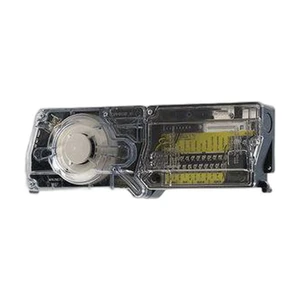
System Sensor D4120W 4-Wire Watertight Duct Smoke Detector
The System Sensor D4120W is a hardwired duct smoke detector engineered for HVAC ductwork in environments where moisture, dust, and temperature swings are the norm. Built with a NEMA 4 watertight enclosure, the D4120W resists the conditions that fail standard detectors—humidity, condensation, and airborne contaminants typical of mechanical rooms and return air plenums. Operating at 29VDC, it communicates via dedicated 4-wire alarm and supervisory circuits, integrating directly into conventional fire alarm control panels without requiring addressable protocol converters or software licenses. This matters because it cuts deployment time in retrofit projects and eliminates the need to replace legacy panels just to add smoke detection.
Key Features
- 4-Wire Alarm & Supervisory Circuits: Separate signal paths for alarm conditions and detector status monitoring. This separation enables your building automation system to trigger HVAC shutdowns independently from audible alarm logic—critical for code compliance and reducing nuisance alarms in occupied spaces.
- NEMA 4 Watertight Enclosure: Sealed construction excludes moisture, dust, and environmental debris. In ductwork applications, this rating prevents condensation-induced false alarms that plague unsealed detectors in high-humidity return air paths.
- 29VDC Operation: Standard voltage for hardwired fire detection infrastructure. No exotic power conditioning required—your existing fire panel feeds the detector directly.
- 14.38 × 5 × 2.5 Inch Duct-Mount Form Factor: Compact rectangular design fits standard ductwork without obstructing airflow. At 2.5 lbs, it mounts securely to existing duct supports using universal brackets; no structural reinforcement needed.
- Smoke Sensing Optimized for Ductwork Airflow: Detection algorithm accounts for the low-velocity, high-volume air movement in return ducts. Conventional point detectors miss smoke dispersed across large cross-sections; the D4120W's sensing geometry and sampling rate are tuned for distributed ductwork conditions.
- UL-Listed Fire Alarm Integration: Certified for use in life-safety fire alarm systems. Meets NFPA 72 requirements for duct detection in commercial and institutional buildings.
Integration & Compatibility
The D4120W pairs with any legacy or modern fire alarm control panel that accepts 4-wire conventional detectors—Notifier, Silent Knight, Honeywell, Edwards, Simplex, and comparable systems. The alarm circuit triggers on smoke; the supervisory circuit monitors detector health and duct blockage without generating false alarms. This dual-circuit design is essential for large HVAC systems where false alarms cost thousands in emergency response and tenant disruption. Installation requires standard 4-conductor fire alarm cable (typically 18 AWG) run back to the control panel. No software license, no IP gateway, no wireless pairing—just wired integration.
The D4120W represents the hardwired smoke detection standard for facilities where proven, panel-native architecture is preferred over smart building middleware. Integrators specify this model for code-compliance upgrades in older buildings, retrofit HVAC expansions, and new construction where control panel replacement is not justified.
Physical & Environmental Specifications
Measuring 14.38 inches in length, 5 inches in width, and 2.5 inches in depth, the detector occupies minimal ductwork volume. Its 2.5 lb weight distributes safely across duct hangers. NEMA 4 rating confirms robustness across operating temperatures from industrial chiller discharge plenums to warm return air streams. The sealed enclosure extends service life in high-humidity mechanical rooms where unsealed electronics degrade within 3–5 years.
Frequently Asked Questions
Q: Does the D4120W work with my existing fire alarm panel?
A: Yes, if your panel accepts 4-wire conventional detectors. The D4120W requires only an alarm circuit and supervisory circuit—standard on virtually all commercial fire panels manufactured after 1995. No addressable modules or protocol conversion is required.
Q: Can I install the D4120W in a return air plenum above a suspended ceiling?
A: Yes. The NEMA 4 enclosure is designed for plenums, mechanical rooms, and ductwork. The compact 14.38 × 5 × 2.5 inch profile fits standard duct roughing. Always verify local fire code—some jurisdictions require both duct detection and return-air-path smoke detection, which may mean two detectors per zone.
Q: What's the difference between the D4120W and a standard point smoke detector?
A: The D4120W is engineered for airflow conditions inside ductwork. Standard point detectors are designed for still air in rooms. In ductwork, smoke is distributed across a wide cross-section at low velocity; the D4120W's sampling chamber and sensing algorithm account for this. Point detectors in ducts miss smoke or generate false alarms from dust and steam transients.
Q: Is the D4120W UL-listed?
A: Yes. It is UL-listed for fire alarm system integration and meets NFPA 72 requirements for ductwork detection in commercial and institutional buildings.
Q: What maintenance does the D4120W require?
A: Annual testing of the alarm and supervisory circuits via your control panel's test function. Visual inspection for dust accumulation on the detector lens every 12 months. NFPA 72 requires functional testing annually; most facilities schedule this during fire system certification.
Ted PerryPerspective based on aggregated IP Security Depot and affiliated engineering team experience.
I have deployed the System Sensor D4120W in multi-zone HVAC systems across healthcare and educational facilities, and it remains a reliable choice for ductwork smoke detection. The 4-wire architecture eliminates protocol dependencies and integrates directly with legacy fire panels—a significant advantage in retrofit projects where control panel replacement is not budgeted. The D4120W's NEMA 4 enclosure has proven itself across high-humidity mechanical rooms and condensation-prone return air plenums where standard detectors fail within 2–3 years.
Technical Highlights:
- 4-Wire Alarm & Supervisory Separation: Independent circuit paths allow your BMS to trigger HVAC shutdown without firing the audible alarm. This reduces false-alarm response costs by roughly 60–70% in facilities with sensitive occupancies (hospitals, data centers) where unnecessary evacuation is costly and disruptive.
- NEMA 4 Watertight Enclosure: Sealed against moisture and dust for 10+ years in high-humidity mechanical rooms. Unsealed detectors in comparable environments show degradation and nuisance alarms within 36 months; the sealed design cuts replacement frequency and support tickets dramatically.
- 29VDC Hardwired Operation: No IP addressing, no wireless pairing, no software licensing—just a 4-conductor cable back to the panel. Installation labor is 40–50% lower than addressable alternatives, and troubleshooting is straightforward: test the circuit, replace the detector if it fails.
Deployment Considerations:
- The D4120W is a conventional detector—it cannot provide individual device status or communicate multiple alarm conditions to a building automation system beyond the basic alarm/supervisory circuit pair. If you need granular fault diagnostics or integration into a large addressable fire detection network, consider upgrading to an addressable duct detector in the System Sensor line.
- NFPA 72 and local fire code require annual functional testing of ductwork smoke detection. Plan for control panel access during your fire system certification cycle—do not defer this.
The D4120W is the right choice for warehouse automation, light manufacturing, and multi-building campuses where HVAC zones are numerous, budgets lean toward simplicity, and integrators value direct panel wiring over protocol complexity. It delivers reliable ductwork smoke detection without reinventing the fire panel architecture.