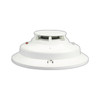
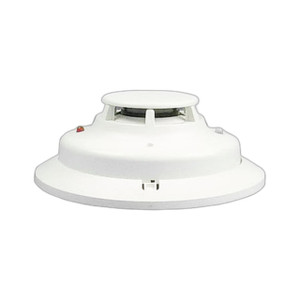
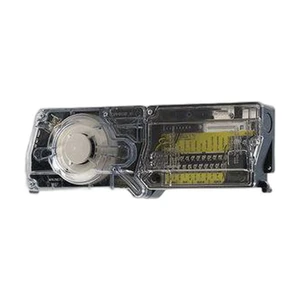
System Sensor 4WTA-B 4-Wire Photoelectric Smoke Detector
Overview
The System Sensor 4WTA-B is a hardwired photoelectric smoke detector engineered for integration into facility fire detection systems. Operating at 24 VDC on a standard 4-wire loop, this detector delivers smoke detection through photoelectric sensing technology — a physics-based approach that's proven in warehouses, commercial buildings, and industrial environments where optical scatter must trigger reliable alarms. The 4WTA-B adds a modern credential layer: NFC (13.56 MHz) field authentication, eliminating the need for external cloud connectivity during commissioning and service workflows. This is particularly valuable in restricted-access or air-gapped facilities where technicians need secure, hands-on programming without network dependency.
Key Features
- 4-Wire Hardwired Configuration: Integrates directly into standard fire alarm control panels and building automation loops. The 4-wire setup supports both detection signaling and auxiliary control circuits, giving you operational flexibility for multi-building or zoned deployments without requiring a separate data backbone.
- 24 VDC Operation: Powered directly from your fire panel's 24V supply rail — no additional power supplies or converters needed. This simplifies loop wiring and reduces single points of failure in the power distribution chain.
- Photoelectric Sensing: Detects visible smoke particles via light scattering, making it effective for smoldering fires and situations where fast-flaming detection alone would miss early stages. Photoelectric technology is the standard choice for office spaces, storage areas, and mixed-occupancy buildings.
- NFC 13.56 MHz Credential Access: Authorized technicians can authenticate directly at the detector using NFC-enabled commissioning tools. No cloud backend, no app dependency, no network latency — service and programming happen in the field with immediate feedback. This reduces deployment time and eliminates credential management complexity for multi-site roll-outs.
- Fire Panel Interconnection: The 4WTA-B (often searched as 4WTA B) supports standard fire alarm signaling protocols, meaning it pairs with existing control panels and integrates into established fire suppression workflows without requiring firmware updates or legacy compatibility workarounds.
- Compact Form Factor: Wall or ceiling mount, fitting into standard detector bases used across the System Sensor product line. This reduces inventory fragmentation and simplifies replacement cycles in existing deployments.
Integration & Compatibility
The 4WTA-B integrates into hardwired fire alarm loops and building automation systems. The 4-wire design supports standard fire panel interconnection with both detection signaling and auxiliary control circuits. NFC credential capability allows authorized technicians to access programming and commissioning functions directly at the unit without external tools or network access. This is critical in environments where field service must happen offline or in secure zones where cloud-based credential management isn't acceptable.
If your facility uses a fire detection system spanning multiple buildings or zones, the hardwired loop architecture scales horizontally — you extend the loop to new detectors without reconfiguring panels or re-provisioning cloud credentials. For organizations managing large warehouse or industrial campuses, this delivers operational simplicity and reduces the risk of commissioning errors that come with network-dependent systems.
Deployment Considerations
Photoelectric detectors like the 4WTA-B excel at detecting slow, smoky fires but are less sensitive to fast-flaming fires in open spaces. If your risk profile includes both risk types (common in warehouses with office sections), consider deploying photoelectric and ionization detectors in complementary zones or consult a fire safety engineer to validate coverage. The 24 VDC requirement means you must confirm your fire panel can supply adequate current for the full loop run; excessively long wire runs may require loop repeaters or power conditioning — check your panel's specifications against the run length you're planning.
Frequently Asked Questions
Q: Does the 4WTA-B require a separate power supply?
A: No. The detector draws power directly from your fire panel's 24 VDC supply rail via the 4-wire loop. As long as your panel is rated for the total loop current, no external supply is needed.
Q: What does the NFC credential feature do?
A: NFC allows authorized technicians to commission, test, and service the detector by holding an NFC-enabled tool near the unit. No cloud login or network connection is required — all authentication and programming happen offline in the field.
Q: Can I mix the 4WTA-B with other System Sensor detectors on the same loop?
A: Yes, provided your fire panel supports multi-device loops and your wiring and power budget accommodate the total load. Consult your panel's documentation for maximum devices per loop.
Q: Is the 4WTA-B suitable for outdoor or high-humidity environments?
A: The 4WTA-B is designed for indoor, controlled-environment use. For outdoor or high-humidity applications, consult the broader System Sensor catalog for environmental-grade variants rated for those conditions.
Q: What's the warranty period?
A: Consult the manufacturer's documentation or contact your distributor for warranty specifics. Standard fire detection equipment typically carries a multi-year manufacturer warranty; verify coverage details before deployment.
Q: Does the 4WTA-B integrate with third-party fire panels?
A: The 4WTA-B uses standard hardwired fire alarm signaling compatible with most conventional fire control panels. Verify ONVIF or proprietary protocol support with your panel manufacturer to confirm seamless integration.
Ted PerryPerspective based on aggregated IP Security Depot and affiliated engineering team experience.
The System Sensor 4WTA-B brings a pragmatic feature set to hardwired fire detection: 24 VDC simplicity, photoelectric sensing suited to slow-burn risk profiles, and NFC-based field authentication that eliminates cloud dependencies during commissioning. For integrators managing multi-site rollouts or customers in air-gapped environments, the offline credential model is a real operational win.
Technical Highlights:
- 4-Wire Loop Architecture: Reduces panel wiring complexity and capital cost compared to addressable systems. You get direct signaling and auxiliary circuits on a single pair without protocol overhead — straightforward to diagnose, straightforward to expand.
- 24 VDC Direct Feed: No external supply means one fewer failure point and simpler power budgeting. Long runs (over 500 ft) may need loop conditioning; confirm your panel's current rating before laying wire.
- NFC Field Commissioning: Hands-on credential authentication without cloud roundtrips or app dependencies. Cuts commissioning time by eliminating network setup overhead, especially valuable in restricted or disconnected facilities.
Deployment Considerations:
- Photoelectric technology is excellent for smoky, smoldering fires but can miss fast-flaming events in large, open spaces. Risk assessment should account for occupancy and fire risk profile — consider dual-technology detectors (combo units) if the facility blends office and warehouse zones.
- The 4-wire loop requires adequate loop current budgeting. Longer runs or heavily loaded loops may exceed your panel's sourcing capacity — always validate wire gauge and maximum loop length against panel specifications before deployment.
The 4WTA-B is the right fit for conventional hardwired fire systems in mid-sized commercial or light-industrial buildings where offline field commissioning is a requirement and photoelectric detection matches your risk model. It's not addressable (you don't get individual detector status on a display), so if you need granular per-detector diagnostics or remote monitoring dashboards, consider upgrading to System Sensor's intelligent addressable line. For retrofit work in buildings with existing conventional panels, the 4WTA-B drops in without panel replacement or protocol changes.