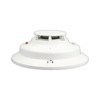
System Sensor 4WT-B 4-Wire Addressable Photoelectric Smoke Detector
Overview
The System Sensor 4WT-B is a 4-wire addressable photoelectric smoke detector engineered for distributed fire detection systems requiring individual device addressing and real-time status reporting. Operating at 35VDC, the 4WT-B integrates directly into multi-sensor fire alarm networks where each detector must be identified and monitored independently. The photoelectric sensing technology identifies smoke particles in protected spaces without requiring separate detector wiring for each zone—a significant cost and labor advantage in buildings with dozens of detection points.
Key Features
- 4-Wire Addressable Architecture: Each 4WT-B detector can be assigned a unique address on the network, eliminating the need for dedicated pairs per zone. This reduces wiring labor and material costs significantly compared to conventional multi-zone panels where each detector requires separate line and signal runs.
- 35VDC Operating Voltage: Standardized supply voltage ensures compatibility with mainstream fire control panels and networked detection system architectures. Simplifies power distribution planning across medium to large facilities.
- Photoelectric Detection: Responds to visible light scattered by smoke particles. This technology performs well in spaces where ionization smoke detectors may trigger false alarms (kitchens, parking structures) and is generally faster at detecting smoldering fires typical of upholstered furniture and paper-based materials.
- NFC/13.56MHz Programming Interface: Credentials and device configuration are managed via NFC or 13.56MHz contactless communication. Technicians can program and verify detector status during installation and maintenance without removing the unit or breaking the supervised circuit—reducing truck rolls and installation downtime.
- Networked Status Reporting: Real-time alarm, trouble, and device health signals are transmitted to the control panel. This enables faster response to faults and clearer visibility into which detection zones have actually alarmed versus false or nuisance triggers.
- Field Serviceability: The NFC interface allows maintenance teams to test, reset, and validate operation without specialized programming consoles or proprietary tools, lowering operational overhead on large campuses.
Integration & Compatibility
The 4WT-B operates on a 4-wire addressable topology compatible with fire control panels and networked detection systems that support the same protocol. Before specifying this model, verify that your fire alarm control panel and any downstream network interface equipment are rated for 4-wire addressable detectors and support the System Sensor protocol. NFC credential communication requires compatible field programming devices or mobile applications approved by your control panel manufacturer.
When to Choose a Different Model
If your facility runs a conventional (non-addressable) fire alarm panel, the 4WT-B will not integrate. Look for a conventional 2-wire photoelectric smoke detector variant in the System Sensor catalog instead. If your application requires dual-sensor detection (smoke + heat), evaluate combination detector models offered in the same product line. For applications in spaces prone to high ambient light or where ionization detection is mandated by code, consult your authority having jurisdiction and your detector supplier.
Frequently Asked Questions
Q: Does the System Sensor 4WT-B work with any fire control panel?
A: No. The 4WT-B requires a 4-wire addressable fire control panel. Verify your panel supports the System Sensor addressable protocol before purchase. Contact your panel manufacturer or integrator if uncertain.
Q: What is the warranty on the 4WT-B?
A: Specific warranty terms are not detailed in available product documentation. Contact the manufacturer or your specialty distributor for warranty period and coverage details.
Q: Can the 4WT-B be programmed without removing it from the ceiling?
A: Yes. The NFC/13.56MHz interface allows programming, testing, and status verification while the detector remains mounted, provided you have a compatible NFC reader or mobile programming application.
Q: Is the 4WT-B suitable for outdoor installations?
A: This is a photoelectric smoke detector designed for indoor protected spaces. Outdoor installations require weatherproof housings and may conflict with fire code requirements for detection in open air. Consult your authority having jurisdiction.
Q: What is the difference between the 4WT-B and a conventional smoke detector?
A: The 4WT-B is addressable, meaning each detector reports its own status and can be individually identified on a networked system. Conventional detectors operate on simple supervised pairs—the panel knows a zone has alarmed but not which specific detector. Addressable detectors enable faster fault isolation and more flexible zone configurations.
Ted PerryPerspective based on aggregated IP Security Depot and affiliated engineering team experience.
The System Sensor 4WT-B addresses a real pain point in modern fire detection deployment: addressable fire panels require detectors that report individual status over shared wiring, but many integrators still spec conventional detectors and then wonder why they can't pinpoint which zone actually alarmed. The 4WT-B eliminates that problem by building in addressable communication from the ground up.
Technical Highlights:
- 35VDC Supply and 4-Wire Topology: Single power and signal pair supports multiple detectors with unique addressing. Cuts installation labor on large networks versus running dedicated pairs to each zone.
- NFC/13.56MHz Programming: Field technicians can validate and reset detectors in place without breaking the circuit or deploying specialized consoles. Real operational savings on service calls and commissioning time.
- Photoelectric Sensing: Faster detection of smoldering fires and lower nuisance alarm rates in food-service and storage areas where ionization detectors frequently false-trigger. If your facility has struggled with repeat false alarms from cooking or dust, this is the right sensing method.
Deployment Considerations:
- Verify your fire control panel explicitly supports 4-wire addressable detectors and the System Sensor protocol before spec'ing the 4WT-B. Integrating an addressable detector into a panel that only supports conventional devices will result in commissioning failure and rework.
- NFC programming requires compatible field equipment or mobile apps. If your team lacks NFC readers or the panel manufacturer hasn't released a compatible app, you'll be limited to hardwired configuration at the panel—losing the main serviceability benefit.
- Photoelectric detectors perform best in spaces with normal air circulation. In high-dust environments or ductwork where air is moving at speed, performance may degrade. Not suitable for outdoor or fully open-air applications without weatherproof enclosure.
Deploy the 4WT-B in medium to large facilities running addressable fire panels where reducing zone-specific wiring, enabling rapid fault isolation, and supporting in-situ commissioning are operational priorities. It's the right choice for campuses, multi-building complexes, and retrofit projects where labor and downtime costs are material factors in the ROI calculation.