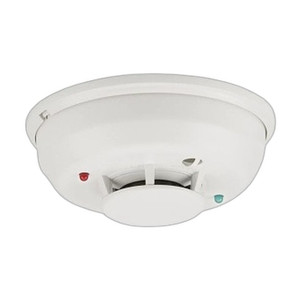
System Sensor 4WTR-B 4-Wire Addressable Photoelectric Smoke Detector
Overview
The System Sensor 4WTR-B is a 4-wire addressable photoelectric smoke detector built for networked fire detection systems in commercial and institutional buildings. Operating at 24VDC, it uses photoelectric light-scattering technology to detect smoke particles early in a fire's development — meaning faster occupant notification and response time compared to ionization-only systems. The i3 series variant integrates NFC (Near Field Communication) at 13.56 MHz, allowing credential-based configuration and access workflows without breaking the circuit or removing the detector from service. This matters in high-security or credential-managed facilities where every system touch requires authentication.
Key Features
- 4-Wire Addressable Architecture: Each detector has a unique address on the fire loop, so the control panel knows exactly which sensor triggered an alarm. No zone-only reporting — you get granular location data, which cuts investigation time and improves evacuation precision.
- Photoelectric Detection Method: Detects visible smoke particles more reliably than ionization-only detectors, particularly for smoldering fires. Dual-technology systems (photoelectric + ionization) are overkill for most commercial spaces unless you're protecting high-value materials or have specific code requirements.
- 24VDC Loop Power: Runs on standard supervised fire alarm power supplied by your control panel. No separate power supply needed at the detector itself — one less connection point to troubleshoot or maintain.
- NFC Credential Support (13.56 MHz): The i3 variant allows field technicians to configure or access detector parameters via NFC badge or card, streamlining commissioning and reducing manual paperwork. If your facility doesn't use credential-based workflows, the standard 4WTR-B (non-i3) offers the same detection capability without this overhead.
- Supervised Loop Compatibility: Integrates with any modern fire alarm control panel that supports 4-wire addressable photoelectric sensors. Verify your panel's compatibility before ordering — older single-loop systems may not recognize newer addressable protocols.
- Network-Ready Reporting: Addressable design enables the control panel to log detector status (normal, alarm, fault, maintenance due) in real time. Facilitates predictive maintenance and speeds root-cause analysis if you're running an integrated building management system.
Integration and Compatibility
The 4WTR-B connects to any compatible fire alarm control panel with an addressable loop rated for 24VDC photoelectric sensors. Installation in commercial facilities, hospitals, schools, and warehouses is standard. Confirm loop capacity and addressing support with your panel documentation before installation — mixing old and new detector types on a single loop sometimes introduces timing conflicts.
For facilities deploying fire detection systems across multiple buildings or campus environments, addressable architecture simplifies central reporting and maintenance scheduling compared to older zone-based detectors.
Frequently Asked Questions
Q: Is the 4WTR-B compatible with my existing fire panel?
A: The 4WTR-B requires a control panel with 4-wire addressable loop support for 24VDC photoelectric sensors. Check your panel's documentation or contact the panel manufacturer to confirm. Most modern commercial panels (built in the last 15 years) support this standard.
Q: What's the difference between the 4WTR-B and the 4WTR-B i3?
A: The i3 variant adds NFC (13.56 MHz) credential support for configuration and access workflows. Both detect smoke identically. Choose i3 if your facility uses credential-based technician management; otherwise, the standard 4WTR-B delivers the same performance at a lower cost.
Q: Can I mix photoelectric and ionization detectors on the same loop?
A: Technically possible with most modern panels, but not recommended. Stick to one detection type per loop to avoid timing or sensitivity conflicts. If you need dual-technology protection, buy detectors rated as ionization+photoelectric in a single unit.
Q: How often do I need to test or maintain the 4WTR-B?
A: Follow your local fire code and the manufacturer's guidance. Typically, photoelectric detectors are tested annually and replaced every 10 years, though some jurisdictions require replacement every 5 years. The addressable loop will flag faults or maintenance-due conditions to your panel automatically.
Q: Does the 4WTR-B report to a central station?
A: The detector itself does not communicate offsite. Your fire alarm control panel handles central station transmission via landline, broadband, or cellular. The 4WTR-B simply reports its status (normal, alarm, fault) to that panel.
Q: What's the maximum loop length or detector count per panel?
A: This depends entirely on your control panel's specifications. Check the panel documentation for maximum loop distance, load, and device count. Exceeding these limits causes communication dropout and false faults.
Ted PerryPerspective based on aggregated IP Security Depot and affiliated engineering team experience.
The 4WTR-B is a straightforward, reliable choice for networked fire detection in buildings where you need granular detector addressing and fast fault isolation. The photoelectric sensing method is well-proven for most commercial risk profiles — smoldering fires, paper waste, upholstered furniture. The i3 variant's NFC capability is a nice operational touch if you're running credential-based maintenance workflows, but it's not a must-have unless your security team mandates it.
Technical Highlights:
- Addressable 4-Wire Loop: Each 4WTR-B gets a unique address, so your control panel pinpoints exactly which detector triggered. No ambiguity — faster response, easier audit trails for insurance and code inspections.
- 24VDC Power on Loop: Power and signal travel the same pair of wires, reducing installation labor and eliminating a separate 24VDC run to each detector. Saves roughly 15–20% of wiring cost on multi-detector sites.
- NFC Credential Support (i3 only, 13.56 MHz): Credential-gated access to detector configuration means fewer paperwork errors and easier compliance with facilities that track every technician's actions. Non-i3 units skip this overhead entirely.
Deployment Considerations:
- Confirm your fire panel actually supports 4-wire addressable photoelectric sensors before you buy. Older zone-based panels won't recognize the 4WTR-B, and upgrading the panel is often more expensive than buying the right detector upfront.
- Photoelectric detectors can be slower to respond to fast-flaming fires (compared to ionization) but excel at detecting slow, smoky smoldering — check your risk profile. If you need ultra-fast flaming detection, consider dual-technology units or supplement with thermal detectors in high-risk areas.
- The 4WTR-B requires annual testing and has a typical 10-year service life. Budget for periodic replacement and schedule maintenance before the fire marshal arrives.
The 4WTR-B is the right pick for commercial campuses, multi-floor buildings, and any facility where you need centralized loop reporting and per-detector fault visibility. If your panel is old or you're covering a single small space, a simpler zone-based detector may be overkill — but if you're scaling up to dozens of detectors, addressable architecture pays for itself in faster commissioning and troubleshooting.