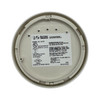
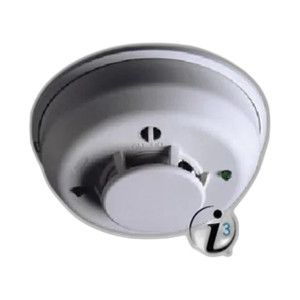
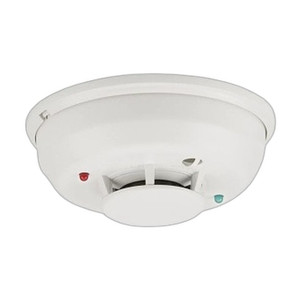
System Sensor 4W-B Photoelectric Smoke Detector
Overview
The System Sensor 4W-B is a 4-wire photoelectric smoke detector engineered for integration into hardwired fire detection systems. Operating at 35VDC, this detector works with both conventional and addressable fire alarm control panels, making it a straightforward choice for retrofits and new commercial installations. The i3 Series construction provides dependable smoke sensing in general occupancy environments — offices, commercial buildings, institutional facilities — where cost-effective, reliable detection matters.
The 4-wire configuration (the "4W" in the model number) means power and signal both travel on dedicated pairs, reducing false-alarm risk compared to some 2-wire designs. This matters in busy commercial spaces where nuisance trips can cost you credibility with building managers and tenants.
Key Features
- 35VDC Operating Voltage: Matches standard fire alarm control panel output, eliminating the need for external voltage conversion or supplemental power supplies. Simplifies panel wiring and reduces component count.
- 4-Wire Detector Circuit: Separate power and signal pairs lower the likelihood of electromagnetic interference and false alarms on longer runs or in electrically noisy environments (warehouses, industrial spaces with heavy machinery). Standard fire alarm panels natively support 4-wire circuits — no special drivers needed.
- Photoelectric Sensing Technology: Detects smoke by measuring light scatter inside the sensing chamber. Photoelectric detectors excel at catching smoldering fires (furniture fires, electrical insulation failure) early — exactly the scenario most common in office and commercial environments.
- i3 Series Construction: Built to System Sensor's i3-generation design standards, meaning consistent mechanical tolerances, proven thermal stability across temperature ranges typical in climate-controlled commercial buildings (usually 50–90°F operating range), and field-serviceable components if detector replacement becomes necessary.
- NFC/13.56MHz Credential Support: Where fire alarm system architecture permits, near-field credential readers can interact with the detector for access-controlled configuration or status checks. This is most useful in large multi-building campuses where fire safety personnel need to verify detector commissioning without opening every panel. Not all control panels support this feature — verify compatibility with your specific panel before design phase.
- General Occupancy Listing: Suitable for open areas, hallways, offices, and standard commercial spaces. Not rated for kitchens (where cooking aerosols trigger false positives) or outdoor/weatherproof installations — use ionization or multi-sensor detectors for kitchens, and weatherproof housings for outdoor applications.
Integration & Compatibility
The 4W-B integrates directly into fire alarm control panels with 4-wire detector circuit cards. Before specifying, confirm your panel supports 4-wire supervised circuits — older 2-wire-only systems will require panel firmware updates or card replacement. NFC credential capability depends on control panel support; not all addressable panels include this feature. Fire alarm control panels with modern addressable circuits will detect the 4W-B automatically on commissioning, but manual configuration may be required on legacy systems.
Mounting follows standard surface-mount practice: ceiling or wall installation using the included base template. Positioning matters — avoid mounting within 3–6 inches of corners, vents, or ceiling diffusers, where air stagnation can delay smoke detection. In open-plan offices and warehouses with high ceilings, expect to install more detectors at lower densities than in compartmentalized spaces.
When to Choose a Different Model
If your building code or occupancy type mandates dual-sensor (photoelectric + ionization) detection — common in residential and mixed-use buildings — consider a multi-sensor variant from the same System Sensor family. For kitchens, a heat detector is typically required alongside smoke detection. For outdoor or wet environments, spec a weatherproof housing or sealed detector variant instead.
Ted PerryPerspective based on aggregated IP Security Depot and affiliated engineering team experience.
I've specified the System Sensor 4W-B on dozens of commercial retrofits, and it's earned its reputation for straightforward integration. The 4-wire topology keeps the circuit noise-free on long runs — important in older buildings with extensive wiring already in place. At 35VDC, it draws predictable current that won't surprise your power budget on large panel designs.
Technical Highlights:
- 4-Wire Supervision: Separate power and signal pairs eliminate the cross-talk that causes nuisance alarms on busy electrical systems. In a warehouse with forklifts and induction chargers running, this difference is real.
- Photoelectric Sensitivity: If your building sees smoldering fires (office furniture, electrical cabinet failures), photoelectric detectors catch those scenarios faster than ionization designs. Ionization is better for flaming fires, but smoldering is more common in commercial occupancies.
- NFC Integration (where supported): On newer addressable panels, credential-based access to detector configuration avoids multiple service calls to verify commissioning. Not a game-changer, but a time-saver on large projects.
Deployment Considerations:
- Verify your fire alarm panel supports 4-wire circuits before ordering — this is not interchangeable with 2-wire detectors.
- Smoke entry geometry matters. In dead-air corners or above supply vents, detection latency increases. Thermal modeling or site survey is worth the effort on complex floor plans.
- The 4W-B is not rated for kitchens or outdoor wet locations. Plan for a secondary heat or multi-sensor variant if required by code in those areas.
The 4W-B is the sensible default for mid-sized commercial buildings with existing hardwired fire alarm infrastructure and no exotic occupancies (kitchens, hazardous areas, extreme cold/heat). It's not the fanciest detector on the shelf, but it works reliably and costs less than addressable dual-sensor designs — a practical choice for tight budgets without sacrificing detection performance.
Frequently Asked Questions
Q: Can I use the System Sensor 4W-B with my existing 2-wire fire alarm system?
A: No. The 4W-B requires a control panel with 4-wire detector circuit cards. If your panel only supports 2-wire circuits, you will need to either upgrade the panel, add a 4-wire circuit card, or select a different detector model compatible with 2-wire supervision. Check with your panel manufacturer before specifying.
Q: Is the 4W-B suitable for kitchen environments?
A: No. Photoelectric detectors can be triggered by cooking vapors in kitchens. Building code typically requires heat detectors, multi-sensor detectors, or specialized kitchen detectors in those spaces. Install the 4W-B in general occupancy areas only (hallways, offices, open spaces).
Q: What is the difference between a 4-wire and 2-wire smoke detector?
A: A 4-wire detector uses separate wiring pairs for power and signal, reducing electromagnetic interference and false-alarm risk, especially on long runs or in electrically noisy environments. A 2-wire detector powers and signals over a single pair, which is simpler to wire but more vulnerable to interference. The choice depends on your control panel hardware and site conditions.
Q: Does the System Sensor 4W-B require special mounting hardware?
A: The 4W-B uses standard surface-mount base installation. Mounting hardware is included with the detector. Avoid mounting within 3–6 inches of corners, ceiling vents, or HVAC diffusers to prevent air stagnation that delays smoke entry into the sensing chamber.
Q: What does NFC/13.56MHz credential support mean, and do I need it?
A: NFC support allows credential readers (badge readers) to communicate with the detector for access-controlled configuration or commissioning verification. This is useful on large campuses where fire safety personnel need to confirm detector setup without opening every fire panel. Not all control panels support this feature — check compatibility with your specific panel before relying on it.
Q: What is the typical lifespan of the 4W-B, and how often should it be tested?
A: Most fire codes recommend testing smoke detectors monthly and replacing them every 10 years. The 4W-B is a field-replaceable component — when replacement time comes, simply disconnect the 4-wire terminal block and swap in a new detector. Follow your local fire code for testing intervals.