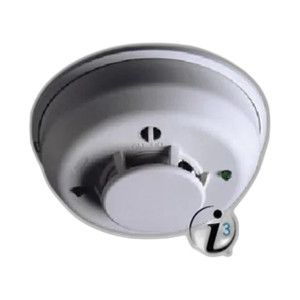
System Sensor 2W-B Photoelectric Smoke Detector
Overview
The System Sensor 2W-B is a 24VDC photoelectric smoke detector engineered for integration into supervised fire detection circuits in commercial and residential fire safety systems. The i3 Series design operates on a 2-wire communication protocol, reducing installation complexity and overall wiring costs compared to multi-conductor alternatives. Photoelectric sensing technology detects visible smoke particles with high sensitivity to smoldering fires — the type most commonly associated with upholstered furniture, paper, and electrical overheating scenarios. This makes the 2W-B a practical choice for mixed-occupancy buildings where smoldering-fire risk is elevated.
Key Features
- 24VDC Operation: Runs on standard building fire alarm DC power, eliminating the need for separate 120VAC circuits. Simplifies power distribution when deploying multiple detectors across a facility.
- 2-Wire Supervised Communication: All signaling and device status flow over a single twisted pair. Reduces cable runs and conduit requirements in retrofit installations — a meaningful cost savings when covering large floor plates.
- Photoelectric Sensing: Optical chamber design responds reliably to visible smoke particles from slow-burn fires. Not fooled by nuisance sources like dust or steam as easily as ionization detectors, lowering false-alarm rates in kitchens and mechanical rooms.
- NFC/13.56MHz Credential Authentication: Built-in Near Field Communication support enables device verification and credential-based access control. Allows technicians to confirm detector identity and commissioning status without breaking the wired connection — useful in large networks where manual verification would be time-consuming.
- Bidirectional Communication: The 2-wire circuit carries both alarm signals and device health status back to the control panel. You get real-time confirmation that each detector is present, powered, and functional — essential for life-safety compliance audits.
- Standard Control Panel Compatibility: Integrates with any 24VDC fire alarm control panel supporting 2-wire supervised loops. Works in distributed detection networks where detectors are wired in series and monitored as a logical group.
Integration & Compatibility
The 2W-B connects to supervised fire alarm circuits using standard 24VDC control panels. Its 2-wire protocol means you can chain multiple detectors on a single loop with minimal wiring infrastructure. The i3 Series architecture supports NFC credential handshakes during commissioning, enabling automated device enrollment and tamper verification at scale. Compatible with fire alarm systems requiring bidirectional feedback on detector status — no one-way alarm-only designs here.
When to Choose a Different Model
If your facility requires ionization detection (particularly sensitive to flaming fires), consider a complementary detector model from the System Sensor catalog rather than the 2W-B alone. If you need wireless communication or battery backup in areas where hardwiring is impractical, ionization-based wireless detectors are a better fit. For applications requiring integrated audio/visual notification or strobe synchronization in the detector itself, evaluate System Sensor models with built-in signaling functions.
Deployment Considerations
Install the 2W-B in locations where smoldering-fire risk is high: bedrooms, living areas, offices with upholstered seating, and storage rooms with paper or textile materials. Photoelectric detectors typically perform better in these environments than ionization-only units. Avoid mounting directly above kitchens or near steam sources — the optical chamber can be temporarily obscured by cooking vapors, though this clears quickly. Position detectors per NFPA 72 spacing guidelines (typically one per 900 square feet, no more than 30 feet from any point in the protected area). Use the NFC authentication feature during handoff testing to confirm each detector is enrolled and functional before final turnover.
Frequently Asked Questions
Q: Can I mix photoelectric (2W-B) and ionization detectors on the same 2-wire loop?
A: The 2W-B operates on a 2-wire supervised protocol. Mixing detector types on the same loop requires that all devices support the same communication protocol. Consult your control panel documentation and the detector manufacturer to confirm compatibility before installing mixed technologies on a single loop.
Q: What is the NFC credential feature used for during installation?
A: The 13.56MHz NFC interface allows technicians to authenticate and verify the detector during commissioning without breaking the wired connection. This enables automated device enrollment in large networks and confirms detector identity before final acceptance testing.
Q: Does the 2W-B require a separate power supply?
A: No. The 2W-B draws 24VDC directly from your fire alarm control panel. No additional transformer or power conditioning is needed — the control panel's 24VDC supply powers all 2-wire loop devices.
Q: Is the 2W-B suitable for outdoor or wet environments?
A: The 2W-B is designed for indoor, dry environments. If you need outdoor or damp-location protection, consult System Sensor's catalog for weatherproof or NEMA-rated variants.
Q: How do I test the 2W-B after installation?
A: Use a smoke test canister or aerosol per NFPA 72 guidelines. The photoelectric chamber will sense visible smoke and trigger an alarm signal on the 2-wire loop. Your control panel will report the alarm. Use NFC authentication to confirm the device enrolled correctly before final sign-off.
Q: What is the typical detector spacing requirement?
A: NFPA 72 requires spacing of no more than one detector per 900 square feet of floor area, with no point in the protected area more than 30 feet from the nearest detector. Specific layouts may require denser spacing depending on ceiling height and obstructions.
Ted PerryPerspective based on aggregated IP Security Depot and affiliated engineering team experience.
The System Sensor 2W-B is a workhorse for anyone deploying multi-detector fire systems on a fixed budget. The photoelectric architecture and 2-wire protocol keep installation labor and material costs predictable — you're not hunting for extra power supplies or running exotic cabling. The NFC credential layer is underrated; it eliminates guesswork during commissioning and gives you an audit trail of which detectors were enrolled and when.
Technical Highlights:
- Photoelectric Sensing: Optimized for smoldering fires (upholstered furniture, paper, slow electrical overheating) — the type that ionization detectors often miss until the fire is well-developed. This is a genuine advantage in office, residential, and hospitality environments.
- 2-Wire Supervised Loop: All alarm and status signals ride the same twisted pair. Reduces conduit volume by 40–50% compared to multi-conductor designs and simplifies troubleshooting when a detector fails — the panel tells you exactly which address on the loop went down.
- NFC/13.56MHz Authentication: Enables device verification without disconnecting wires. In a 50-detector installation, this cuts commissioning time by hours. Automated handshake also prevents spoofing if someone tries to install a counterfeit or misconfigured device.
Deployment Considerations:
- Photoelectric detectors are blind to ionization-sensitive flaming fires. For full coverage in high-risk areas (electrical closets, mechanical rooms with fuel), pair the 2W-B with a complementary ionization detector on a separate loop or choose a multi-technology head.
- The optical chamber can fog temporarily in high-humidity or steam-prone areas. Don't mount directly above kitchen exhaust or shower stacks. If kitchen coverage is critical, evaluate heat detectors or multi-sensor alternatives.
- Bidirectional communication means every detector's health status flows back to the panel in real-time. Make sure your control panel can handle the reporting load if you're deploying 100+ detectors across multiple loops — some older legacy panels can't process that volume.
The 2W-B shines in commercial retrofit and new construction where you're covering 10–200 detectors and need a balance between detection performance, installation simplicity, and cost control. It's the practical choice for architects and integrators who prioritize uptime and commissioning speed over exotic features.