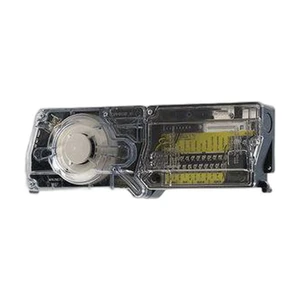
System Sensor D2 2-Wire Photoelectric Duct Smoke Detector
Overview
The System Sensor D2 is a 2-wire photoelectric duct smoke detector engineered for HVAC ductwork and air handling systems where early smoke detection is essential for life safety and code compliance. Unlike ionization detectors, the photoelectric sensing method in the D2 responds more reliably to smoldering fires common in ducted air environments. The unit operates on a conventional 29VDC fire alarm circuit, integrating directly into addressable and non-addressable control panels without requiring special interface cards or modules.
Key Features
- Photoelectric Sensing Technology: Optical chamber design detects smoke particles with greater sensitivity to slow-burning, smoldering fires—the dominant hazard in air handling systems. This is a real advantage over ionization in duct applications, where air velocity and particle distribution favor optical detection.
- 2-Wire Conventional Circuit: Connects directly to standard fire alarm wiring without addressable decoder cards, reducing installation labor and troubleshooting complexity. Two-wire operation means one wire pair handles both power and status signaling, cutting conduit runs and termination work compared to four-wire systems.
- 29VDC Operating Voltage: Standard voltage for legacy and modern fire alarm panels. Ensures compatibility across a broad installed base—critical when retrofitting or expanding existing systems without panel replacement.
- NFPA 72 Installation Compliance: Dimensions of 14.38 in. length × 5 in. width × 2.5 in. depth fit standard duct mounting brackets specified in the National Fire Code. The compact form factor works in supply ducts, return ducts, and mixed-air plenums without impeding airflow or creating installation headaches.
- Lightweight Design: Weighs 2.5 lbs, reducing bracket load and simplifying handling during installation and maintenance. Lower weight also eases temporary removal for duct cleaning or HVAC service.
- Direct Panel Integration: No intermediate modules, gateways, or specialized power supplies required—the D2 draws power directly from the fire alarm circuit. This streamlines wiring design and eliminates a potential single point of failure in the detection chain.
Integration & Compatibility
The D2 integrates into both conventional and addressable fire alarm systems. On conventional circuits, multiple detectors share a single pair of wires; when any detector goes into alarm, the entire circuit signals. Addressable installations use loop card technology where the D2 responds as a conventional device, allowing central reporting of its location without addressable intelligence in the detector itself. This dual-mode compatibility makes the D2 a practical choice for mixed-age systems or gradual upgrades where not all ductwork is monitored by the same panel generation.
Installation follows NFPA 72 National Fire Alarm and Signaling Code, which specifies duct detector placement, spacing, and airflow considerations. The D2's physical design accommodates these rules without custom fabrication or adapter plates.
When to Choose a Different Model
If your HVAC system requires spot-type detectors for enclosed spaces (rooms, corridors, lobbies), a ceiling- or wall-mounted photoelectric detector from the System Sensor catalog is more appropriate. If you need wireless or intelligent addressable duct detection with on-board diagnostics, higher-end models in the System Sensor lineup may offer those capabilities. For applications requiring aspirating (air-sampling) detection in very large or hard-to-access ducts, a sampling-line detector system is a better fit than a point detector.
Frequently Asked Questions
Q: Does the D2 work with my existing fire alarm panel?
A: The D2 is compatible with any standard fire alarm panel that supports 29VDC conventional or addressable circuits. Check your panel manual to confirm it provides 29VDC to the circuit where you plan to wire the D2. Most commercial panels (Notifier, Honeywell, Silent Knight, Edwards) support this voltage.
Q: How is the D2 mounted inside a duct?
A: The D2 uses standard duct mounting brackets (not included with the detector) that attach to the duct frame or sleeve. The compact 14.38 in. × 5 in. × 2.5 in. form factor sits flush or slightly protruding into the airstream, depending on bracket orientation. Verify airflow velocity and duct diameter against NFPA 72 tables before finalizing placement.
Q: What is the difference between photoelectric and ionization detection in ducts?
A: Photoelectric detectors (like the D2) are triggered by visible smoke particles that block or scatter light in an optical chamber. Ionization detectors respond to microscopic ions from combustion. In HVAC ducts, photoelectric sensors typically respond faster to smoldering fires and slower to fast-flaming fires. Ionization performs better on open flames. Most codes now favor photoelectric for duct applications.
Q: What is the warranty on the D2?
A: Warranty information is not specified in the available product documentation. Contact the manufacturer or your distributor for current warranty terms.
Q: Do I need separate power conditioning or backup power for the D2?
A: No. The D2 draws power directly from your fire alarm circuit at 29VDC. If your panel includes backup battery for the circuit, the D2 is automatically backed up. No additional UPS or power supply is required.
Q: Can the D2 be used in return air ducts?
A: Yes. The D2 is approved for installation in supply ducts, return ducts, and air handlers. Consult NFPA 72 Section 17.7.5 for specific placement rules based on duct size and airflow rate to ensure compliant detector spacing and sensitivity.
Ted PerryPerspective based on aggregated IP Security Depot and affiliated engineering team experience.
The System Sensor D2 is the workhorse 2-wire duct detector for facilities upgrading smoke protection in HVAC systems or maintaining legacy conventional fire alarm infrastructure. At 29VDC operating voltage and 2-wire signaling, it's designed to drop straight into existing panels without decoder cards or addressable logic, which matters when you're retrofitting older buildings or adding coverage to an overloaded addressable loop.
Technical Highlights:
- Photoelectric Optical Chamber: Smoldering fire response is faster and more reliable in ducted air than ionization. The D2's optical design is the current code preference for HVAC smoke detection under NFPA 72—real compliance traction, not a marketing claim.
- 29VDC Direct Power Draw: No power supply modules, no separate 24VDC or 12VDC rails needed. The D2 pulls power straight from the conventional circuit, which simplifies wiring diagrams and eliminates a failure point if your backup battery is already rated for the circuit.
- 2.5 lb Weight & Compact Profile (14.38" L × 5" W × 2.5" D): Fits standard duct brackets without custom fabrication. Low weight means less stress on hanging hardware and simpler removal for annual duct cleaning or HVAC maintenance.
Deployment Considerations:
- Verify your fire alarm panel actually provides 29VDC to the circuit you intend to use. Some older or reconfigured panels run at 24VDC or require step-down modules—check the panel wiring diagram before ordering.
- NFPA 72 mandates specific spacing and airflow velocity rules for duct detectors. A D2 in a low-velocity return air plenum may not meet sensitivity requirements. Have your duct layout reviewed against Section 17.7.5 before installation.
- Standard duct mounting brackets are sold separately and are not included with the detector. Factor bracket cost and availability into your project schedule.
The D2 is the right call for conventional fire alarm systems protecting medium-to-large HVAC plants where duct smoke detection must integrate with existing wiring and panel capacity without adding intelligent loop load or requiring new power infrastructure.