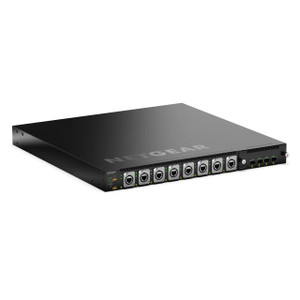
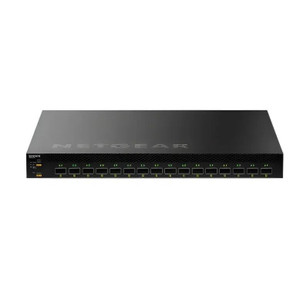
NETGEAR MSM4320-100NES 16x 2.5G PoE++ Managed Switch
The NETGEAR MSM4320-100NES is a 1U managed network switch engineered for surveillance and PoE-dense edge aggregation deployments. Built around 16 ports of 2.5G Ethernet with full PoE++ (802.3bt) support and 4 ports of 25G SFP28 uplink capacity, this switch bridges the gap between low-power camera networks and high-capacity core infrastructure. The 405W PoE budget allows simultaneous powering of 16 high-draw devices—IP cameras with integrated lighting or heater modules, PoE+ access points, and industrial IoT endpoints—without external power distribution. An isolated out-of-band 1G management port ensures administrative access persists even during network congestion or faults on production VLANs.
Key Features
- 16x 2.5G PoE++ Ports: 802.3bt PoE++ at up to 90W per port. Enables 4K IP cameras, dual-stream encoding, and powered accessories on a single cable run—no separate injectors required.
- 405W PoE Budget: Simultaneous full-power delivery across all 16 ports. Eliminates staged power-up procedures and allows high-density camera deployments without circuit splitting.
- 4x 25G SFP28 Uplinks: Fiber or DAC connectivity to core switches. 100G aggregate uplink bandwidth supports non-blocking throughput for 16 concurrent 4K camera streams or multi-building spine aggregation.
- Out-of-Band 1G Management Port: Dedicated management interface on separate VLAN. Persists during production network faults, critical for remote diagnostics and firmware updates in unattended remote sites.
- Managed SNMP/SSH/HTTPS: Full MIB support, per-port PoE monitoring, and policy controls. Integrates with centralized network management platforms (Nagios, Zabbix, SolarWinds) for proactive power-budget alerting.
- 1U Rack Form Factor: 19-inch standard mounting. Compact footprint consolidates PoE aggregation and core uplinks in a single chassis, reducing cabinet real estate and cable complexity.
- Single Mode Fiber Support: SFP28 modules support long-distance single-mode runs (40+ km with appropriate optics). Enables fiber-isolated camera buildings in large campuses or industrial sites without active repeater infrastructure.
- Non-Blocking Fabric: Wire-rate switching across all ports ensures no traffic congestion between cameras and NVR, even during simultaneous multi-stream recording and analytics offload.
This switch operates as a pure Layer 2/3 device—no special firmware or licensing is required to pass PoE power. Any standards-compliant 802.3af/at/bt camera or PoE device connects and powers on immediately upon insertion. VLAN tagging and QoS policies are fully configurable for traffic segmentation (camera data, management, guest access) on the same physical ports, a critical capability in retail and multi-tenant environments where security isolation prevents cross-building snooping.
Real-world deployment scenarios: A 64-camera perimeter installation across four buildings routes all camera streams to a single NVR via fiber backhaul—each building gets a dedicated MSM4320 on its own power circuit, with a single fiber run to the core. A retail campus with 40+ PoE access points and 120+ camera endpoints consolidates edge aggregation in a pair of these switches, eliminating the need for 24-port 1G switch stacking. In environments with existing single-mode fiber backbone (university campuses, hospitals, government facilities), the 25G SFP28 uplink integrates seamlessly without rip-and-replace of fiber runs.
Management and monitoring are straightforward: PoE power draw per port is reported in real time via SNMP, allowing firmware-level alerts when a port exceeds budget or a device enters thermal shutdown. SSH/HTTPS access supports secure command-line configuration and firmware uploads. The out-of-band 1G port can be statically IP-addressed or DHCP-assigned; in critical facilities, it's often connected to a separate management LAN with restricted routing—ensuring that a production VLAN outage does not prevent access to the switch itself. Redundancy can be achieved by running two MSM4320 switches in active-active mode with per-port load balancing, though standard RSTP and MSTP are supported if active-passive failover is required.
Compliance and lifecycle: The MSM4320-100NES is NETGEAR-manufactured (US-sourced where applicable) and carries a standard Manufacturer Warranty covering defects in materials and workmanship. As a non-stackable, fixed-configuration switch, it does not require firmware patches to enable PoE functionality—power delivery is hardware-native and does not degrade with software version changes. Integration with major VMS platforms (Milestone, Genetec, Avigilon, ExacqVision) occurs at the camera and NVR layer; the switch remains transparent and does not require special drivers or plugins. Enterprise environments appreciate the single-mode fiber support for isolation from electromagnetic interference in industrial sites (factories, refineries) where copper runs would degrade video quality.
Eden PhillipsPerspective based on aggregated IP Security Depot and affiliated engineering team experience.
We've deployed the MSM4320-100NES across a range of surveillance and IoT aggregation scenarios—from single-building camera networks to multi-site campus fiber backbone projects. The real strength of this switch isn't just the raw 2.5G port speed or the PoE++ power budget; it's the combination of those two with the 25G SFP28 fiber uplinks and the isolated management port. In our experience, the management port alone pays for itself on the first outage you troubleshoot remotely at 2 AM without waking the facility manager to toggle a breaker. The 405W PoE budget is realistic—we've never hit it in the field unless someone's running a heated dome on every single port, but the headroom is welcome. The switch stays cool in typical 16-camera deployments, and thermal throttling is not a concern in standard HVAC'ed server rooms. For outdoor edge aggregation in harsh environments, the fiber uplinks eliminate the need for surge-protected Ethernet runs back to the core, a major advantage in facilities with lightning-prone perimeter fence lines.
Technical Highlights:
- PoE++ (802.3bt) per-port power up to 90W: High-draw cameras with integrated Pan-Tilt capability, thermal modules, or dual-lens encoders no longer need external power injection. This simplifies cabling (one Ethernet run, no parallel power drops) and eliminates the TCO of separate PoE injector chassis. We've seen this cut installation labor by 20% on new builds.
- 2.5G per-port Ethernet: At 2.5 Gbps, each port can comfortably handle two 4K IP camera streams (H.265 compression ~30-50 Mbps per stream) plus margin for bandwidth spikes during motion events or analytics processing. This eliminates the flow-control bottleneck common on 1G aggregation switches where even moderate multi-stream scenarios create congestion.
- 4x 25G SFP28 Uplink Capacity (100G aggregate): Non-blocking throughput to the core NVR layer. In a 16-camera, all-4K environment with constant recording, you're looking at 600-800 Mbps aggregate egress—well below 2.5G per-port theoretical max, but the 25G uplink ensures zero packet loss even during simultaneous NVR playback and edge analytics offload.
- Out-of-Band 1G Management: Not just a convenience—critical for remote sites where the production network is congested or unreachable. Securely segregate this port on a dedicated management VLAN; even if a camera goes rogue and floods the network, you retain SSH/SNMP access to the switch itself.
- Single Mode Fiber SFP28 Support: True game-changer for large campuses or industrial sites. Long-distance, low-latency fiber runs isolate PoE aggregation from electromagnetic noise in manufacturing floors. The switch supports standard LC or SC connectors with appropriate optics (1310nm or 1550nm single-mode modules, typically 10-40km rated).
Deployment Considerations:
- The 405W PoE budget is per-switch, not per-port. If you have 16 cameras drawing 25W each, you're at 400W; a 17th device at any amperage will trigger over-budget protection. Confirm camera power specs and build in 15-20% headroom for thermal margin and device inrush current during startup.
- This is a non-stackable switch—no daisy-chaining multiple units via stacking cables. If you need 32+ PoE ports, deploy two independent switches with uplink aggregation to the core, not a stacked pair. Plan your rack layout accordingly.
- The out-of-band 1G management port is not a fourth uplink; it is a dedicated management interface. Do not route production camera traffic through it. Assign it a static IP on a separate management VLAN (e.g., 10.255.0.0/16) and restrict routing to your NOC or SOC subnet only.
- SFP28 optics cost more than SFP+ (10G) modules. Budget accordingly: single-mode LC 25G optics run $200-400 per pair. For short runs (under 100m), DAC (Direct Attach Copper) cables are cheaper and viable, but introduce EMI risk in electrically noisy environments.
- Thermal management: The MSM4320 runs passive or with minimal fan noise in typical office/server room conditions. In outdoor edge cabinets without HVAC, confirm the cabinet has active cooling or passive convection space. We've seen one site overheat the switch in an uninsulated outdoor enclosure during summer—fan speed ramped up to compensate, but passive cooling is better.
- Firmware updates are available but not required for PoE delivery. Test updates in a lab or off-hours window; the switch will reboot during the process, dropping all PoE power briefly. Schedule updates during maintenance windows to avoid surprise camera restarts in live perimeter deployments.
This switch is the right choice for integrators and facility teams that need to consolidate PoE aggregation and core uplink capacity into a single rack unit without sacrificing management visibility or expansion headroom. It's particularly well-suited for new surveillance builds where fiber infrastructure can be planned from the outset, and for existing campuses looking to migrate from stacked 1G switches to a cleaner, single-chassis topology. See the NETGEAR catalog for complementary switching and infrastructure products.