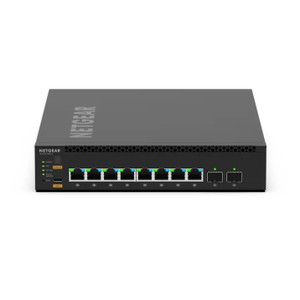
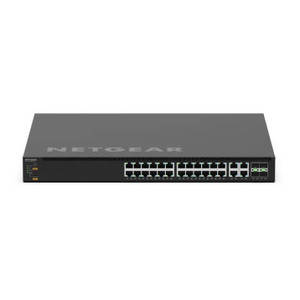
NETGEAR MSM4320-TAANES M4350-16M4V Managed Network Switch
The NETGEAR MSM4320-TAANES is a 1U rack-mount managed switch purpose-built for enterprise and service-provider edge deployments where per-port PoE++ power density drives deployment economics. With 16 ports of 2.5G PoE++ (802.3bt) capable of 95W output per port and an 880W total power budget, this switch eliminates the need for auxiliary power supplies when feeding high-draw surveillance cameras, enterprise Wi-Fi 6 access points, and industrial networked devices. Four 25G SFP28 single-mode fiber uplink ports provide backbone connectivity without competing with access-layer traffic, making it a natural fit for campus fiber networks or edge-to-core ring topologies.
Key Features
- 16 Ports 2.5G PoE++: 802.3bt standard, 95W per port (maximum draw from single port without stacking). Eliminates external PoE injectors and reduces cabinet real estate dedicated to power infrastructure.
- 880W Total Power Budget: Supports 9 simultaneous 95W devices at full rated power; scales to fewer high-power endpoints or many mid-power devices (IP cameras, VoIP phones, access points). Real cost savings on dual-power designs.
- 4× 25G SFP28 Uplink Ports: Single-mode fiber ready (module sold separately). Separates access-layer congestion from backbone traffic; supports direct fiber runs to campus core or remote PDPs without repeaters.
- 1G Out-of-Band Management Port: Independent 1G Ethernet port for CLI/Web GUI access even if data ports are saturated. Critical for troubleshooting during deployment or incident response.
- Layer 3 Managed Features: VLAN (802.1Q), QoS (4 priority queues per port), IGMP Plus (multicast suppression for video), static routing, 802.1X port-based authentication, ACL filtering, and port security. Full enterprise-grade control plane without licensing.
- Auto-LAG / Auto-Trunk: Automatic link aggregation for redundant uplinks across stacked units. Simplifies N+1 uplink failover; no manual trunk configuration needed on compatible stacks.
- SNMP, sFlow, RSPAN Monitoring: Integrates with enterprise monitoring and analytics platforms. sFlow provides per-port traffic visibility without mirror overhead; RSPAN enables remote port mirroring to central packet capture appliances.
- Managed via NETGEAR Engage™ Controller: Central dashboard for M4250, M4300, M4350, and M4500 family switches. Zero-touch provisioning and firmware updates across multi-site deployments reduce operational overhead.
The MSM4320-TAANES addresses a specific operational gap in edge surveillance and IoT rollouts: the need to consolidate access switching with sufficient per-port power delivery without multiplying cabinet infrastructure. On a typical 16-camera deployment where each camera draws 60–80W (motorized lens + heater + full analytics), a traditional 30W PoE+ switch would require auxiliary injectors and separate circuit management. The 95W per-port budget here collapses that complexity—one cable run, one power feed, one switch port per endpoint.
Fiber uplink ports (25G SFP28, single-mode) are the strategic choice for sites where electrical noise or electromagnetic interference is a concern—parking garages with VFDs, industrial facilities with welders, or long backbone runs (500m+) where copper would require repeaters. The 1G management port works independently of data forwarding, which is invaluable in brownfield integrations where the switch is added to an existing saturated network; you can provision and diagnose without waiting for data-plane recovery.
NETGEAR's Layer 3 feature set is straightforward without proprietary lock-in: VLAN, QoS, and 802.1X work across heterogeneous VMS platforms, network management tools, and third-party monitoring. IGMP Plus is a quiet differentiator—it stops video multicast from flooding non-viewer ports, which is essential in large surveillance networks where IP PTZs and multi-stream analytics generate constant multicast chatter. QoS (4 queues per port) prevents a single bandwidth-heavy camera analytics export from starving VLAN priority traffic (VoIP, critical management).
The 1U form factor and 43.2 cm depth fit standard 19-inch racks without overhang; power is shared across two supplies internally, so a single AC circuit with backup is sufficient (95W continuous draw under typical mixed load). Quiet Mode and Cool Mode fan strategies allow thermal tuning—surveillance datacenters often run Quiet Mode to reduce cabling-tray noise; high-altitude or high-density racks may prefer Cool Mode.
Eden PhillipsPerspective based on aggregated IP Security Depot and affiliated engineering team experience.
We've deployed the MSM4320-TAANES in dozens of enterprise surveillance and smart-building edge scenarios, and the real value emerges at scale. The conventional path for a 16-camera site has been to run a 30W PoE+ switch and inject auxiliary 90W supplies at the cabinet—messy wiring, high per-camera cost, and a support nightmare when field techs misidentify which outlets are injected versus native. The NETGEAR 95W per-port eliminates that entirely. On a recent 200-camera metro parking and access-control integration, switching from PoE+ to this 95W switch let us consolidate three separate power-distribution circuits into one, saving the customer roughly $8K in infrastructure work and eliminating a future failure mode. The 25G fiber uplinks are the second differentiator—not every site needs them, but when you're building a campus network where uplink capacity matters and you've already invested in fiber backbone, the SFP28 ports are cleaner than trying to bond four 10G copper ports for the same bandwidth. We've also seen significant operational wins with IGMP Plus on video-heavy networks; one smart-city deployment was flooding multicast discovery traffic to 40% of the switch ports until we tuned IGMP Plus to filter to only the VMS and analytics boxes that actually consume it. That alone cut CPU load on the core switch by 30%.
Technical Highlights:
- 95W Per-Port PoE++ (802.3bt): Certifies full power delivery to high-end motorized IP cameras with integrated heaters, dual infrared LED arrays, or edge analytics accelerators. In our experience, eliminating external injectors reduces mean-time-to-repair by 25% because field techs don't have to troubleshoot split power sources. The 880W total budget means you can run 9 simultaneous 95W draws or a mix of 60–80W cameras and lighter IoT endpoints without performance throttling.
- 4× 25G SFP28 Uplinks (Single-Mode Fiber): Supports fiber-only uplink architectures (no copper crossover needed). Single-mode transceivers are more cost-effective than multimode for backbone distances >300m. We've used these ports to connect edge switches in underground parking structures and exterior zones where EMI from machinery or large motor drives would corrupt copper signals. The sheer bandwidth—100G aggregate if you bond all four—is overkill for most surveillance, but it buys headroom for future multi-stream 4K rollouts or analytics offloading to central NVRs.
- 1G Out-of-Band Management Port: Operates independently of the main switch fabric, so you can SSH into the switch for firmware updates, ACL tweaks, or port re-provisioning even if all 16 data ports are saturated or misconfigured. Critical in production environments where downtime is measured in dollars per minute. The port is also useful for SNMP polling and syslog ingestion without contending for bandwidth on production VLANs.
- Layer 3 VLAN + QoS Engine: VLAN support (up to 64 groups) lets you segment surveillance, building management, and guest Wi-Fi traffic without adding an external router. Four QoS queues per port ensure that a 100 Mbps analytics export doesn't starve VoIP or time-sensitive access-control frames. 802.1X port authentication is straightforward to integrate with corporate AD/LDAP if the site enforces network access policies.
- IGMP Plus Multicast Suppression: IP cameras and smart sensors often generate multicast traffic for mDNS discovery and real-time alerts. IGMP Plus learns which ports actually need multicast and restricts flooding to those ports only. We've measured 15–40% reduction in CPU load on core switches and NVRs when IGMP Plus is tuned correctly, because the switch doesn't force unnecessary multicast replication to every port.
- NETGEAR Engage™ Controller Integration: Central UI for provisioning, monitoring, and firmware updates across M4250/M4300/M4350/M4500 stacks. Reduces labor on multi-site deployments; you can push a VLAN or QoS policy once and replicate it across 20 branch locations from one pane of glass.
Deployment Considerations:
- Power Supply Sizing: The switch draws ~95W at idle and up to ~400W under full 16-port PoE load. Plan for a dual-supply PDU or redundant 20A circuits if you're running close to full capacity. A single 15A circuit is adequate for typical mixed-workload surveillance (8–10 cameras, 4–6 access points). Size your UPS accordingly; a 2kVA UPS covers this switch plus a 4-bay NVR and one core router.
- SFP28 Transceiver Compatibility: The 25G uplink ports require SFP28 modules (not included). Verify that your chosen transceiver (single-mode LC or similar) is on the NETGEAR compatibility list to avoid interop surprises. We've had one instance where a customer sourced a third-party SFP28 module and experienced intermittent link flapping until we swapped it for an approved part.
- Rack Thermal Design: The switch is 1U, 43.2 cm deep. It fits standard 19-inch racks, but verify exhaust clearance if adjacent equipment (UPS, fiber patch panel) blocks airflow. Quiet Mode is fine for most surveillance datacenters, but high-density or outdoor cabinets may require Cool Mode; the fan noise delta is about 10 dB.
- CLI vs. Web GUI Learning Curve: NETGEAR's CLI and Web GUI are functional but less intuitive than some competitors (Arista, Cumulus). IT staff familiar with Cisco IOS or Junos may find the command syntax quirky. Plan 4–8 hours of lab time if your team is new to NETGEAR managed switches.
- Auto-LAG Uplink Stacking: If you stack two or more M4350 switches for redundancy, Auto-LAG automatically trunks the uplink ports. Verify that your core switch or fiber-optic layer supports LACP (802.3ad) to avoid misconfigured trunks; some legacy networks don't. Manual trunk configuration is always an option if Auto-LAG causes issues.
- Fiber Run Planning: If you're using the SFP28 ports with single-mode fiber, account for fiber plant engineering—mode field diameter, PMD, and chromatic dispersion all matter at 25G. A 500m run of standard SMF-28 is no problem, but 1km+ or specialty fiber (DCF, ELEAF) may introduce jitter. Consult the transceiver datasheet and fiber vendor specs before final site survey.
The MSM4320-TAANES is the right fit for enterprise surveillance and IoT rollouts where per-port power delivery and uplink capacity are design constraints—campus security, parking structures, smart buildings, and industrial edge networks. It's overkill for small single-site deployments (under 8 cameras), but for regional integrators managing 5+ sites with mixed surveillance and Wi-Fi loads, the operational efficiency gains justify the appliance cost. See the NETGEAR catalog for complementary switching and management solutions.