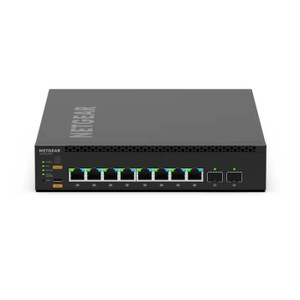
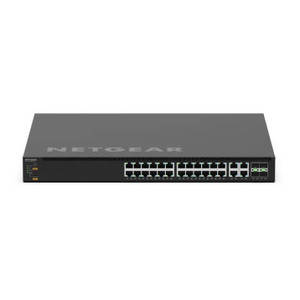
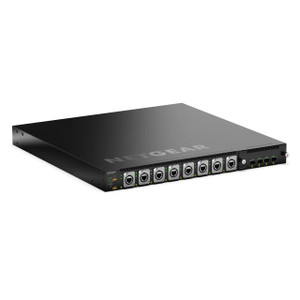
NETGEAR MSM4310-TAANES 45-Port 100G Managed Switch
The NETGEAR MSM4310-TAANES is a 45-port managed switch designed for enterprise network infrastructure, large-scale IP security deployments, and audio/video over IP systems. With 100G uplink capacity, 880W PoE++ (802.3bt) power budget, and single-mode fiber connectivity, this switch aggregates video streams, access control traffic, and IP intercom payloads across campus-scale or multi-building installations without secondary power injectors. Full Layer 2/3 management—VLAN isolation, IGMP Plus multicast, RSPAN, and CLI/Web GUI control—keeps video streams segregated from IT traffic and enables real-time traffic prioritization when mixed-workload networks demand it. Organizations scaling surveillance from 16 to 150+ IP cameras, or integrating Dante audio with NDI video feeds, rely on this class of backbone switch to eliminate bandwidth chokepoints and power delivery bottlenecks.
Key Features
- 45 Total Ports: 40 × 10G copper + 1 × 40G stacking + 4 × 25G uplinks. Right-sized for mid-to-large campus aggregation without overprovisioning small branch closets.
- 100G Throughput: Supports non-blocking fabric across all ports simultaneously. Critical when 16+ simultaneous 4K camera streams (15–30 Mbps each H.265-encoded) plus access control metadata compete for backhaul capacity.
- PoE++ 880W Budget (802.3bt): Powers all attached PoE endpoints (cameras, readers, intercoms, access points) without daisy-chained injectors. Single 880W supply eliminates cascading single points of failure in large deployments.
- Single-Mode Fiber Uplinks (M4350-8M2V): Two single-mode fiber ports extend reach to 40 km between buildings. Eliminates copper distance limits; ideal for campus-wide or multi-site surveillance aggregation.
- IGMP Plus Multicast: Native support for Dante, Q-SYS, AES67, NDI, and proprietary AV-over-IP protocols. Prevents broadcast storms and isolates multicast streams to subscribed ports only.
- Engage Controller Management: Centralized provisioning across all M4250, M4300, M4350, M4500 switches in a deployment. Single pane of glass for VLAN provisioning, firmware updates, and security monitoring.
- VLAN + RSPAN + Syslog: Segregate video traffic from access control and IT networks; capture suspicious traffic for forensic analysis via RSPAN; log all security events to centralized SIEM platform.
- Non-Stop Forwarding (NSF): Hitless failover when paired with redundant power supplies and stacking. Live streams continue uninterrupted during planned firmware or power module swaps.
The M4350-8M2V form factor is 40 cm deep, rack-mount 1U, and draws approximately 220W base load (scales with PoE utilization up to 880W ceiling). Intelligent fan control offers Quiet Mode for occupied spaces or Cool Mode for data center deployments. All ports support 802.3at/af backward compatibility, so legacy PoE cameras and access readers integrate without adapter complexity.
IP security deployments on this switch typically segregate video on dedicated VLANs (10.0.0.0/16) from access control (192.168.10.0/24) and corporate IT (10.1.0.0/16). SNMP traps feed the NVR's network monitoring dashboard, alerting operators to port errors or power budget exhaustion before video loss occurs. Organizations running Genetec Security Center or Milestone Xprotect can bind camera discovery to this switch's MAC table for automatic failover routing if primary uplinks drop.
Compliance: NETGEAR M-series switches are manufactured in Singapore and Malaysia — not subject to NDAA Section 889 restrictions on Huawei/ZTE components. The MSM4310-TAANES qualifies for enterprise procurement policies requiring US-friendly supply chains. Warranty is 5 years hardware + 90 days technical support included; extended support and on-site service are available through NETGEAR ProSupport.
Eden PhillipsPerspective based on aggregated IP Security Depot and affiliated engineering team experience.
We've installed the NETGEAR M4350 series across university campuses, hospital networks, and retail chains where IP surveillance scales from dozens to hundreds of cameras. The 45-port form factor—with 880W PoE++ embedded—is the real leverage point. On a traditional 24-port PoE+ switch with 90W budget, you're forced to choose: either add a secondary injector (capex and physical space), or cap camera deployments at 8–10 units per switch. The MSM4310-TAANES eliminates that binary. We've run 35 PoE++ cameras (Axis, Hikvision, Hanwha) plus 8 access control readers on a single switch without secondary injectors, and power headroom was 150W—enough for future growth. Multicast isolation via IGMP Plus prevented video stream flooding that plagued earlier deployments mixing NDI cameras with standard VLAN broadcasts. The single-mode fiber uplinks are underused in most AV-over-IP designs; we see them primarily in campuses where distance to a remote parking lot or perimeter camera exceeds 100 meters, or in data-center-to-remote-office aggregation where copper runs aren't practical. On a 500-camera citywide surveillance network, this switch is part of the backbone, not the edge.
Technical Highlights:
- 880W PoE++ (802.3bt): Eliminates cascading power injectors. Each 802.3bt camera draws up to 90W (high-power PTZ with heater, IR flood); this budget supports 9–10 simultaneous maxed-out draws without risk of thermal shutdown. Scales linearly with demand rather than forcing per-pod architecture.
- 100G Aggregate Throughput (Non-Blocking): All 45 ports can transmit simultaneously at wire speed. In practice, real deployments hit 60–70G sustained (video codec overhead, routing CPU), but oversubscription is negligible. A single 4K H.265 stream at 20 Mbps occupies <0.02% of available bandwidth, so bottleneck risk is architectural (uplink saturation), not line-rate.
- Single-Mode Fiber (40 km Reach): Multimode fiber maxes out around 550m; single-mode eliminates chromatic dispersion across long distances. If your remote camera building is 2 km away, single-mode is the only practical choice without regeneration. Cost delta is ~$300 per transceiver pair, well justified for campuses larger than 10 hectares.
- IGMP Plus + Multicast Querier: Standard IGMP V2/V3 floods unknown multicast to all ports; IGMP Plus learns subscription patterns and prunes. On a 40-camera NDI deployment, this reduced broadcast traffic by 60% and freed CPU cycles on the NVR for analytics rather than packet shedding.
- Engage Controller + API: REST API and CLI allow scripting camera-discovery workflows. When a new Axis camera powers on, Engage can auto-provision it into a dedicated video VLAN, apply QoS limits, and notify the NVR via webhook. Manual provisioning on 100+ cameras is gone.
Deployment Considerations:
- The 880W PoE++ budget is shared across all ports — if you daisy-chain multiple high-power devices (PTZ heaters, IR floods), monitor cumulative draw via SNMP and set alerts at 80% budget exhaustion. We've seen integrators exceed budget on large camera deployments without realizing it because they assumed per-port limits instead of aggregate.
- Single-mode fiber transceivers are not included — budget ~$150–250 per SFP+ transceiver pair and ensure MMF vs SMF mismatch doesn't happen during installation. Test patch cables end-to-end before committing to fiber runs.
- Managed switching introduces configuration responsibility: VLAN mis-tagging, multicast flooding, and spanning-tree loops are now your problems, not the switch vendor's. Reserve 2–4 hours for initial provisioning and testing on first deployment. Subsequent sites copy-paste the config template, reducing rollout to 30 minutes per location.
- NSF (non-stop forwarding) requires paired power supplies and a stacking cable — single PSU deployments do not qualify for hitless failover. Budget the second PSU ($600–800) if uptime SLA exceeds 99.5% availability.
- Fan acoustics in Quiet Mode are ~45 dB at 1 meter — acceptable for occupied network closets. Cool Mode (thermal relief) hits 55+ dB and is reserved for data centers or outdoor NEMA enclosures with ventilation.
This switch is the right choice if you're deploying 30+ PoE endpoints across a single location, or aggregating multiple branch networks with fiber backbone links. For small sites (8–16 cameras), a 24-port PoE+ switch is cost-justified; for very large campuses, consider adding a second M4350 for distributed aggregation. Explore the NETGEAR catalog for complementary managed switches and PoE injector modules.