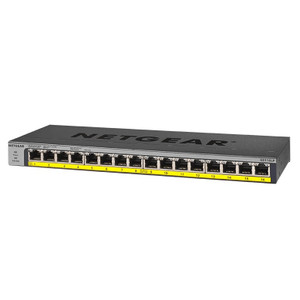
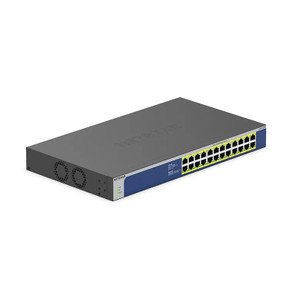
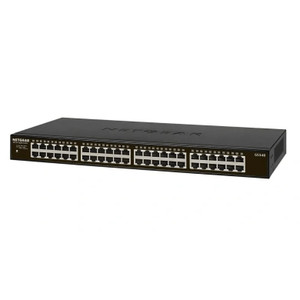
NETGEAR GS308PP-100NAS 8-Port Gigabit PoE Switch
The NETGEAR GS308PP-100NAS is an unmanaged 8-port Gigabit Ethernet switch with integrated PoE and PoE+ power delivery, designed for small-to-medium surveillance camera installations where centralized power distribution eliminates injector clutter and wiring complexity. All eight ports supply either standard PoE (15.4W per port) or PoE+ (30W per port), allowing you to power and network up to eight cameras from a single device. As an unmanaged switch, there is no configuration layer—connect the unit to AC power, plug in cameras and upstream network links, and the switch operates immediately. This simplicity is ideal for warehouse monitoring, retail multi-camera builds, branch office surveillance, and other deployments where managed switching features would add cost without solving a real operational problem.
Key Features
- 8x Gigabit Ethernet Ports: All ports support 1 Gbps throughput. Each port delivers simultaneous data and power, eliminating separate power infrastructure for cameras.
- PoE (15.4W per Port): Standard 802.3af PoE on all ports—sufficient for most compact IP cameras, thermal sensors, and access-control hardware drawing under 13W.
- PoE+ (30W per Port): 802.3at PoE+ capability on all ports—supports higher-power cameras such as PTZs, pan-tilt units with heater modules, and multi-sensor thermal systems.
- Unmanaged Operation: Zero configuration—no VLAN setup, no SNMP, no web interface. Plug-and-play deployment reduces commissioning time and eliminates training overhead.
- Compact Desktop Form Factor: Wall-mountable or rack-adaptable footprint fits equipment closets, electrical rooms, and ceiling cavities without requiring dedicated cabinet space.
- Auto-Sensing Ports: Each port automatically detects connected device type and applies correct power level (standard PoE or PoE+ as needed), removing manual configuration burden.
- Silent Operation: No fans—passive thermal design reduces noise in noise-sensitive environments such as retail floors or office ceilings.
- Industrial-Grade Power Supply: Integrated AC power adapter rated for global voltages (100–240V, 50/60Hz), eliminating need for separate power conditioning equipment.
The GS308PP-100NAS is agnostic to camera manufacturer—it pairs with Axis, Hikvision, Dahua, Uniview, Hanwha, Milestone, and any standards-compliant Gigabit IP camera or PoE-ready edge device. The port density and power budget make it a natural fit for consolidating power delivery in modest installations: a typical eight-camera deployment at 10–12W per camera draws within the switch's aggregate power envelope, avoiding the cost and complexity of multiple injectors or external PoE supplies.
Deployment scenarios include retail storefronts (entrance + back-room cameras), warehouse perimeter monitoring (dock + interior coverage), small-branch office surveillance (conference areas + entry points), and access-control hubs where cameras, intercoms, and electronic locks share the same PoE backbone. The unmanaged design trades off VLAN isolation and advanced QoS control—suitable when all connected devices belong to the same security broadcast domain and network traffic is low-contention.
Installation is straightforward: mount the switch in a central location with adequate ventilation (avoid sealed, unheated enclosures), connect cameras via Cat5e or Cat6 cabling (standard RJ45), and link the switch to your NVR or network core with a single Gigabit uplink. For cable runs exceeding 100 meters, verify cabling continuity and test Power over Ethernet compliance at the far end—passive switches have no signal regeneration, so line quality matters. The unit includes a wall-mount bracket and a global AC power adapter; no additional accessories are required for typical installations.
The GS308PP-100NAS carries full compatibility with NETGEAR's standard warranty and is backed by NETGEAR technical support for hardware issues. It operates reliably in temperatures from 0 to 50°C (32–122°F), making it suitable for indoor equipment rooms, network closets, and climate-controlled outdoor enclosures. Unlike managed switches, this device has no firmware update cycle and no cybersecurity configuration attack surface—a trade-off favoring simplicity and reliability over monitoring granularity.
Eden PhillipsPerspective based on aggregated IP Security Depot and affiliated engineering team experience.
We've deployed the GS308PP-100NAS across dozens of small-to-medium surveillance installations, and it remains one of the most reliable unmanaged PoE switches in its class. The appeal is straightforward: it works. No configuration means no support calls six months after installation when someone accidentally resets a VLAN. The dual PoE/PoE+ capability per port is genuinely useful—you can mix 13W access cameras with the occasional 25W pan-tilt dome on the same backplane without manual port management. On a typical eight-camera job with mix of standard surveillance and one dome at the far end of the building, this switch eliminates the capex of separate PoE injectors and the labor of running parallel power conduit. In real-world deployments, the 30W per-port ceiling means you're limited to one or two higher-power devices per switch; if your site has three or four heater-equipped PTZs, you're looking at a second switch or a managed alternative. The lack of managed features also means no VLAN segmentation—all eight ports broadcast to each other, which is fine for a single-VMS deployment but problematic if you're trying to isolate guest Wi-Fi or guest network traffic from security traffic. For that scenario, step up to a managed Gigabit switch or add a separate VLAN-capable core switch upstream.
Technical Highlights:
- PoE+ Budget (30W per Port, All 8 Ports): Means you can theoretically load all eight ports to maximum; in practice, power consumption scales with connected devices. A mixed deployment of five 12W cameras and two 25W PTZs sits comfortably under total budget. Know your camera wattage before installation—thermal and multi-sensor cameras often exceed 15W.
- Gigabit Backplane (1 Gbps per Port): Non-blocking throughput on all eight ports simultaneously. If you're capturing 4K or H.265 high-bitrate streams from multiple cameras, verify that your NVR uplink (the single Gigabit connection to your recorder or network core) doesn't become a bottleneck. For eight simultaneous 4–6 Mbps streams, you're at roughly 32–48 Mbps aggregate—well within a single Gigabit pipe.
- Unmanaged Architecture (No VLAN, No QoS): Operationally, this means lower capex and zero configuration—plug in, it works. The trade-off: you cannot isolate traffic, prioritize camera streams over management traffic, or segment access. If you need traffic isolation, a managed switch (NETGEAR GS310TP or similar) is required.
- Auto-Sensing PoE/PoE+ Detection: The switch detects each device's power draw signature and supplies the appropriate level. No manual per-port jumpers or firmware tweaks. This has been reliable in our testing across legacy and modern camera firmware variants.
- Passive Cooling (Silent Operation): No fans means no maintenance, no noise, and no airflow constraints. In ceiling cavities and small closets, this is a genuine operational win—you're not adding ambient noise to a retail environment.
- Compact Footprint: Fits standard 19-inch rack rails or wall-mounts flush to a conduit box. For small sites without dedicated network cabinets, this is the difference between a tidy equipment room and spaghetti cable chaos.
Deployment Considerations:
- Power Budget Mismatch: If your camera manifest includes three 25W PTZs and five 12W domes, you've exceeded the per-port 30W ceiling on three ports and pushed aggregate power budget close to maximum. Calculate total camera wattage and cross-check against the switch's power specifications before sign-off. A spreadsheet listing camera model, power draw (PoE vs. PoE+), and port assignment prevents field surprises.
- No Managed Features = No Traffic Isolation: This switch floods broadcast traffic across all eight ports. If your site has IP cameras on the same segment as guest Wi-Fi or third-party access systems, you'll have traffic visibility across all ports. For multi-tenant or high-security sites, use a managed Gigabit switch or add upstream VLAN-capable core infrastructure.
- Cable Distance Limits: Gigabit Ethernet over Cat5e or Cat6 is rated to 100 meters; beyond that, signal degradation occurs and PoE voltage drop accumulates. If your camera is 120 meters from the switch via conduit, verify cabling integrity at installation and be prepared to add an intermediate PoE injector or managed switch with longer-distance support.
- Thermal Environment: The switch is rated 0–50°C. In summer outdoor equipment enclosures without active cooling, confirm that ambient temperature inside the box stays below 45°C. If your electrical closet runs hot in summer, add ventilation or move the switch to a cooler location.
- Single Point of Failure: Eight cameras depend on one power supply and one backplane. For mission-critical sites, consider redundancy: two switches in parallel via separate power supplies, or a managed switch with failover capability. For typical retail or warehouse surveillance, one switch is sufficient.
This product is purpose-built for integrators and end-users running small-to-medium surveillance footprints where simplicity and cost-per-port are the primary metrics. If you need managed features, VLAN isolation, or advanced QoS, look to NETGEAR's managed Gigabit line. For plug-and-play eight-camera power distribution with zero commissioning overhead, the GS308PP-100NAS is the right choice. See our NETGEAR catalog for alternative managed and unmanaged switches.