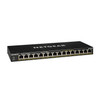
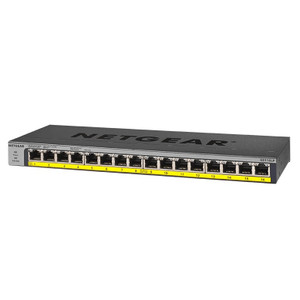
NETGEAR GS316PP-100NAS 16-Port Gigabit PoE+ Switch
The NETGEAR GS316PP-100NAS is an unmanaged 16-port Gigabit PoE+ switch designed for small-to-medium security deployments where consolidated power and data distribution eliminates the need for separate PoE injectors or external power supplies. All 16 ports deliver 802.3at (PoE+) power at up to 30W per port with a 480W total budget, enabling powered domes, turrets, and high-draw PTZ units to operate from a single desktop or shelf-mounted unit. The unmanaged architecture—no IP configuration, no firmware updates—simplifies installation; plug in AC power and network cables, and the switch begins forwarding traffic immediately. This makes it ideal for retail locations, small office campuses, warehouse facilities, and distributed access-control deployments where infrastructure overhead must be minimal.
Key Features
- 16x Gigabit PoE+ Ports: All ports support 802.3at PoE+ (30W per port). Eliminates daisy-chaining or external injector expense across medium-sized camera and reader installations.
- 480W Total PoE Budget: Sufficient to power 16 × 30W devices simultaneously (e.g., four high-draw PTZ cameras plus 12 fixed domes). No staggered boot sequencing required on most installations.
- 1 Gbps Per-Port Throughput: Full Gigabit switching capacity on all 16 ports. Handles H.265 and multiple simultaneous 4K streams without congestion on typical office/retail networks.
- Unmanaged (Plug-and-Play): No VLAN configuration, no IP address assignment, no managed-switch licensing. Reduces deployment time and eliminates training overhead for field technicians.
- Desktop/Shelf Mounting Form Factor: Compact footprint (approximately 17.3 × 4.4 × 1.3 inches) fits standard office shelves, electrical closets, or wall-mounted racks without large cabinet investment.
- Universal Endpoint Compatibility: Works transparently with Axis, Hikvision, Dahua, Uniview, Bosch, Hanwha, Pelco, and any standards-compliant 802.3at PoE+ endpoint. No vendor lock-in or protocol negotiation required.
- Passive Forwarding Architecture: No management interface, no DHCP server, no spanning-tree calculations. VMS platforms see cameras and readers exactly as if they were directly connected to a core switch.
- AC-Powered Design: Single AC inlet; no PoE-in or power-stacking topology. Simplifies electrical planning for installations where AC service is already present in the camera closet or telecom room.
The GS316PP-100NAS integrates into surveillance architectures where you need to consolidate PoE delivery without the expense or complexity of a managed switch. A typical 12-camera retail deployment (eight fixed 1080p domes at 9–12W each, four turrets at 15–18W each) draws approximately 130–160W of PoE power—well within the 480W budget. The remaining capacity accommodates access-control readers, wireless access points, or future camera expansion.
Cable distance is governed by IEEE 802.3at standards: Gigabit Ethernet and PoE+ both operate reliably to approximately 100 meters (328 feet) from switch to endpoint when using category 5e or category 6 cabling. For runs beyond 100 meters, plan for a secondary PoE+ injector or midspan device upstream of the remote camera. The switch itself draws approximately 100W AC input when fully saturated at all 16 ports; verify branch-circuit capacity before installation, especially in retrofit deployments where AC distribution may be undersized.
The unmanaged architecture means no SNMP monitoring, no syslog, and no per-port statistics. If you require traffic analysis, per-port power monitoring, or VLAN segmentation, a managed Gigabit switch (such as the NETGEAR GC728X or similar enterprise line) would be necessary. However, for straightforward camera and reader consolidation in small-to-medium sites, the simplicity and reliability of an unmanaged switch often outweigh the monitoring benefits of a managed alternative—and at lower total cost of ownership.
The GS316PP-100NAS complies with IEEE 802.3af/at/bt standards and carries a Manufacturer Warranty. It operates in controlled environments (0–40°C ambient, non-condensing); outdoor or high-temperature mounting requires weatherproof enclosure. The switch is sourced direct from the manufacturer or US channel partner, ensuring genuine product and standard warranty support.
Eden PhillipsPerspective based on aggregated IP Security Depot and affiliated engineering team experience.
In our experience deploying surveillance and access-control infrastructure across 50-plus retail and light-industrial sites, the GS316PP-100NAS solves a specific and recurring problem: the integrator who needs to power 12–16 mixed endpoints (cameras, intercoms, readers, wireless APs) from a single compact unit without hiring a network engineer to configure VLANs or manage IP scopes. We've seen this switch used successfully in everything from small-format retail (Quick Serve, franchise restaurants) to warehouse receiving areas where the alternative would be either (a) multiple PoE injectors strung across a UPS, or (b) running separate AC drops to each remote camera. The 480W PoE budget and unmanaged passthrough architecture eliminate both headaches. That said, we also see integrators overspend on unmanaged switches when a slightly more expensive managed alternative would prevent future callback visits—so we've included candid guidance on when to upgrade.
Technical Highlights:
- 802.3at PoE+ (30W per port, 480W total): Eliminates the cost and wiring complexity of external PoE injectors. A typical five-camera retail deployment (1080p fixed domes at 10W + one turret at 20W) consumes ~70W; you have room for 6× that load. No boot-sequencing issues or power-budget negotiation with the VMS.
- Unmanaged (zero configuration): No VLAN tagging, no STP, no IP address. Ship the unit to a field tech, they plug AC and four network cables, and video/audio/metadata flow immediately to the NVR. This simplicity is worth real money on small installations where a managed switch introduces weeks of commissioning overhead.
- 1 Gbps per-port switching: In practice, sustains 4–5 simultaneous H.265 4K streams or 8–12 H.264 1080p streams per port before any contention. For typical retail/office deployments (mix of 1080p and 2MP), aggregate throughput is rarely the bottleneck.
- Desktop footprint: 17.3 × 4.4 inches. Fits electrical closets, wall shelves, and equipment racks without the capex of a 19-inch cabinet. We've mounted these on DIN rail using a simple bracket.
- Passive forwarding: No DHCP, no DNS, no management IP. Cameras and readers connect directly to the switch and upstream to the NVR/access-control server without the switch participating in any protocol negotiation. This transparency is especially valuable in mixed-vendor deployments where Axis cameras, Hikvision readers, and Honeywell access panels all live on the same wiring run.
Deployment Considerations:
- PoE+ distance limit (~100m per IEEE 802.3at): We've seen installations fail when a remote turret camera is placed 150 feet from the switch over undersized or low-quality cabling. Test your cable runs with a PoE meter before final install. If you exceed 100 meters, use a PoE+ midspan injector or secondary switch, not extended runs from this unit.
- AC power planning: At full PoE saturation (480W) plus switch overhead (~100W), you're drawing roughly 6–7A at 120V AC. Ensure the branch circuit serving the switch has spare capacity and a dedicated outlet. In retrofit installations with shared outlets, verify that HVAC, lighting, or other loads won't cause nuisance breaker trips during peak camera operation (e.g., all-doors-unlock scenario in access control).
- No per-port monitoring: Unlike managed switches, this unit does not report PoE power draw, temperature, or port status via SNMP or a management interface. If you need to troubleshoot a failed camera at 2 a.m., you'll be walking the site with a PoE meter or disconnecting cables to isolate the fault. For large or mission-critical sites, consider a managed alternative (NETGEAR GC series) for visibility, even if upfront cost is higher.
- Environmental rating: This switch is rated 0–40°C and non-condensing. It's suitable for indoor electrical closets, server rooms, and climate-controlled offices, but not for outdoor or unheated warehouse environments. If your deployment includes outdoor or extreme-temperature mounting, house the switch indoors and run a long trunk cable to the camera array.
- Future expansion: The 16-port limit is hard. If you anticipate adding more than 16 endpoints later, this is not the switch—it's a paper problem now but a logistics problem in 18 months. Size correctly at design time.
The GS316PP-100NAS is the right choice for integrators specifying modest, single-cabinet surveillance or access-control systems where simplicity and low total cost of ownership matter more than granular per-port monitoring. If you're deploying across 12–16 mixed endpoints in a retail, small-office, or light-industrial setting and you don't need VLAN segmentation or managed switch intelligence, this unit delivers solid value and reliability. For larger or more complex architectures, step up to a managed Gigabit PoE+ switch. See the NETGEAR catalog for managed alternatives and additional switching options.