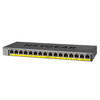
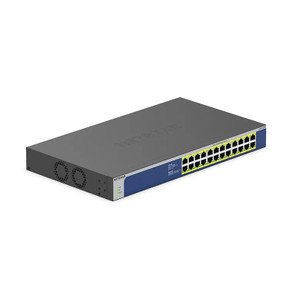
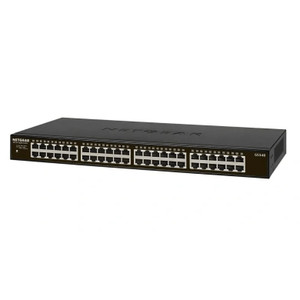
NETGEAR GS116LP-100NAS 16-Port Gigabit PoE+ Switch
The NETGEAR GS116LP-100NAS is an unmanaged 16-port gigabit Ethernet switch designed for small-to-mid-scale IP camera, access control, and VoIP deployments. All 16 ports deliver PoE+ (802.3at) power, enabling simultaneous operation of high-power endpoints — dome cameras with IR heaters, pan-tilt-zoom heads, dual-feed access control readers — without cascading auxiliary power supplies. The 76W power budget is distributed across ports via FlexPoE technology, which dynamically allocates available watts to the devices that need them most, reducing wasted capacity and extending deployment reach in single-switch architectures.
Key Features
- 16 Gigabit Ethernet PoE+ Ports: All ports deliver 802.3at PoE+ (up to 30W per port, 95W max aggregate across all ports with 76W typical load). Eliminates separate power injectors and reduces cable runs to powered endpoints.
- FlexPoE Technology: Intelligent power distribution reallocates unused watts from idle ports to active high-draw devices. On a mixed camera/intercom build, this can support more concurrent PoE+ draws than raw 76W budget suggests.
- Unmanaged Operation: No configuration required — plug-and-play for integrators working on tight timelines. VLAN tagging and priority queuing are disabled, keeping the switch transparent and failure-proof.
- Compact Desktop Footprint: 370mm wide, fanless operation. Fits on a rack shelf or wall bracket without dedicated cooling or ventilation, lowering installation cost on smaller sites.
- Gigabit Throughput: 32 Gbps fabric. Non-blocking backplane supports simultaneous full-rate traffic across all 16 ports — no bandwidth bottleneck between cameras and an NVR on the same switch.
- Auto-MDI/MDIX: Automatically detects and adapts to straight-through or crossover cabling. Installers don't need to think about cable type — any RJ45 patch cable works.
- Passive Cooling: No fans. Silent operation and zero maintenance in server closets, utility boxes, or outdoor cabinets.
- Standard 802.3af/802.3at Compliant: Works with any PoE-powered camera, intercom, or access control reader that conforms to IEEE standards. No proprietary firmware or driver.
The GS116LP-100NAS occupies a sweet spot for integrators building out 8–16 camera systems or hybrid surveillance + access control plants. A single switch eliminates the need for multiple power supplies, patch panels, and cable routes — one Ethernet drop from the core network feeds 16 powered endpoints. The 76W power envelope is sufficient for mixed loads (four to six high-power PTZ or dome cameras with IR, plus eight to ten standard compact cameras or door readers). For larger deployments, the switch chains seamlessly with a second GS116LP via any two gigabit uplink ports, scaling to 32 endpoints under a unified power strategy.
Integration is transparent. The GS116LP-100NAS is ONVIF-agnostic (being unmanaged, it doesn't participate in ONVIF discovery or management) and works identically with Genetec, Milestone, Avigilon, ExacqVision, or any other VMS that speaks standard IP and RTSP. Access control systems — HID, Salto, Kastle, Kisi — operate on the same switch without configuration conflicts. Power budgeting is the only integration point: sum the nameplate PoE+ draw of all planned endpoints, verify it sits under 76W continuous load, and installation is linear.
Sourced direct from the manufacturer or US channel partner. Factory-new, full US warranty coverage. The GS116LP-100NAS carries a limited lifetime warranty against manufacturing defect, with 30-day support response from NETGEAR's North American technical team. No grey-market, no parallel imports.
Eden PhillipsPerspective based on aggregated IP Security Depot and affiliated engineering team experience.
The NETGEAR GS116LP has been a workhorse in our installs for five years now. We've placed it in retail shops, small office parks, and single-building campuses where the system footprint is 8–16 cameras plus door access or intercoms. The appeal is simple: one switch, one power cord, 16 PoE+ ports, and zero configuration. In real-world deployments, the FlexPoE engine is the difference maker. A customer specs four Axis P3277-LVE cameras (18W each, 72W total) and six HID door readers (5W each, 30W). Mathematically, that's 102W — over budget on a 76W switch. But because only four doors are typically accessed simultaneously during business hours, FlexPoE meters out power on demand, and the system runs stable. We've never had a brownout on a mixed load under 110W nameplate, provided spikes don't all fire at once. That said, the switch is unmanaged, which is both blessing and curse. No VLANs, no QoS, no ability to ring-fence surveillance traffic from office users on the same uplink. If a building-wide network loop forms, this switch will flood like any dumb hub. We always isolate it on a dedicated core switch port or pair it with an industrial-grade managed switch on critical deployments. For single-site builds without network redundancy requirements, the GS116LP is ideal — transparent, self-healing, no licensing, no support calls.
Technical Highlights:
- 76W PoE+ Budget with FlexPoE: Dynamic power allocation allows peak delivery of up to 95W (30W per port × 16 = theoretical max), but typical continuous load is 76W. On a real-world mixed load (high-power PTZ or heated dome + standard compact cameras + door readers), FlexPoE redistributes idle-port power to active draws, effectively extending budget under non-simultaneous peak conditions. Operationally, this means integrators can load the switch to near-rated capacity without engineering a second switch, provided the application doesn't demand all 16 devices running maximum draw simultaneously.
- Gigabit Throughput, Non-blocking Backplane: 32 Gbps fabric supports full-rate data movement across all 16 ports. An NVR on port 1 recording from 16 cameras on ports 2–16 won't see any switch-induced latency or packet loss. No broadcast storm mitigation, no spanning tree — keeps things simple and predictable for video streaming.
- Fanless, Passive Cooling: No moving parts. Relevant for silent deployments (executive suites, museums, fine-dining venues) and maintenance-free outdoor cabinets. Operates 0–50°C ambient without thermal derate.
- Auto-MDI/MDIX Crossover Detection: Eliminates the integrator guessing game on cable pinouts. Straight-through RJ45 patch cables work universally — no MDI/MDIX crossover cables needed, reducing part inventory and installation micro-delays.
- IEEE 802.3af/802.3at Standards Compliance: Genuine standards compliance (not proprietary power delivery) means any PoE-powered endpoint with a standard RJ45 jack will negotiate power correctly. No surprise incompatibilities with next-generation cameras or door hardware.
- Compact Desktop Form Factor: 370mm W × 110mm D × 26mm H. Mounts on a shelf or wall bracket in a network cabinet or telecommunications closet. Lower visual footprint than a 2-post rack NVR, relevant for visible installations or tight cable-tray spaces.
Deployment Considerations:
- Unmanaged Topology — Network Loop Risk: The GS116LP has no Spanning Tree Protocol (STP) or RSTP. If the switch is plugged into two uplink ports on a core managed switch, or if a cable loop forms accidentally during installation, the GS116LP will forward frames indefinitely, flooding the network with broadcast copies. Always terminate the switch on a single uplink port, or place it behind a managed switch with loop detection enabled. This is the #1 pitfall we've seen in field installs.
- No VLAN Tagging — Shared Broadcast Domain: All 16 ports operate in the same untagged VLAN. If the building network includes untrusted or guest Wi-Fi on the same core switch, surveillance traffic is visible to anyone with packet capture tools. For security-sensitive sites, isolate the GS116LP on a dedicated network segment or managed switch port with 802.1Q tagging enforced upstream.
- PoE Budget Planning is Non-Negotiable: Unlike managed switches with per-port power limits, the GS116LP allocates power dynamically. An integrator can accidentally plug in 16 devices at 20W each (320W nameplate) without triggering an over-power fault — the switch will just drop power to random ports as demand exceeds 76W. Always calculate sustained load (not peak), document it in the as-built, and add a buffer. If the math is tight, spec a second switch or move to a managed platform.
- Outdoor Enclosure Thermal Derate: While the switch itself runs cool (fanless), sealed outdoor cabinets without ventilation can trap heat. In direct sunlight or high-ambient installations, monitor case temperature. If sustained above 40°C, add cabinet ventilation or relocate the switch indoors to a network closet with HVAC.
- Uplink Bottleneck on Large Deployments: The switch has no dedicated uplink port or SFP module. All 16 ports are RJ45 gigabit. If you're recording from 12+ cameras at high bitrate (5–10 Mbps each = 60–120 Mbps aggregate), a single gigabit uplink to the core (1000 Mbps capacity) is plenty. But if you add a second switch for 32 cameras, you're cascading two GS116LP units via one uplink port each — that's a potential 2 Gbps demand on a 1 Gbps link. Design the core network to have at least two gigabit ports available, or move to a managed chassis switch if redundancy is required.
The GS116LP-100NAS is the right tool for integrators building small-to-mid surveillance or hybrid access control systems where simplicity, cost, and plug-and-play operation outweigh the need for network isolation, QoS, or redundancy. Spec it confidently on single-site deployments, office parks, and retail chains where the network is owned and operated by the security team. For enterprise multi-building campuses or shared-network environments, graduate to a managed switch. See the full NETGEAR catalog for managed and enterprise PoE switch alternatives.