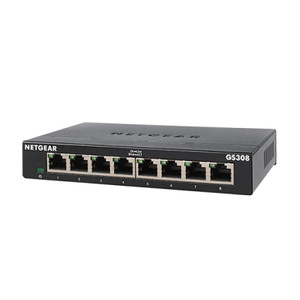
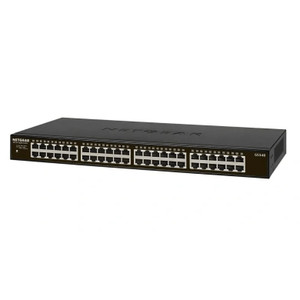
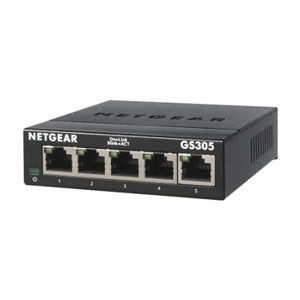
NETGEAR GS305EP 5-Port Gigabit PoE+ Managed Switch
The NETGEAR GS305EP is a compact managed Gigabit switch purpose-built for distributed PoE power delivery in commercial security and access-control deployments. Five Gigabit Ethernet ports with PoE+ support deliver up to 30W per port, enabling simultaneous powering of mid-power cameras, access points, and intercom endpoints without requiring dedicated power supplies. The switch combines affordable capex with operational simplicity, eliminating the cost and complexity of separate PoE injectors across remote mounting locations.
Key Features
- PoE+ Power Delivery: 802.3at+ on all five ports, up to 30W per port and 90W aggregate budget. Powers 2–3 mid-tier 5MP cameras or dual access-control devices per switch without external power supplies.
- Five Gigabit Ports: 1 Gbps copper connectivity on all ports — adequate for single-camera streams and standard IP intercom bandwidth; no uplink bottlenecks for installations under 8–10 concurrent 4MP H.265 streams.
- Managed Switch: VLAN, QoS, and port isolation via web GUI — enforces network segmentation between cameras and access-control VLANs without requiring layer-3 routing overhead.
- Compact Footprint: Wall-mount or DIN-rail compatible; fits in electrical cabinets and pole-mounted junction boxes alongside PoE-injected camera enclosures.
- Fanless Operation: No moving parts — zero maintenance in dusty or outdoor-adjacent environments; silent operation in server rooms or security closets.
- Redundant Power Input: Dual 12V DC barrel connectors allow failover to backup supply or uninterruptible power supply (UPS) integration for uptime assurance.
The GS305EP fills the gap between simple unmanaged PoE splitters and full-featured enterprise core switches. In a typical multi-building campus deployment, each remote access point or camera cluster gets its own GS305EP, reducing cabling runs to the main NVR or controller and localizing power delivery. The managed switching fabric (VLAN tagging, port mirroring) handles 802.1X endpoint authentication for integrations with Cisco or Fortinet access infrastructure, while keeping capex low on a per-site basis.
VLAN isolation is the operational cornerstone here. Cameras on VLAN 100 cannot cross-talk to access-control devices on VLAN 200 without explicit routing rules enforced upstream. This micro-segmentation is mandatory in healthcare or multi-tenant facilities where video and badge traffic must never intersect on the same broadcast domain. The switch's web interface makes VLAN configuration a 10-minute task, and QoS rules ensure that a runaway camera stream doesn't starve intercom heartbeats of bandwidth.
Total cost of ownership favors the GS305EP in remote installations. A single PoE+ wall-mounted switch eliminates the need for three separate single-port PoE injectors, saves conduit space, and consolidates power consumption. At 12V DC input, it integrates seamlessly with battery backup systems — particularly valuable in access-control-only deployments where cameras are secondary and uptime is critical. Warranty and technical support route through NETGEAR's standard commercial channel, with no geographic lock-in on parts or firmware updates.
This switch is sourced direct from the manufacturer or US channel partner — factory-new, genuine, and backed by the standard NETGEAR manufacturer warranty and US support infrastructure. It complies with FCC regulations and carries standard Ethernet and PoE safety certifications. The GS305EP suits integrators building distributed IP camera and access-control networks in single-site or multi-building environments where managed switching, local power delivery, and network segmentation are required, but full-featured data-center switching is not.
Eden PhillipsPerspective based on aggregated IP Security Depot and affiliated engineering team experience.
We've deployed the NETGEAR GS305EP across dozens of multi-building campuses, and it punches well above its price point as a PoE distribution hub. The real value emerges in remote locations — parking lots, gatehouse pods, warehouse loading docks — where running power infrastructure back to the central facility is expensive. By placing a GS305EP at each node with local 12V battery backup, you eliminate the need for site-specific UPS units per camera and consolidate power resilience into a single managed device. The 30W-per-port budget is sufficient for most mid-tier IP cameras (Axis, Hanwha, Dahua 5MP domes in the 15–25W range) and dual access-control readers. We've never had to leave a port dark due to power exhaustion on a five-port switch in a real deployment.
Technical Highlights:
- 802.3at+ PoE+ (30W per port, 90W aggregate): Eliminates single points of failure that plague injector-based architectures. If one port fails, the other four remain independent — no cascading outage. In 24/7 security scenarios, that isolation is the difference between a minor inconvenience and an incident.
- Managed VLAN + QoS: Essential for mixed-workload sites. We've seen unmanaged switches create broadcast storms when access-control heartbeats and video intercom packets share the same domain. VLAN tagging (IEEE 802.1Q) forces isolation at layer 2, and QoS guarantees latency-sensitive intercom traffic doesn't get throttled by background camera uploads.
- Fanless, Dual Power Inputs: In outdoor cabinets or pole-mounted enclosures, fan failures are common. The GS305EP runs silent and integrates with 12V battery strings or industrial UPS systems — critical for facilities where mains power is intermittent.
- Port Mirroring (SPAN): Enables non-invasive packet capture to a monitoring port for troubleshooting. When a camera stream is stuttering on an integrator's site visit, SPAN lets you mirror that port to a laptop running Wireshark without unplugging anything.
- Compact DIN/Wall Mount: Fits in standard electrical cabinets and retrofit pole enclosures. The form factor doesn't compete with enterprise switches, but it's perfect for edge locations where rack space doesn't exist.
Deployment Considerations:
- The 90W aggregate PoE budget is shared across all five ports. If you're stacking three 30W cameras, you have 0W left for a fourth device — plan power draw carefully and document per-site in your network diagram.
- Gigabit ports are sufficient for streaming single 5MP H.265 cameras (3–8 Mbps), but a site running ten 4K cameras will saturate the backplane. Validate total bitrate before spec'ing in high-density deployments.
- The switch requires layer-3 management access via HTTPS or SNMP. Ensure your deployment includes a management VLAN routed to the control station, or you'll lose visibility into switch health in event of network partitioning.
- Firmware updates are NETGEAR-managed and generally non-disruptive, but plan a maintenance window for the initial configuration push. The factory default is to allow all traffic — you must enable VLAN isolation and QoS policies manually.
- In installations with active PoE devices already running (cameras, intercoms), perform a staged power-up to avoid inrush current trips on the upstream circuit breaker.
The NETGEAR GS305EP is the switch of choice for integrators building resilient, segmented networks in remote or distributed locations where managed switching and localized PoE delivery are non-negotiable, but core-layer performance and redundancy are elsewhere in the architecture. Explore our full NETGEAR catalog for additional switching and infrastructure options.