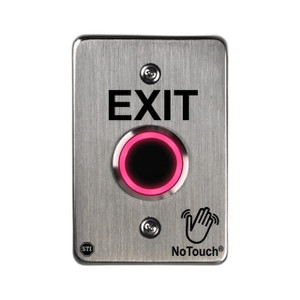
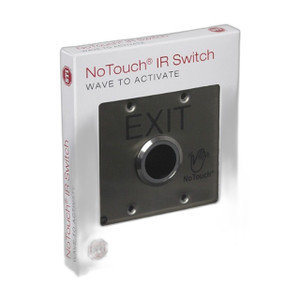
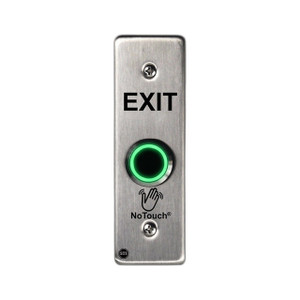
STI NT-SS101-FR Touchless Stainless Steel EXIT Switch
The STI NT-SS101-FR is a single-gang infrared-actuated exit button designed for access control systems where eliminating hand contact is mission-critical. Built from medical-grade 304 stainless steel and rated IP65, it operates at 12VDC–24VDC and delivers a dry-contact relay closure (Form C, 0.5A @ 120VAC / 1A @ 24VDC) sufficient to trigger standard door strikes, magnetic locks, and electronic latches. Deploy this in healthcare facilities, public transit stations, government buildings, and any high-traffic environment where reducing surface transmission risk directly impacts operational continuity and occupant safety.
Key Features
- Contactless IR Motion Sensing: 1.5–6 inch (4–15 cm) detection range eliminates hand contact entirely. Reduces pathogen transmission in hospitals, schools, and public facilities where touchless egress is a hygiene or code requirement.
- IP65 Stainless Steel Enclosure: 304 stainless steel faceplate and housing resist corrosion, moisture, and washdown cleaning. Rated for high-humidity and chlorinated environments (pools, food-service areas, healthcare wash-down zones).
- Dual Voltage Input (12VDC–24VDC): Works with both legacy 12VDC access control systems and modern 24VDC platforms. Single wiring harness adapts to your existing power supply without reconfiguration.
- Dry-Contact Relay Output: Form C relay (0.5A @ 120VAC, 1A @ 24VDC) wires in parallel with or replaces conventional push buttons. Drop-in retrofit into existing exit-control panels with zero rewiring of main system logic.
- Adjustable Relay Latch Time: 0.5–20 second configurable dwell matches your door-release timing and accessibility codes (ADA 5-second minimum). Prevents false re-triggers on slow-moving occupants.
- Extended Sensor Lifespan: IR sensor rated 100,000 operating hours; mechanical relay rated 1 million cycles. No battery replacement or calibration maintenance required.
- Oversized Faceplate: Retrofit-friendly single-gang form factor covers existing mounting marks and obsolete button holes during panel upgrades.
The NT-SS101-FR integrates seamlessly into any 12VDC or 24VDC access control system that accepts a dry-contact output. Magnetic locks, electronic strikes, relay-driven latches, and electromagnetic holders all trigger from the same dry-contact closure — no additional interface cards or signal conditioning required. Operating temperature range spans −10°C to +70°C (14°F to 158°F), covering indoor air-conditioned facilities and unheated building vestibules. Maximum power draw is 45mA at 12VDC, negligible on most control-panel 12VDC buses.
Mount the button at standard exit height (42–48 inches from floor) with clear line of sight to the IR emitter — any obstruction (signage, thermometer housing, conduit) reduces detection reliability. The ±25% range tolerance (typical 4–15 cm with 1.5–6 inch nominal span) accounts for sensor aging and dust accumulation; verify detection during commissioning by slowly approaching the button face. In high-traffic areas, position the detector 6+ inches from the door frame to prevent false activations from passing shadows or reflected IR from adjacent surfaces. IP65 rating permits washdown and splashing but not full submersion; do not install below water level or in uncontrolled flooding zones.
Healthcare, government, and transit integrators standardizing on touchless egress cite three operational wins: (1) reduced surface-contact viral load in critical circulation paths, (2) ADA-compliant 5-second relay dwell without accessible lever modification, and (3) retrofit compatibility that avoids costly control-panel rewiring. IT directors appreciate the zero-battery design — no annual maintenance schedule, no dead batteries during power outages. In kitchens, loading docks, and food-prep areas, the IP65 stainless enclosure eliminates corrosion and frequent button replacement that plagues painted steel alternatives.
Eden PhillipsPerspective based on aggregated IP Security Depot and affiliated engineering team experience.
We've deployed the STI NT-SS101-FR across hospital campuses, transit facilities, and government office buildings where code compliance or operational protocol demands contactless exit buttons. The pairing of IR motion sensing with a dry-contact relay output is deceptively simple — no Wiegand, no serial protocol, no integration headaches. Drop it in parallel with a conventional button, adjust the relay dwell to match your door closer, and it just works. The 12VDC–24VDC dual-voltage input is a real time-saver on mixed-infrastructure sites where legacy 12VDC panels and newer 24VDC systems coexist. The differentiator versus competing push-button alternatives (passive IR motion sensors, capacitive touch pads, or floor mats) is the stainless enclosure and the lack of moving parts — no solenoid hum, no wear-out surfaces, no seasonal calibration drift. Capacitive buttons fail in high-moisture zones; motion mats wear out in three years; this relay-based design runs 10+ years on the same sensor and latch mechanism. Against piezo-electric or electromagnetic-release buttons, the trade-off is that you do need true IR line-of-sight — no obstruction tolerance. A thermometer mounted in front of the detector, or a hand-wash dispenser at waist level, will kill detection reliability. Know your mounting envelope before installation.
Technical Highlights:
- IR Motion Sensing (1.5–6 inches): Passive infrared detector, not active — no LED flicker, no reflective-surface dependency, works reliably in bright sunlight or dim corridors. The ±25% range tolerance accounts for sensor drift over 100,000 hours; plan for 4–12 inch practical detection at installation.
- Form C Dry-Contact Relay (0.5A @ 120VAC, 1A @ 24VDC): Matches standard door-control panel inputs (magnetic lock coils, solenoid strikers, relay banks). No opto-isolation, no signal conversion — wire it directly and you're done. Latch-time adjustment spans 0.5–20 seconds to satisfy both quick-egress security and ADA-compliant dwell requirements.
- IP65 304 Stainless Steel Housing: Survives chlorinated pools, food-service washdown, hospital disinfectant spray, and salt-fog coastal environments. Oversized retrofit faceplate covers old button holes and mounting damage during panel upgrades.
- Zero Active Power Drain: 45mA at 12VDC is negligible on any control-panel power supply. No battery backup required; sensor and relay operate passively once powered. No field calibration, no annual maintenance cycle.
- Mechanical Relay (1 Million Cycle Rating): Conservative estimate; real-world hospital traffic (20–40 egress events per day on a single exit) puts expected lifespan at 50–100+ years before relay contact wear requires replacement. IR sensor rated 100,000 operating hours (11+ years 24/7).
Deployment Considerations:
- Verify line-of-sight during site survey — any obstruction (signage, thermometer, hand-sanitizer dispenser, fire extinguisher bracket) within the 1.5–6 inch detection cone will block activation. Mount at 42–48 inches height, 6+ inches from door frame to avoid shadow-induced false triggers.
- Dual-voltage input (12VDC–24VDC) accepts either supply without jumper change, but confirm your panel supplies stable 12V or 24V within ±10% — brown-outs or surges will degrade IR sensor sensitivity over time.
- Relay dwell adjustment is field-configurable (0.5–20 seconds) but requires panel access. Test door closure speed during commissioning and lock in the minimum safe dwell (ADA minimum 5 seconds for accessible routes, 3 seconds for emergency egress if local code permits).
- In high-traffic zones (hospital corridors, transit platforms), IR sensor dust accumulation occurs within 6–12 months. Include lens-cleaning in your preventive-maintenance schedule (isopropyl wipe, quarterly in food-service areas).
- IP65 rating protects against splash and spray but not submersion; do not install in outdoor exposed locations, uncontrolled freeze-thaw cycles, or below water level. For coastal salt-fog or chemical-exposure environments, specify the 304 stainless enclosure explicitly — some integrators default to painted aluminum on budget bids.
The NT-SS101-FR is the right choice for healthcare, transit, government, and food-service operators who need touchless egress compliance without touching the underlying access-control system architecture. It's also the pragmatic retrofit option when a conventionally-mounted push button is failing or when ADA accessibility retrofits demand a button that works for users with limited hand strength or mobility. Pair it with a magnetic lock or electronic strike on a standard 12VDC or 24VDC panel, and you've eliminated surface-contact risk in minutes. For more touchless and access-control solutions, visit the STI catalog.