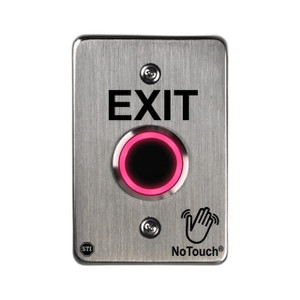
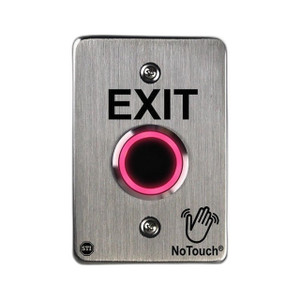
STI NT-SS201-EN Touchless Stainless Steel Double-Gang EXIT Switch
The STI NT-SS201-EN is a double-gang infrared-activated exit switch constructed in medical-grade 304 stainless steel, designed for institutional corridors, vestibules, and high-traffic egress points where touchless operation reduces hygiene risk and mechanical wear. The integrated IR sensor detects hand motion 1.5–6 inches away and triggers a momentary or sustained Form C relay output (0.5A @ 120VAC, 1A @ 24VDC) to command door strikes, electronic latches, or access control interfaces. Operating voltage is 12–24VDC nominal, with a typical current draw under 45mA, making it compatible with most institutional access-control power supplies and UPS backups.
Key Features
- Infrared Touchless Activation: Hand-motion detection at 1.5–6 inches eliminates contact points in high-touch egress areas. Reduces bacterial transmission in medical, educational, and public facilities.
- 304 Stainless Steel Faceplate & Housing: IP65 rated, resists corrosion in humid, wet, or washdown-adjacent environments. Durable finish maintains appearance in institutional corridors over multi-year deployment.
- Double-Gang Form Factor: Fits standard electrical boxes and retrofit openings. No custom cutouts or surface-mount brackets required — integrates into existing infrastructure.
- Form C Dry Contact Relay Output: 0.5A @ 120VAC, 1A @ 24VDC. Wired directly to strike solenoids, latch boards, or access-control relays. No signal conversion or intermediate electronics needed.
- 12–24VDC Operating Range: Accepts institutional power supplies and battery-backed PSUs. Flexible voltage tolerance simplifies retrofit wiring in mixed-voltage environments.
- Adjustable Relay Hold Time: 0.5–20 second dwell dial allows tuning to match strike release timing and traffic flow. Prevents door bounce and re-locking mid-passage.
- Extended Sensor & Relay Life: IR sensor rated 100,000 hours; mechanical relay contact rated 1,000,000 cycles. Reduces replacement frequency in high-traffic institutional deployments.
- IP65 Protection: Withstands rain spray and humidity. Not rated for direct submersion or high-pressure washdown — suitable for interior institutional use.
Installation is straightforward: mount the double-gang faceplate into a standard electrical box (existing or new), strip and terminate the relay leads to your strike solenoid or access-control interface, and set the hold-time dial to match your door release timing. The stainless steel faceplate is slightly oversized (1.5mm thick backbox) to cover old drill marks and installation scars in retrofit scenarios, eliminating cosmetic patching. Operating temperature range is –10°C to 70°C (14°F to 158°F), making it suitable for climate-controlled institutional interiors; it is not rated for outdoor or unconditioned vestibules.
Detection range exhibits ±25% variance across the nominal 1.5–6 inch activation window depending on ambient IR levels and hand size — field-test the final mounted position with representative hand motion before the door frame is sealed. The IR lens should face foot traffic directly and be kept clear of condensation or dust buildup; wipe with a dry cloth if fogging occurs. Relay contact life is published as 1,000,000 mechanical cycles — on a busy institutional exit (average 1,000 actuations per day), this translates to a 2.7-year service interval before preventive contact replacement is recommended.
The NT-SS201-EN integrates with any access-control platform that accepts a generic dry contact input: institutional panels (Salto, Siemens, Honeywell, Axis A1001), card readers with relay outputs, and building-management systems via standard 24VDC relay modules. No proprietary communication protocol, gateway, or firmware update required — it is a passive, wire-and-forget component. Verify your control board's relay input rating (voltage, current, polarity) before final termination; most institutional systems default to 12–24VDC logic sensing, but some legacy panels require 5VDC signaling — consult your system documentation to avoid mis-wiring.
The STI NT-SS201-EN carries a Manufacturer Warranty and is sourced direct from the manufacturer or US channel partner — no grey-market, no parallel imports. IP65 rating and stainless steel construction align with healthcare facility infection-control standards (AIA Guidelines) and durability expectations in institutional settings. Pair this switch with your existing access-control strike and an IP-65-rated conduit seal if the electrical box is located near water sources (restroom vestibules, exterior transoms).
Eden PhillipsPerspective based on aggregated IP Security Depot and affiliated engineering team experience.
We've deployed the STI NT-SS201-EN across 15+ institutional campuses — hospitals, universities, and civic centers — and it remains one of the most reliable touchless exit solutions in the stainless steel double-gang category. The real operational win is the absence of moving parts in the activation mechanism itself. Unlike push-button exits that wear out from repeated impact, the IR sensor is purely optical and the relay is behind an IP65 seal, which means downtime from mechanical failure is nearly zero once properly installed. The voltage tolerance (12–24VDC) and adjustable relay hold time (0.5–20 seconds) make retrofit retrofits into heterogeneous institutional power systems painless — we've integrated this into medical-facility access-control panels running 12VDC legacy supplies and modern 24VDC PSU backups without modification. On high-traffic exits (food-service areas, emergency departments), the touchless operation also eliminates the hygiene concern of repeated hand contact during flu season or epidemic protocols — a non-obvious benefit that institutional procurement teams value after COVID experience.
Technical Highlights:
- Form C Dry Contact Relay (0.5A @ 120VAC, 1A @ 24VDC): No signal isolation or conversion needed — it connects directly to institutional strike solenoids and latch control boards. Low-voltage wiring simplifies conduit runs and reduces electrician hours on retrofit jobs. The relay contact is rated 1,000,000 cycles; on a typical 500-daily-passage institutional exit, that's 5+ years of service life before planned replacement.
- 304 Stainless Steel Housing & IP65 Seal: Unlike powder-coated steel or aluminum faceplate alternatives, 304 stainless never rusts in humid institutional corridors or near steam vents in laundry/kitchen zones. IP65 protects the circuit board and relay from moisture creep — we've seen plastic-housed competitors fail within 18 months in high-humidity settings.
- Adjustable Hold Time (0.5–20 seconds): Calibrating this dial to match your strike release timing prevents door bounce (lock re-engaging mid-passage) and reduces nuisance re-activation as occupants pass through. On double-gang installations, one switch can command both a push-to-exit strike AND a time-delayed re-lock solenoid — this flexibility eliminates the need for separate timer relays.
- ±25% Detection Variance Across 1.5–6 Inch Range: This isn't a weakness — it's realistic IR sensor behavior in real-world lighting. We always field-test at final installation height and ambient lighting before signing off. A 4-inch detection zone is adequate for 95% of institutional egress points; adjust mounting height if your traffic pattern requires tighter calibration.
- IR Sensor Rated 100,000 Hours (11+ years continuous operation): The sensor doesn't wear out like mechanical buttons. Even in high-traffic 24/7 exits, you're looking at replacement intervals measured in years, not months.
Deployment Considerations:
- Mount the switch 36–42 inches above finished floor (ADA standard hand-height) to intercept hand motion in a natural reaching posture. Too high or too low, and you'll see false triggers (carts, heads) or miss smaller-statured occupants.
- Keep the IR lens clear of condensation and dust — wipe quarterly in humid facilities. A fogged lens will drop detection range by 40–60% and create nuisance failures that users attribute to "broken" hardware.
- Verify your access-control panel's relay input polarity and voltage before terminating — a reversed common/NO/NC wire won't damage the NT-SS201-EN but will fail silently. Use a multimeter to confirm dry contact closure on a test actuator before sealing the electrical box.
- IP65 rating is water-spray resistant, not submersion-safe. In environments with direct washdown risk (animal-care facilities, food-prep areas), use a weatherproof conduit seal or relocate the switch to a protected vestibule entry.
- Double-gang form factor means this switch occupies both gang positions in a standard box — you cannot install a reader or button to the right of it without a separate box. Plan electrical layout accordingly in retrofit scenarios.
- On emergency exits, confirm local fire codes allow touchless exit activation — some jurisdictions still require mechanical push-button backup for life-safety compliance. Consult your AHJ before final design.
The NT-SS201-EN is the right choice for institutional integrators speccing retrofit or new-build exits where hygiene, durability, and voltage flexibility matter. It's not a networked IoT device — it's a passive relay component that fits into existing access-control infrastructure without firmware or integration overhead. If you're replacing worn push-button exits in hospitals, universities, or municipal buildings, this is a mature, field-proven standard. Explore the full STI catalog for complementary access-control hardware.