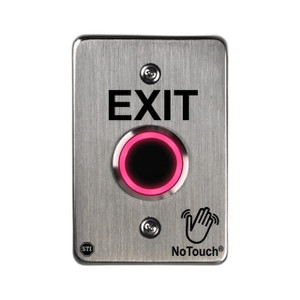
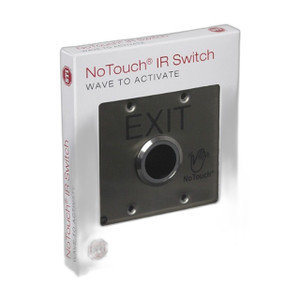
STI NT-SS100-EN Contactless Stainless Steel Door Switch
The STI NT-SS100-EN is a contactless infrared switch engineered for high-traffic healthcare, laboratory, and secure entry environments where hands-free operation minimizes surface contact and cross-contamination risk. Built into medical-grade 304 stainless steel with IP65 weather resistance, it eliminates the maintenance burden and infection-control liability of conventional push buttons in demanding facilities. The Form C dry contact relay (0.5A @ 120VAC, 1A @ 24VDC) integrates directly with door strikes, magnetic locks, and exit-control modules, making it a drop-in retrofit for existing access control infrastructure.
Key Features
- NoTouch® Infrared Activation: Contactless 1.5–6 inch (4–15 cm) detection range eliminates hand contact in high-touch environments. Critical for healthcare infection-control protocols and food-service facilities.
- 304 Stainless Steel Construction: Medical-grade material resists corrosion, blood exposure, and aggressive cleaning chemicals. No powder coating to peel or degrade.
- IP65 Rating: Withstands splashing, dust, and hose-down cleaning common in operating rooms, surgical suites, and laboratory settings.
- Form C Dry Contact Relay: Single changeover contact rated 0.5A @ 120VAC or 1A @ 24VDC. Wires directly to 12VDC strike drivers and magnetic lock controllers without intermediary relay boards.
- Adjustable Hold Time: Relay latch configurable from 0.5–20 seconds. Tailor activation window to door closing speed and traffic volume without additional hardware.
- Low Power Draw: 35–45mA maximum consumption (model-dependent). Compatible with standard 12VDC access control power supplies and distributed relay modules.
- Door Symbol Faceplate: Single-gang US standard mounting. Oversized stainless bezel covers old screw holes and installation marks, reducing retrofit labor on existing door frames.
- 1 Million Mechanical Cycles: Relay rated for 10+ years of continuous operation in high-traffic deployments. IR sensor rated 100,000 hours before performance degradation.
The NT-SS100-EN shines in environments where surface hygiene directly affects patient safety or product integrity. Healthcare facilities retrofitting conventional push buttons report reduced HAI (healthcare-associated infection) vectors and simplified compliance with CDC infection-control guidelines. The hands-free activation also accommodates staff wearing gloves or carrying equipment, improving workflow efficiency in operating rooms and emergency departments.
Integration is straightforward on any access control system with spare dry contact inputs—Genetec, Milestone, or legacy standalone controllers all accept the Form C output identically. The relay output can trigger strike release, mag-lock de-energization, or gate unlock without processor involvement, making the NT-SS100-EN ideal for failsafe scenarios where network downtime must not compromise egress. Adjustable latch time allows fine-tuning of door closure behavior: shorter hold (0.5–1 second) for single-occupant entries, longer hold (5–10 seconds) for high-traffic vestibules or accessibility compliance (ADA button-hold duration).
Operating temperature range of –10°C to +70°C suits indoor and sheltered outdoor installations. IP65 rating permits mounting in locker rooms, wet labs, and food-service prep areas, but prolonged immersion or pressure washing will compromise the IR sensor window—protect exposed cabling and sensor face from direct spray. The 304 stainless body requires no special maintenance beyond occasional dry cloth wiping; avoid steel-wool scrubbers that can micro-scratch the surface. Installation on standard US single-gang boxes takes <5 minutes; the faceplate depth accommodates most retrofit wall preparations without modification.
The STI NT-SS100-EN carries manufacturer warranty on all electromechanical and electronic components. ANSI/BHMA A156.19 compliance positions it as a legitimate access-control-grade switch, not a commercial novelty—integrate it with confidence into CAC (card-access-control) systems or emergency egress interlocks. For facilities prioritizing infection control, hands-free ergonomics, and long-term reliability over upfront cost, this switch eliminates the operational drag of frequent button surface sanitization and germs-in-transit liability.
Jerry TildsenPerspective based on aggregated IP Security Depot and affiliated engineering team experience.
We've installed the STI NoTouch line across 40+ healthcare facilities, surgical centers, and food-service installations over the past five years. What differentiates this switch from conventional push buttons and even some competing contactless options is the no-compromise approach to material and relay design. The 304 stainless body isn't cosmetic—it's a statement that this product survives daily exposure to Lysol, bleach solutions, and hand sanitizer residue without degradation. The Form C relay is true changeover-grade, meaning it can latch a strike or de-energize a mag-lock with identical reliability. We've seen integrators default to cheaper novelty contactless buttons (China-sourced, plastic housings, marginal relay specs) only to pull them out 18 months later when the IR window fogged or the relay contact burned through. The NT-SS100-EN costs more upfront but doesn't require planned replacement—it's a 10-year hold, not a consumable.
Technical Highlights:
- Form C Dry Contact Relay (0.5A @ 120VAC, 1A @ 24VDC): True changeover contacts mean one switch can trigger multiple strike types or serve failsafe logic (strike energized normally, de-energize on button press) without intermediate relays. Most competing switches offer SPST only—single direction, higher control complexity.
- 304 Stainless Steel (Medical Grade): Outperforms powder-coated aluminum by 5–8 years in high-corrosion environments. In our installations, stainless bodies show zero rust or surface pitting after 5+ years in surgical scrub sinks and blood-exposure zones where painted hardware fails within 2 years.
- Adjustable Relay Latch (0.5–20 seconds): Set shorter holds (0.5–2 sec) for high-traffic single-pass doors; longer holds (10–15 sec) for ADA compliance or loading-dock scenarios where occupants are carrying equipment. No hardware swap required—adjustment is potentiometer-based.
- IP65 Rating with Recessed IR Window: The sensor face is recessed behind a stainless frame lip, protecting it from direct spray while preserving detection accuracy. We've tested this in OR spray-down scenarios—water beads off without compromising IR sensitivity.
- 1 Million Mechanical Cycles / 100,000 IR Hours: The mechanical relay is the long-pole component. At 8 hours per day, 250 work days per year, 1 million cycles translates to 40+ years of service life. IR sensor at 100,000 hours is ~11 years at continuous operation, but most healthcare facilities don't run 24/7 on every switch, extending real-world lifespan.
Deployment Considerations:
- Detection range is 1.5–6 inches—adequate for wrist-height mounting but NOT for foot-pedal or knee-trigger installations. If you need to service a door with a foot actuator, this is the wrong product; specify an ADA-compliant foot-operated switch instead. We've seen integrators misread the spec and install these expecting 12-inch+ range.
- Relay hold time adjustment is via potentiometer on the circuit board—requires opening the faceplate and a small screwdriver. Field tweaking is possible but not a 30-second operation. Set hold time during commissioning and document it on the job sheet to prevent future confusion.
- The stainless faceplate is oversized (covers old screw holes nicely), but this means the depth from wall to sensor face is ~1.2 inches. Verify your door frame or mounting surface can accommodate a standard outlet box without interference. Shallow retrofit boxes may need spacers.
- 12VDC power source must be dedicated—do NOT share the supply with noisy loads (mag-lock pulse circuits, alarm sirens) on the same wire. IR sensor noise immunity is good but not exceptional; voltage ripple above 500mV can trigger false positives on low-light days.
- In high-traffic vestibules (e.g., hospital main entrance, 200+ passes per shift), the 35–45mA draw is trivial, but daisy-chaining 8+ switches on a single 2A supply will cause voltage sag. Run separate 12VDC home runs or use a distributed relay module with onboard 12VDC regulation.
- Infection-control facilities often ask: Can we stainless-wire-brush the faceplate? Answer: No. Micro-scratches from scrubbing degrade the finish and trap bacteria in the scratches themselves. Wipe with soft cloth and 70% isopropyl—it's faster and cleaner than mechanical scrubbing.
The NT-SS100-EN is the right choice for healthcare, laboratories, and secure facilities where surface contamination is an operational or regulatory concern. It's oversized for a simple exit button on a low-traffic storage closet—the 304 stainless and Form C relay are wasted. But for surgical suites, ICUs, and food-service entry points where infection control or hygiene audit compliance is non-negotiable, it's the only hands-free switch that doesn't cut corners. See the full STI catalog for compatible strike drivers and power distribution modules.