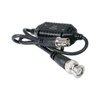
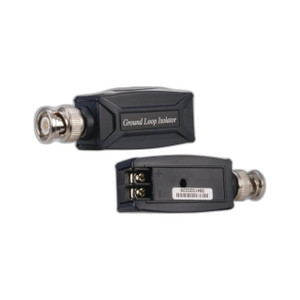
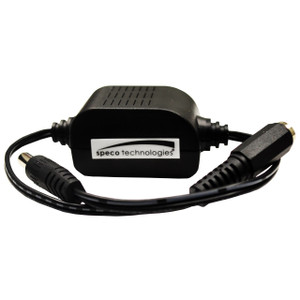
Speco Technologies VIDGL Video Ground Loop Isolator
The Speco VIDGL is an inline video ground loop isolator engineered to eliminate 60 Hz (or 50 Hz internationally) hum and signal degradation on coaxial cable installations common in analog CCTV systems. Ground loop interference manifests as horizontal hum bars or visible noise across video feeds when cameras, DVRs, monitors, and associated equipment connect to multiple AC power sources or ground paths. The VIDGL addresses this problem at the connection point by breaking the ground loop through galvanic isolation, delivering clean video signal without system redesign, cable replacement, or integrator callbacks.
Overview
Ground loop issues arise in security deployments where parallel return paths develop between camera power supplies and monitoring equipment grounds. This creates an unintended antenna that couples 60 Hz mains noise into the video signal path. Industrial facilities, parking structures, and buildings with extensive electrical infrastructure are particularly prone to this interference. The VIDGL solves the problem by inserting galvanic isolation between input and output, maintaining full video signal bandwidth while blocking the DC and low-frequency ground paths that carry the hum. This passive approach means zero power consumption, no configuration overhead, and immediate deployment without firmware updates or reconfiguration of the larger system.
Key Features
- Galvanic isolation on coaxial video: Breaks ground loop paths that induce 60 Hz hum, eliminating the characteristic horizontal banding visible on monitor displays without altering video signal bandwidth or quality.
- Passive design requiring no external power: Operates entirely without a power supply or batteries, eliminating one more power consumption point and simplifying field deployment — install and it works immediately.
- Compatible with standard analog video formats: Maintains full signal integrity for standard-definition and high-definition analog video (including HD-TVI, HD-CVI, and AHD), meaning you can retrofit existing systems without format conversion.
- Compact inline form factor: Small enough to mount directly at the camera connector, DVR input, or intermediate junction points in extended cable runs, keeping the isolation point close to the noise source for maximum effectiveness.
- Supports RG-59, RG-6, and equivalent coaxial cable: Works with the coaxial infrastructure already in place on legacy and modern analog systems, avoiding the need to recertify cabling or run new lines.
- No signal loss or processing delay: Passive isolation preserves video quality without introducing latency, compression, or frame dropping that would affect live monitoring or forensic review.
Integration and Deployment
The VIDGL connects between any coaxial analog video source (camera, distribution amplifier, or secondary DVR output) and its receiving equipment (DVR input, monitor input, or matrix switcher). Installation requires no configuration—connect input to the noise-affected feed and output to the receiving device. In multi-camera systems with localized hum on specific channels, isolate only those affected feeds rather than treating the entire backbone. Position the isolator as close as possible to the noise source or grounding point where the ground loop is shortest. The passive design ensures immediate improvement; if hum persists after installation, verify grounding configuration at the AC distribution panel and inspect cable connectors for corrosion or damage, which can produce similar symptoms.
The VIDGL represents a proven field solution for analog video ground loop problems, allowing integrators to restore video quality and reduce callback rates without extensive system redesign or customer downtime.
Frequently Asked Questions
Q: Will the VIDGL work on all analog video formats?
A: Yes. The VIDGL maintains full bandwidth for standard composite video, HD-TVI, HD-CVI, AHD, and other analog video formats. It does not work on digital formats like IP cameras or SDI.
Q: Does the VIDGL require power or batteries?
A: No. The VIDGL is entirely passive and draws no power. It operates immediately upon connection without configuration or external power sources.
Q: Can I install the VIDGL anywhere in the video run, or does location matter?
A: Location matters. The VIDGL is most effective installed close to the noise source or at the shortest ground loop path—typically at the camera or DVR input. Isolating only the affected feeds (rather than the entire system) also improves results.
Q: Does the VIDGL introduce any latency or signal delay?
A: No. The passive isolation design introduces zero processing delay or latency. Video quality is preserved without compression or frame loss.
Q: What should I do if hum persists after installing the VIDGL?
A: Verify grounding configuration at the AC power distribution panel and inspect coaxial connectors and cable integrity. Poor connectors, damaged coax, or multiple uncontrolled ground paths at the equipment rack can produce similar symptoms to ground loop hum.
Marty AllisonPerspective based on aggregated IP Security Depot and affiliated engineering team experience.
I've deployed the Speco VIDGL on dozens of analog security systems over the past several years, and it remains one of the most reliable ground loop fixes available. When clients report hum bars or visible noise on their video feeds, the VIDGL resolves the issue in the majority of cases without requiring camera relocation, cable replacement, or extensive troubleshooting—and without consuming power from your UPS or DVR power budget.
Technical Highlights:
- Passive galvanic isolation: Breaks ground loops without active circuitry or power draw. This means zero latency, zero configuration overhead, and zero risk of the isolator failing and taking the video feed down.
- Full bandwidth preservation: The VIDGL maintains signal integrity for both standard and HD analog formats, meaning you won't lose resolution or visual detail on feeds that are already compressed by the DVR.
- Installation proximity matters: Position the isolator close to the noise source (typically at the camera or DVR input) rather than in the middle of a long cable run. This dramatically improves effectiveness because you're breaking the ground loop at its shortest path.
Deployment Considerations:
- The VIDGL is a symptom fix, not a root cause fix. If hum persists after installation, the problem likely originates in your AC grounding configuration or equipment bonding, not in the video cable itself.
- On multi-camera systems, don't assume you need to isolate every feed. Isolate only those feeds exhibiting hum, then monitor the others. Unnecessary isolation adds connection points and potential failure modes.
- Verify coaxial connectors and cable condition before assuming ground loop issues. Corroded BNC connectors, kinked or damaged coax, and poor terminations produce visual artifacts similar to hum.
The VIDGL is purpose-built for analog CCTV systems in electrically noisy environments—parking structures, industrial facilities, and older buildings with mixed electrical infrastructure. Deploy it as your first troubleshooting step on hum-affected feeds, and you'll avoid callbacks and customer frustration.