
StarTech Share AND Switch Four Distinct HDMI - VS424HDPIP
In stock · Ships same business day
Free shipping over $499
$761.99


Manufacturer-verified compatible cameras, recorders, mounts, accessories, and licenses for this product. Adjust quantities and add the entire bundle to your cart in one click.
Questions about this product? Free pre-sales support from a senior specialist — product questions, compatibility checks, BOM quotes, price confirmation — typically answered within one business day. Need camera placement or system design work? Engineering time is $175 per hour (qty 1 = 1 hour). Hardware buyers get up to one hour ($175) credited back on their order.
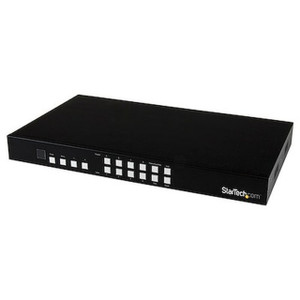
The StarTech VS424HD4K60 is a 4-input, 4-output HDMI matrix switch designed for commercial AV environments where multiple sources need to be routed independently to multiple displays — simultaneously and without compromise on signal quality. At 18Gbps bandwidth with support for resolutions up to 3840x2160 @ 60Hz (and 4096x2160 @ 24Hz for cinema-grade content), this unit handles modern 4K sources without the resolution throttling or dropped frames that plague lower-bandwidth matrix switches. If you're running a command center, digital signage array, boardroom, or multi-display control room, this is the routing layer that keeps every screen fed with the right source at full fidelity.
Measuring 17.2 x 6.3 x 1.7 inches and weighing 4.5 lb, the VS424HD4K60 sits in a 1U rack-friendly form factor that integrates cleanly into AV racks or credenzas without consuming excess vertical space. Power input is universal 100–240V AC, converting to 24V DC at 2.7A — so it will run on any standard circuit globally, a practical advantage in multi-site enterprise deployments.
The four control interfaces make the VS424HD4K60 a practical fit for most commercial control system ecosystems. RS232 is the native language of Crestron, AMX, Extron, and Q-SYS control processors — integrators can write simple ASCII command strings to switch routes programmatically, trigger presets on room booking events, or tie routing to occupancy sensors. The WebGUI path is useful for IT-managed deployments where a dedicated control processor isn't in the budget; browser-based routing control means any authorized network user can manage the matrix without installing client software.
IR control enables user-facing remotes for environments like conference rooms or digital signage applications where end users need switching ability without exposing them to a full control interface. Front-panel push-buttons serve as a local fallback — critical when a control system goes offline and you need manual override without laptop access.
For HDMI signal distribution planning, verify that your cable runs are rated for 18Gbps at the intended distances — standard HDMI cables degrade signal at 4K@60Hz beyond approximately 3–5 meters. Consider active HDMI cables or fiber extenders for longer runs. Pair this matrix with a compatible 4K display array to take full advantage of the resolution headroom. For larger AV systems, review your AV distribution infrastructure to ensure end-to-end 18Gbps signal integrity.
Q: Does the VS424HD4K60 support 4K at 60Hz on all four outputs simultaneously?
A: Yes. The 18Gbps bandwidth applies per output path — all four outputs can carry 4K @ 60Hz simultaneously without shared-bus degradation, provided your source and display equipment support that resolution.
Q: What control systems are compatible with the VS424HD4K60?
A: The RS232 serial interface is compatible with most commercial control processors including Crestron, AMX, Extron, and similar platforms that accept ASCII command strings. WebGUI control works from any networked browser. IR and push-button control are also available as alternatives.
Q: Can the VS424HD4K60 pass HDR content?
A: The 18Gbps HDMI 2.0 bandwidth is sufficient to carry HDR-flagged signals at 4K@60Hz. StarTech's published specs do not explicitly call out specific HDR formats (HDR10, Dolby Vision) — verify with your source and display equipment for end-to-end HDR compatibility.
Q: What is the warranty on the VS424HD4K60?
A: StarTech provides a 2-year manufacturer warranty on the VS424HD4K60.
Q: Is the VS424HD4K60 rack-mountable?
A: At 17.2 x 6.3 x 1.7 inches (approximately 1U height), the unit fits in a standard 19-inch rack. Confirm that rack ears or a rack-mount kit are included or available, as mounting hardware specifics are not detailed in available documentation.
Q: Does the VS424HD4K60 support 4096x2160 (DCI 4K) resolution?
A: Yes, at up to 24Hz. This is the DCI cinema 4K format used in post-production preview and digital cinema playback — supported at 24Hz, not 60Hz, which is standard for that content type.

The spec that stands out to me on the VS424HD4K60 is the 18Gbps per-port bandwidth — it's not a shared pool across the matrix. That distinction matters in real deployments: you're not gambling on whether two simultaneous 4K@60Hz outputs will compete for headroom. All four outputs run full bandwidth independently, which is what you need when you're routing a live camera feed to one display, a playback server to a second, and a PC desktop to a third — all at the same time, all at 4K.
Technical Highlights:
Deployment Considerations:
The VS424HD4K60 is well-suited for corporate command centers and multi-display briefing rooms where you need simultaneous independent routing to four screens, RS232 integration with an existing control system, and a matrix that won't throttle resolution on any output. It's a direct fit for that specific use case — not overkill, not undersized.

Manufacturer-verified compatible cameras, recorders, mounts, accessories, and licenses for this product. Adjust quantities and add the entire bundle to your cart in one click.


Looking for more StarTech products? Shop the full StarTech catalog →
Support services and planning resources for commercial surveillance, access control, and infrastructure deployments.
Fixed scope • Fixed price