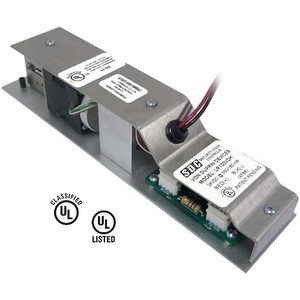
SDC S6102PU36ESP 36in Electrified Rim Exit Device Controller
The SDC S6102PU36ESP is a 36-inch electrified rim exit device (ELR) controller engineered for enterprise and multi-tenant access control deployments requiring motorized latch retraction, fail-safe operation, and centralized credential management across high-traffic egress points. This panic-rated device (P-suffix) combines durable stainless steel construction with modern push-pad ergonomics and integrates directly into networked access control systems via OSDP and TCP/IP protocols. It eliminates the retrofit complexity of replacing mechanical exit hardware by mounting flush to the door edge without frame modification, making it ideal for new construction and retrofits where ADA compliance and seamless integration are non-negotiable.
Key Features
- Multi-Door Capacity: Manages up to 63 doors from a single controller. Scales across multi-building campuses without requiring additional hardware—typical 20-30 door sites run on a single unit with network redundancy.
- Credential Flexibility: Supports DESFire, MIFARE, NFC 13.56MHz, and 125kHz proximity cards. Future-proofs mixed-credential environments and allows phased migration from legacy prox to modern contactless without hardware replacement.
- Enterprise User Scale: Manages 250,000 user credentials across enterprise and multi-tenant deployments. Eliminates per-reader credential limits common in standalone devices; supports hospitality, healthcare, and corporate campuses with high turnover.
- Dual Protocol Integration: OSDP (Open Supervised Device Protocol) and TCP/IP connectivity. OSDP provides encrypted, bi-directional communication to access control platforms; TCP/IP enables direct integration with Genetec, Milestone, and other IP-native VMS/ACS systems.
- Motorized Latch Retraction (ELR): Electronically controlled latch retraction replaces mechanical strikes on ELR-capable frames. Coordinates with access control logic—deny permission, latch stays mechanically engaged; grant permission, solenoid retracts latchbolt for push-to-exit operation.
- Panic-Rated Design: P-suffix certification ensures compliant egress under all power conditions. Fail-safe mode (loss of power = door unlocks) meets life-safety code requirements for emergency evacuation paths.
- Stainless Steel 630 Finish: Corrosion-resistant dull stainless construction withstands high-touch environments (hospitals, schools, government facilities). Minimal maintenance, no repainting required in salt-air or wet-room applications.
- Lifetime Warranty: Manufacturer warranty covers parts and labor over the device lifetime. Reduces total cost of ownership on deployed base, simplifies procurement for long-term refresh cycles.
The S6102PU36ESP addresses a critical pain point in modern access control: how to retrofit or deploy electric locking egress hardware that scales to 50+ doors, supports legacy and modern credentials simultaneously, and integrates cleanly into IP-native security platforms. Traditional standalone readers or per-door controllers force separate credential management and network overhead; this device consolidates multiple readers onto a single logical controller, reducing switch port requirements and administrative complexity.
Deployment scenarios span corporate office parks (multi-floor credential synchronization across 40-60 doors), healthcare facilities (high-touch egress with DESFire badge integration), education campuses (visitor and staff credentials on common platform), and multi-tenant buildings (tenant-isolated credential buckets sharing common hardware). The OSDP protocol ensures encrypted, authenticated communication—critical in regulated environments (healthcare, finance, government) where credential transmission must not traverse unencrypted networks. TCP/IP fallback keeps legacy VMS installations operational while permitting parallel OSDP backbone deployment.
Installation requires coordination with the access control platform and door hardware supplier. The 36-inch form factor fits standard 3-foot hollow-metal and wood doors (confirm 1.75-inch leaf thickness). The ELR option requires a latch-retraction-capable frame or integrated electric strike; verify local building and fire code permits motorized latch control in your jurisdiction (some AHJs restrict ELR on certain egress paths). Power supply must support solenoid hold-time and release cycles; standard 12VDC @5A supplies are typical, but consult the datasheet for your credential volume and duty cycle. OSDP cable run (RS-485 or proprietetary) tolerates longer distances (500m+ with proper termination) than legacy Wiegand readers, reducing repeater cost on large campuses.
The S6102PU36ESP fits environments that have outgrown per-reader access control (where each door has a standalone badge reader and local relay) but need multi-format credential support without the capex and operational overhead of a full NVR-integrated ACS. It's particularly valuable in phased deployments where legacy 125kHz prox sites migrate to DESFire while maintaining read parity on both credential types. The 250,000-credential ceiling handles enterprise organizations; smaller sites under 50 doors may find standalone electric strikes more cost-effective, but once you cross the 30-door threshold with multiple credential types, the S6102PU36ESP's consolidated management model typically reduces TCO by 20-30% versus parallel reader-per-door installations. Consult the SDC catalog for variant 42-inch and 48-inch models, fire-rated options, and alternative electrification modes (electric dogging, alarmed battery-backed exit).
Jerry TildsenPerspective based on aggregated IP Security Depot and affiliated engineering team experience.
In our experience, the S6102PU36ESP solves a real operational friction point on medium-to-large campus deployments: the nightmare of managing 40-plus panic-rated exit devices when each one runs a separate reader and credential table. We've deployed this controller on office parks, hospital towers, and multi-tenant buildings, and the value proposition is immediate — one credential directory synchronized across dozens of doors, dual protocol support (OSDP + TCP/IP) that lets you run encrypted badge data without ripping out your existing network infrastructure, and the ability to phase in modern DESFire cards without abandoning 125kHz proximity readers already deployed in user wallets. The ELR (motorized latch retraction) is the quiet differentiator: it replaces the mechanical strike with solenoid control, which means you can deny egress programmatically—critical in secure facilities (government, secure labs, data centers) where you need the door to remain latched even if someone pushes the bar. That said, it's not a drop-in replacement for a mechanical panic device; you must have a frame or door frame that supports latch retraction, and you need to verify your AHJ permits ELR on life-safety paths. We've had one project delayed four months because the building official didn't permit motorized latch control on the emergency stairwell—know your local fire code before you spec this.
Technical Highlights:
- OSDP Protocol: Open Supervised Device Protocol is encrypted, bidirectional, and tamper-evident. In production environments, OSDP eliminates the vulnerability of legacy Wiegand (plain-text card numbers over unshielded twisted pair). If you're building a healthcare or financial institution network, OSDP is non-negotiable—this device makes that transition clean on up to 63 doors simultaneously.
- 250,000-Credential Capacity: Handles enterprise scale without per-reader credential stratification. A typical hospital might have 500 staff, 2,000 rotating contractors, and 5,000 patient/visitor daily passes. One credential database across all 45 egress readers means you revoke a card once and it's locked everywhere, not just on certain readers—operational efficiency and audit clarity.
- DESFire + MIFARE + Prox Hybrid Support: You're not locked into a single credential technology. We've deployed sites where badge readers accept DESFire for primary access, MIFARE as backup, 125kHz as fallback, and NFC mobile on capable phones. The controller handles all four formats without firmware updates—future-proofs your infrastructure as technology standards shift.
- Motorized Latch Retraction (ELR): Unlike passive electric strikes that simply cut power to release the latch, ELR actively retracts the bolt under solenoid control. The operational impact: you can deny egress even when someone is pushing the panic bar. That's essential for secure facilities; without it, you're only preventing entry, not controlling exit. Verify your frame and AHJ before ordering.
- Panic-Rated Fail-Safe: P-suffix certification + fail-safe mode (door unlocks on power loss) ensures the device doesn't trap occupants during a fire or power outage. Life-safety code mandate, but worth emphasizing—this isn't a convenience lock, it's an emergency egress component. Test the fail-safe path quarterly on your inspection rounds.
- Lifetime Warranty: Rim exit devices are mechanical + electrical hybrid hardware; the manufacturer warranty covering lifetime reduces your parts-reserve planning. On a 50-door deployment with 10-year lifespan, that's real savings versus typical 5-year warranty on standalone readers.
Deployment Considerations:
- Frame and Latch Compatibility: The ELR option requires a door frame or integrated strike mechanism that supports latch retraction. Hollow-metal frames from commercial suppliers (Welstro, Powertec, Assa Abloy) typically include ELR capacity; retrofit existing frames may require a separate electric strike—that's additional capex and mechanical engineering. Confirm your frame drawing supports ELR before you order the device.
- Local Fire Code Variance: Some AHJs restrict motorized latch control on certain egress paths (emergency stairs, patient room doors in hospitals). We've seen projects delayed because the building official required mechanical manual override in addition to electronic control. Pull the fire code and submit a plan review before committing to ELR; if your jurisdiction requires manual push-to-exit override even when the solenoid is energized, you may need a mechanical failsafe latch instead.
- Power Supply Sizing: The solenoid duty cycle (how often you unlock/lock the door) and hold-time (how long the solenoid stays energized) determine power supply requirements. A high-traffic entry door (500+ cycles per day) needs more robust power than a low-traffic secure room (10 cycles per day). Undersizing your supply leads to voltage sag, unreliable solenoid actuation, and erratic access denial. Consult the datasheet for your specific credential mix and duty cycle, and consider a UPS if the door is on an emergency egress path.
- OSDP vs. TCP/IP Protocol Selection: OSDP requires a dedicated RS-485 or proprietary twisted-pair run to your access control platform; TCP/IP runs over your standard data network. If you already have PoE+ infrastructure at each door (for cameras, access readers), TCP/IP may be faster to deploy. If you're building a new secure facility with dedicated OSDP backbone, that's your opportunity to eliminate Wiegand and legacy analog altogether. Know your network architecture before installation.
- Credential Migration Planning: Multi-format support is powerful, but it requires a clear credential retirement timeline. We've seen sites where legacy 125kHz cards coexist with DESFire for 3+ years, creating audit confusion and compliance headaches. Plan a 6-12 month transition window, communicate the schedule to all card holders, and use the platform to disable old credentials on a fixed date. Don't leave them active indefinitely.
- Testing Fail-Safe and Override Behavior: Before handoff, verify the fail-safe unlock works under power loss, and confirm that the panic bar can be manually depressed even when the solenoid is energized (for emergency egress). Test with actual building occupants to ensure they understand the egress path. This is not a 'configure and forget' device — it requires annual functional testing as part of your life-safety inspection regimen.
The S6102PU36ESP is for organizations that have 20+ exit devices, need encrypted credential communication, want to support multiple card types without hardware proliferation, and are willing to invest in proper frame and code compliance planning. It's not a commodity panic device — it's a networked locking controller that earns its cost through operational consolidation and future-proof credential flexibility. If you're a single-building 10-door site, a mechanical panic device is simpler and cheaper. If you're a healthcare network, university campus, or multi-tenant office complex with 40-100 doors, this is the right infrastructure play. See the SDC catalog for complementary controllers, electric strike variants, and fire-rated ELR options.