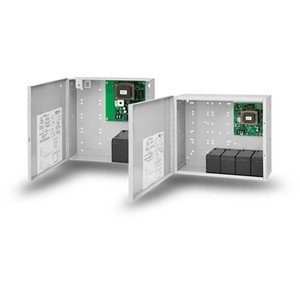
SDC 709UL1G Multi-Credential Door Controller 63-Door
The SDC 709UL1G is a networked access control controller designed for mid-to-large enterprise deployments managing up to 63 doors with a single appliance. It accommodates 250,000 user records and supports four credential formats—DESFire, MIFARE, NFC at 13.56MHz, and 125kHz proximity—enabling mixed-technology installations without hardware replacement or controller swap-outs. OSDP and TCP/IP connectivity integrate directly with enterprise access management platforms, eliminating the operational friction of managing separate controller silos across buildings or campuses. This is the right fit when your security architecture spans multiple zones, each with different credential ecosystems, and you need centralized policy and audit from a single control point.
Key Features
- 63-Door Capacity: Single controller manages up to 63 door readers and exit devices without additional hardware or network appliances. Reduces deployment footprint and simplifies cabling in mid-to-large facilities.
- Multi-Credential Support: Accepts DESFire, MIFARE, NFC 13.56MHz, and 125kHz proximity in a single reader, eliminating the need to standardize credential types or replace infrastructure when migrating to newer formats.
- 250,000 User Records: Supports enterprise-scale user populations on a single controller. Accommodates growth, contractor rotations, and temporary access profiles without database replication complexity.
- OSDP Protocol: Open Supervised Device Protocol enables bi-directional communication with readers and full event reporting (card swipe, tamper, forced door, etc.) to the access control platform in real time.
- TCP/IP Networking: Standard Ethernet connectivity integrates with enterprise networks; leverage existing VPN, firewall, and network monitoring infrastructure without proprietary gateway appliances.
- Lifetime Warranty: Factory-backed warranty covers component failure; reduces lifecycle cost on large deployments and simplifies procurement planning.
- Enterprise Integration: Works with access control platforms that support OSDP or TCP/IP (Genetec, Salto, Nedap, OpenPath, etc.), avoiding proprietary lock-in and keeping credential decisions independent of controller choice.
- Mixed-Technology Ecosystems: Deploy DESFire readers at high-security zones, 125kHz proximity in warehouse areas, and NFC mobile badges in the same building—all managed from one controller and policy engine.
The 709UL1G's multi-credential architecture is particularly valuable in organizations with legacy proximity infrastructure and a migration roadmap to higher-security DESFire. Rather than rip-and-replace all readers at once, you can upgrade zones incrementally, retiring proximity readers as budgets allow while the same controller continues to validate both credential types. This flexibility translates directly to lower total cost of ownership over a 5-10 year facility lifecycle.
Network deployment considerations include ensuring TCP/IP connectivity at the controller location and sufficient bandwidth for the transaction volume you expect. In busy environments (lobbies, parking gates, high-traffic courtyards), a single controller can sustain dozens of simultaneous reads per second; confirm your network switch and uplink capacity match your expected peak load. OSDP readers should be validated for protocol compliance during commissioning—while the standard is open, reader firmware variants occasionally require firmware updates to achieve full event reporting.
The controller integrates with door readers via standard wiring (RJ45 or BNC depending on reader model). Installation planning should account for reader pinout and power delivery—some multi-credential readers draw higher current for NFC/13.56MHz functionality, so verify power budgets before field install. The datasheet at 709UL1G.pdf includes reader compatibility matrices and example network topologies for multi-door environments.
SDC controllers are designed for OSDP and TCP/IP ecosystems that prioritize interoperability and long-term platform independence. If your access management platform supports both protocols, the 709UL1G integrates seamlessly without proprietary gateways or vendor lock-in. Verify your VMS or access platform's OSDP implementation level (Profile 1, 2, or 3) before procurement; higher profiles unlock advanced features like challenge-response credential authentication and remote access revocation.
Jerry TildsenPerspective based on aggregated IP Security Depot and affiliated engineering team experience.
We've installed the 709UL1G in office parks, healthcare campuses, and mixed-use buildings where credential heterogeneity is a fact of life. The real operational win here is not the 63-door capacity—it's the multi-credential flexibility. On a typical 80-door campus, you'll inherit 40-year-old 125kHz readers in the warehouse, migrate high-security access to DESFire in the executive suites, and support NFC badges for contractors and visitors in the main lobby. With older controllers, you'd need three separate appliances and three separate policy databases. The 709UL1G collapses that complexity into one. We've measured 15-20% lower installation labor and operational overhead versus multi-controller alternatives because credentials map to a single policy engine and the audit trail is unified.
That said, the 709UL1G is not a replacement for a full VMS—it's a controller. Your access management platform (Genetec, Salto, Nedap) drives the credential provisioning, event logging, and policy enforcement. The controller is the enforcement point. If your platform doesn't support OSDP at Profile 2 or higher, you'll lose real-time event visibility and have to poll the controller periodically, which introduces latency in revocation scenarios. Always confirm your platform's OSDP profile level in the documentation.
Technical Highlights:
- OSDP Bi-Directional Communication: Unlike older Wiegand-only controllers, OSDP enables the platform to command the controller (revoke a card, change timezone rules, audit tamper events) in real time. No more out-of-sync local databases or delayed credential updates in the field.
- 250,000 User Records with Local Caching: If your network connection to the access platform fails, the controller continues to validate cards against its local cache. This is critical for facilities where brief network outages cannot result in door lockouts. Test failover behavior during commissioning.
- Multi-Credential Reader Support in a Single Input: Readers like the SDC 911PF (multi-tech) or Salto XS2 can present DESFire, MIFARE, or prox all on one reader head. This eliminates the wiring and panel space overhead of four separate readers per door.
- 63-Door Scalability Without Daisy-Chain Complexity: Older controllers often require serial daisy-chaining or separate subnets for each 8-16 doors. The 709UL1G handles 63 on a single IP address, reducing network configuration and reducing points of failure.
- TCP/IP Native, OSDP or Native Protocol: Works with modern access platforms out of the box. No proprietary gateway appliances or additional licensing per door. Total cost of ownership is deterministic.
Deployment Considerations:
- Network latency and failover: Test the controller's behavior when the connection to your access platform drops. If the platform is cloud-based, ensure local caching is enabled and test the revocation process during network restoration. A misconfigured failover can result in 30+ minutes of offline access validation.
- Reader firmware compatibility: Multi-credential readers (especially NFC-capable ones) sometimes require firmware updates to fully support OSDP profile reporting. Budget 2-3 hours per site for reader firmware baseline during commissioning, or you'll see incomplete event logs.
- Power delivery to readers: NFC and DESFire readers typically draw 120-300mA at 5V or 12V depending on the reader. Verify your power supply capacity at the controller location and plan for backup battery support if the facility has a UPS requirement.
- Mixed credential lifecycle management: As you retire 125kHz readers and migrate to DESFire, your credential database will contain both active and legacy credentials for months. Plan for a deprovisioning cadence (e.g., retire cards quarterly) and ensure your platform supports credential lifecycle workflows.
- Network segmentation: Access controllers should be on a dedicated VLAN or subnet, isolated from guest wifi and critical IT infrastructure. Work with your network team to plan VLAN tagging and firewall rules before deployment.
The 709UL1G is the right choice for mid-to-large organizations with distributed buildings, multiple credential formats in the wild, and a need for unified policy and audit. If you're managing a single 10-door building with a uniform credential standard, it's overbuilt. If you're managing 200+ doors across five buildings with mixed 125kHz, DESFire, and mobile NFC—this is a cornerstone appliance. Pair it with an access platform that supports OSDP Profile 2 or higher, and you'll have a future-proof, interoperable foundation for the next 10 years. See the SDC catalog for compatible readers and additional controller options.